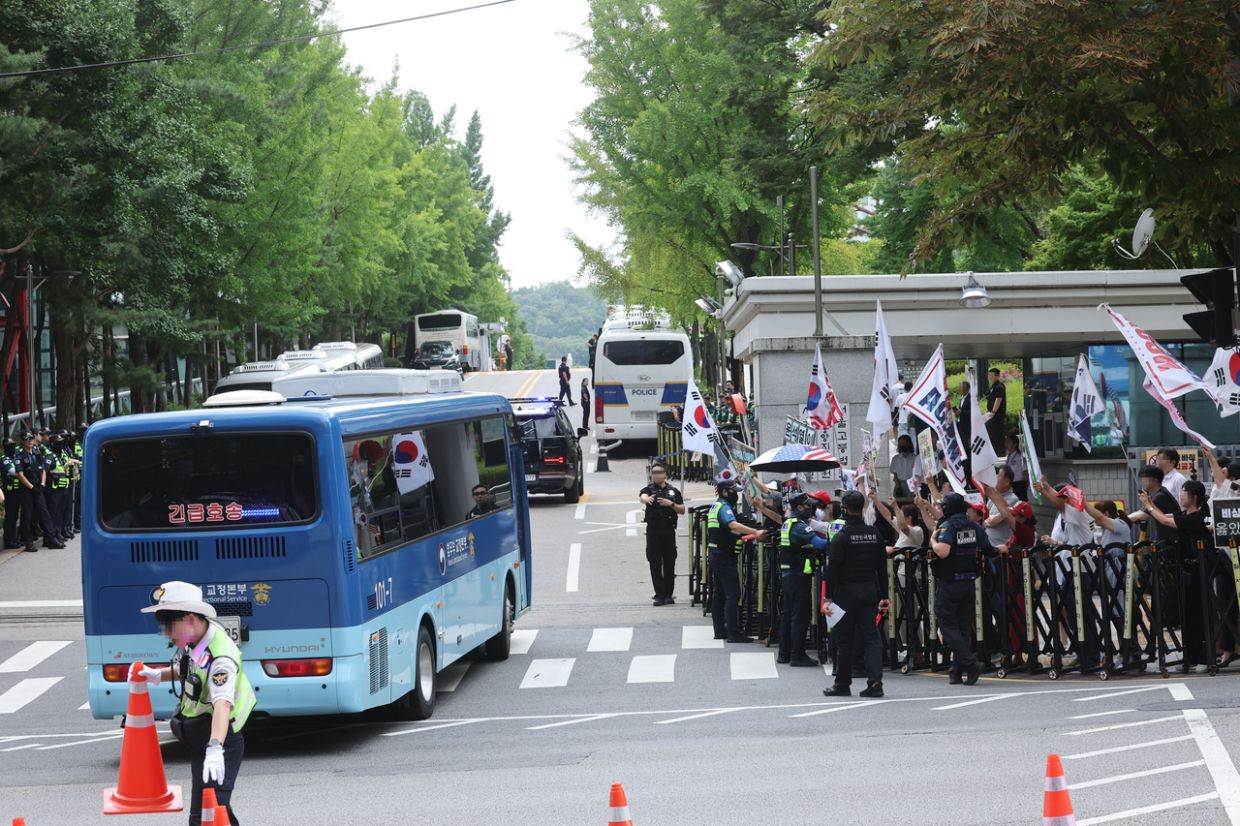
Former South Korean President Yoon Suk Yeol has received a two-year prison sentence after the Seoul Central District Court found him guilty of violating campaign finance laws by accepting complimentary polling services. The conviction marks a significant moment in South Korea's political landscape, where campaign finance regulations have long been scrutinized for their enforcement and application to high-profile figures. Yoon's case underscores the persistent tension between political ambition and legal accountability that has characterized leadership transitions in the country.
The court determined that Yoon had benefited from fourteen opinion surveys provided without payment by political intermediary Myung Tae-kyun, with the services valued at 27.92 million won, equivalent to approximately $18,600. These polls were commissioned during the critical period between June 2021 and March 2022, when Yoon was preparing for and conducting his successful presidential campaign. The provision of these services violated the Political Funds Act, a cornerstone of South Korea's electoral regulatory framework designed to ensure transparency and fair competition among candidates.
Judge Lee Jin-gwan articulated the court's reasoning by emphasizing how opinion surveys function as influential tools within democratic processes. The judge noted that the credibility and distribution of polling data can substantially shape voter behaviour and public perception, making their regulation essential to maintaining electoral fairness. When political actors obtain such services through mechanisms outside those prescribed by law, the judge argued, the result threatens to distort the information environment that voters rely upon when making electoral decisions. This reasoning reflects international concerns about the integrity of opinion polling and its role in shaping democratic outcomes, issues increasingly relevant across Southeast Asia as the region witnesses growing political competition.
Proof of a direct quid pro quo arrangement proved unnecessary for establishing the violation, according to the court's interpretation of the statute. Prosecutors had originally charged Yoon with conspiring alongside his wife, former first lady Kim Keon Hee, to receive fifty-eight unpaid surveys totalling more than 270 million won from Myung. However, the court found sufficient evidence to convict only on fourteen of these surveys. The judges determined that Kim Keon Hee had authorized Myung to control the timing, substance, methodology, and release of the polling results, and that Yoon possessed knowledge of and tacitly approved this arrangement through his silence and continued participation.
The court's analysis identified a pattern of implicit agreement among the three parties that structured the transaction. Rather than requiring explicit written contracts or direct verbal promises, the judges reasoned that Yoon's awareness of his wife's authorization combined with his acceptance of the polling benefits constituted sufficient evidence of knowing participation in the scheme. This approach reflects evolving jurisprudence on campaign finance violations, where courts increasingly examine the totality of circumstances rather than demanding documentary proof of quid pro quo exchanges.
Beyond the polling services themselves, evidence emerged that Yoon had promised Myung that former lawmaker Kim Young-sun would receive the People Power Party's presidential nomination in exchange for the surveys. Yoon subsequently exercised influence over the party's nomination process through Chang Je-won, then chief of staff to the president-elect, to fulfill this alleged commitment. Though the court acknowledged this apparent exchange of favours, the judges emphasized that establishing such a quid pro quo was not legally required to prove a Political Funds Act violation.
Myung Tae-kyun, the political broker who supplied the unpaid surveys, was sentenced to eighteen months imprisonment and immediately taken into custody within the courtroom. His conviction reflects the court's determination that facilitating illegal campaign finance transactions implicates both the recipient and the provider, establishing shared responsibility for circumventing electoral regulations. Myung's shorter sentence relative to Yoon's two-year term suggests the court weighted Yoon's position as a presidential candidate and subsequent president more heavily when assessing culpability and deterrence.
The conviction of Yoon contrasts sharply with the contrasting outcome in the parallel case involving his wife, former first lady Kim Keon Hee. The lower courts acquitted Kim of related Political Funds Act charges stemming from the same polling services, finding that prosecutors had failed to demonstrate that Kim herself received a quantifiable financial benefit from the surveys or that the services were conditional upon political favours. Judge Lee explicitly distinguished between the two cases, noting that the allegations against Kim and Yoon, though arising from identical polling transactions, could not be treated as legally identical given the differing evidence regarding their individual participation and benefit.
Kim Keon Hee's case remains pending before South Korea's Supreme Court, which is scheduled to deliver its final judgment on Thursday. This scheduled ruling adds further complexity to the broader scandal, as the highest court's decision could either affirm the lower courts' acquittals or overturn them, potentially creating precedent regarding spousal liability in campaign finance violations. The timing of the Supreme Court decision so shortly after Yoon's conviction suggests accelerated judicial processing of these interconnected cases.
For Malaysian and Southeast Asian observers, the Yoon conviction offers instructive lessons about the mechanics of campaign finance enforcement and the challenges democracies face in regulating political spending and polling activities. South Korea's experience demonstrates that even high-profile political figures can face prosecution following electoral defeat, a outcome that contrasts with patterns in some regional countries where former leaders have escaped legal consequences for campaign finance irregularities. The case highlights how opinion polling, typically viewed as a neutral information tool, can become a vehicle for circumventing campaign finance regulations when provided without proper compensation.
The broader significance of Yoon's conviction extends to questions about institutional accountability and the rule of law in mature democracies. The fact that a sitting president could be investigated, charged, and convicted while still alive represents a functioning judicial system willing to hold the highest offices accountable to electoral law. However, Yoon's subsequent impeachment, removal, arrest, and prosecution have also generated ongoing political controversy, with his supporters viewing the legal proceedings as politically motivated. This perception, whether justified or not, reflects the challenge democracies face in separating genuine legal accountability from partisan politics.
For campaign finance regulators throughout Asia, the Yoon case illustrates the difficulty of policing in-kind contributions and non-monetary benefits that shape electoral competition. Opinion polling sits at an intersection of commerce, information, and politics, making it particularly susceptible to regulatory circumvention. As political campaigns throughout the region become increasingly sophisticated in their use of data analytics, market research, and public opinion measurement, election authorities will face mounting pressure to adapt their enforcement mechanisms to address evolving methods of undisclosed support. South Korea's courts have signalled that such adaptations can extend liability to recipients of unpaid services even absent explicit quid pro quo agreements, potentially influencing how other democracies approach similar violations.

