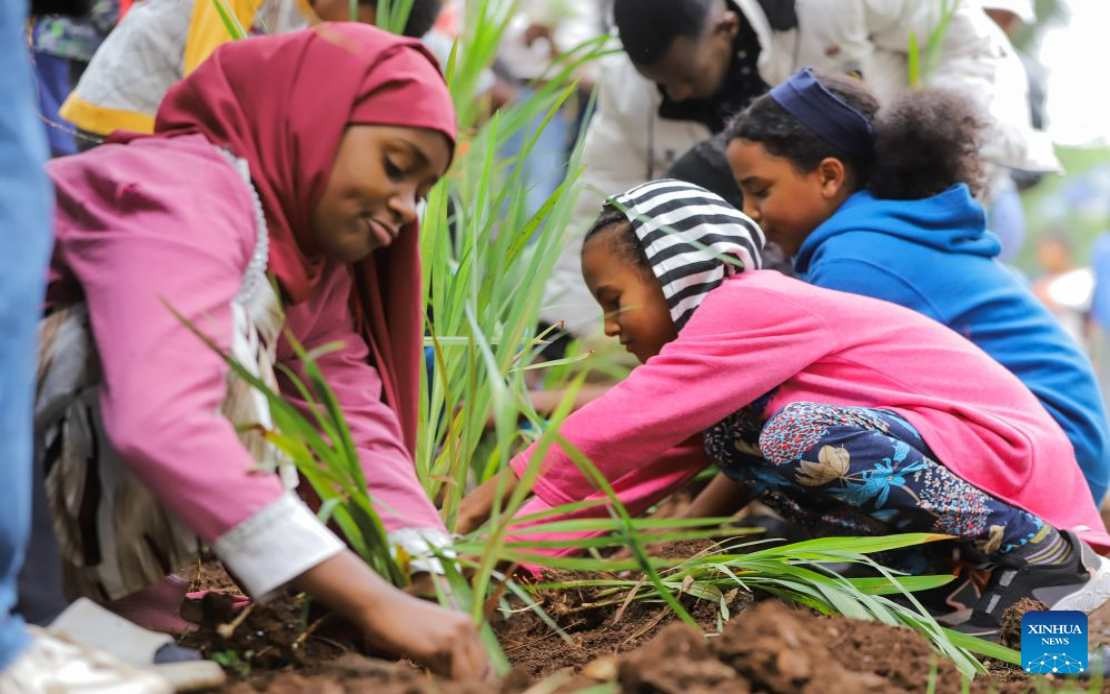
Ethiopia executed an extraordinary environmental mobilization on Monday when millions of citizens and foreign nationals across the country participated in a nationwide tree-planting campaign, collectively setting out over 800 million seedlings in what officials described as a record-breaking single-day effort. The coordinated event underscores the East African nation's determination to reverse decades of forest degradation and establish itself as a leader in climate action within the region.
The initiative draws its authority from the Green Legacy Initiative, a flagship environmental program launched by Prime Minister Abiy Ahmed in 2019. This year's edition targets the planting of more than 8 billion seedlings during the rainy season alone, representing a significant escalation in the government's reforestation ambitions. The cumulative effort since the program's inception has set Ethiopia on track to surpass an overarching goal of planting 50 billion trees, transforming the relationship between the nation and its natural resources.
Participation cut across demographic and professional lines, reflecting how thoroughly the environmental message has penetrated Ethiopian society. Edilawit Legesse, a thirteen-year-old from Addis Ababa's Alembank neighborhood, exemplified the youth engagement central to the campaign's success. Having participated for three consecutive years, young Legesse brought both her family and community members to contribute seedlings, describing the experience as something she and her neighbors anticipated with genuine enthusiasm. Such intergenerational involvement suggests the initiative has transcended a purely governmental directive to become a social movement with roots in local communities.
Healthcare workers also mobilized in significant numbers, recognizing that environmental restoration directly connects to public health outcomes. At a planting site near Entoto Mountain in the capital, Hewan Legesse, a nurse at a local hospital, coordinated her workplace colleagues in a group effort to establish 350 trees collectively. The presence of medical professionals underscores growing awareness that deforestation, degradation, and climate vulnerability impose substantial burdens on health systems through drought-related malnutrition, water scarcity, and disease proliferation.
The scale of this undertaking reflects Ethiopia's evolving strategic calculus regarding economic development and environmental stewardship. Rather than viewing these as competing priorities, policymakers have articulated a vision of building a green, lower-middle-income economy where environmental restoration and prosperity reinforce each other. This positioning carries significance for neighboring nations and development partners in Southeast Asia watching how sub-Saharan African states navigate the development-sustainability tension.
Prime Minister Abiy framed the annual campaign in explicitly unifying language, describing it as "a moment when Ethiopians from all walks of life come together to create a lasting legacy for generations to come." His public statements emphasized that eight years of consecutive action had strengthened the initiative through accumulated public commitment and what he characterized as a shared belief in collective capacity to reshape environmental futures. This rhetorical positioning—emphasizing unity, transgenerational responsibility, and collective agency—reflects an understanding that environmental restoration demands not merely technical implementation but sustained social solidarity.
The strategic objectives animating the Green Legacy Initiative extend well beyond simple afforestation. Officials identify forest restoration as essential to combating deforestation pressures, expanding forest cover that Ethiopia has lost over preceding decades, and building climate resilience in a region increasingly vulnerable to erratic rainfall patterns. Simultaneously, the program addresses biodiversity conservation by protecting and restoring ecosystems that support wildlife populations facing pressure from habitat fragmentation and expanding human settlement patterns.
For Malaysian observers and policymakers, Ethiopia's approach offers instructive parallels and contrasts. Both countries face pressure to balance development demands against environmental degradation, and both have experienced substantial forest loss. However, Ethiopia's nationwide mobilization model, emphasizing annual single-day campaigns that achieve symbolic and quantitative scale, differs from Malaysia's sector-specific and incremental restoration approaches. The Ethiopian template suggests potential value in periodic, society-wide environmental undertakings that combine substantive ecological work with nation-building and climate consciousness-raising.
The initiative's emphasis on rainy season planting demonstrates sophisticated adaptation to climatic realities, maximizing seedling survival rates and reducing establishment costs. This technical dimension complements the social mobilization strategy, ensuring that enthusiasm translates into ecological outcomes. The targeting of 8 billion seedlings this year alone, sufficient to substantially exceed earlier cumulative targets, reflects confidence that the institutional capacity and social participation mechanisms have matured sufficiently to support dramatically accelerated implementation.
Sustainability of such efforts remains a critical consideration. Successful reforestation requires not only planting but long-term protection, management, and monitoring of planted areas to ensure survival and ecosystem functionality. Ethiopia's multi-year commitment and government-led institutional framework suggest institutional persistence, though challenges related to land tenure, pastoral land use conflicts, and protection from unsustainable harvesting will require sustained attention and adaptive management.
The timing of Ethiopia's intensified reforestation efforts coincides with heightened global attention to nature-based climate solutions and recognition that forest restoration offers cost-effective approaches to carbon sequestration, watershed protection, and livelihood diversification. For Southeast Asian nations confronting similar pressures, Ethiopia's mobilization model and commitment to measurable, time-bound environmental targets provide a reference point for what large-scale governmental environmental engagement might achieve when coupled with broad social participation.

