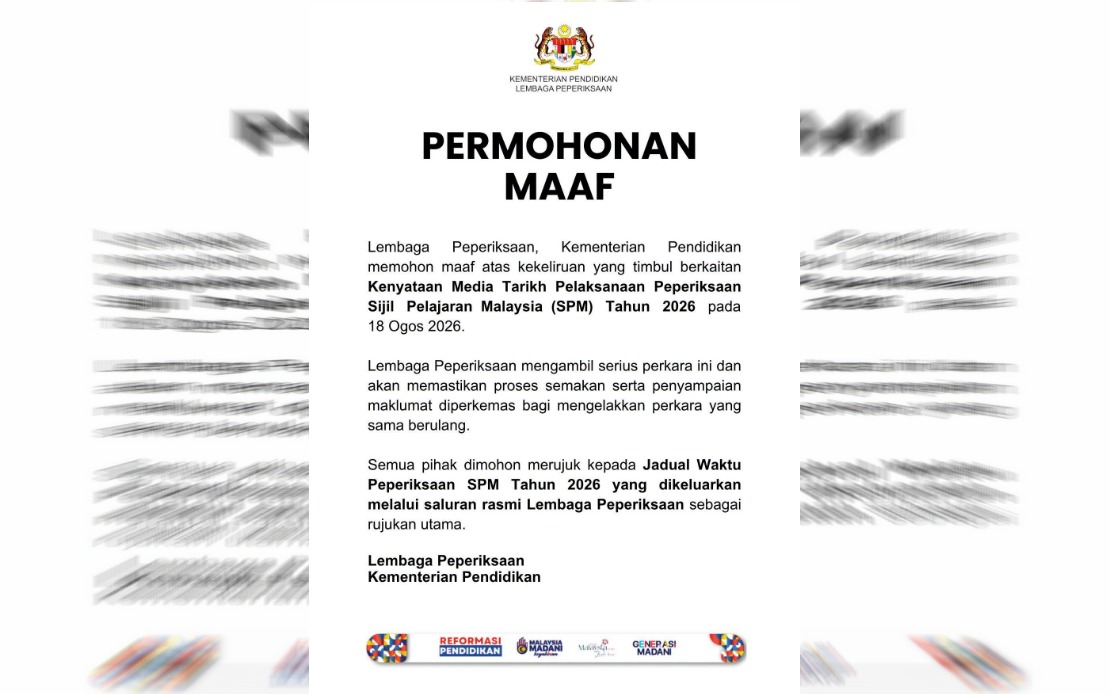
The Examination Board under the Ministry of Education has issued a formal apology following confusion created by conflicting press releases regarding the implementation schedule for the 2026 Sijil Pelajaran Malaysia (SPM) examination. The clarification came just one day after the initial announcement that sparked widespread uncertainty among students, parents, and educational institutions across the country. The board acknowledged that the matter warrants serious attention and committed to implementing stronger oversight mechanisms to prevent similar missteps in the future.
In its statement, the Examination Board emphasised that all stakeholders should rely exclusively on the official SPM examination timetable distributed through its authorised channels when seeking accurate information. This directive aims to eliminate the possibility of candidates and schools receiving conflicting schedules from secondary sources or unofficial announcements. The emphasis on official channels reflects a broader concern within Malaysia's education system about ensuring consistent communication regarding critical national examinations that directly affect hundreds of thousands of students annually.
The scope of this examination administration challenge is substantial. According to the Examination Board's records, a total of 420,879 candidates have registered to sit for the 2026 SPM examination across 3,334 examination centres established throughout Malaysia. This figure underscores the massive logistical undertaking involved in coordinating a national examination of this scale, with centres distributed across urban and rural areas, and spanning multiple time zones and regional jurisdictions. Any confusion regarding examination dates carries the potential to disrupt preparation schedules for nearly half a million students.
The 2026 SPM examination is scheduled to commence on November 23 and conclude on December 17, spanning a four-week period during the final months of the calendar year. This timing places the examination in the latter portion of the academic year, allowing students adequate preparation time following completion of their syllabus. The extended examination window also facilitates the Examination Board's logistical requirements in administering tests across such a geographically dispersed network of centres simultaneously.
The confusion that necessitated this apology highlights the critical importance of institutional communication protocols within Malaysia's education administration. When conflicting information circulates regarding examination schedules, the consequences extend beyond mere inconvenience. Students may adjust their study timetables based on incorrect dates, schools may miscalculate their academic calendars, and educational planning at both institutional and family levels becomes complicated. For students in their final year of secondary education, such disruptions can create unnecessary stress during an already demanding period.
The Ministry of Education's commitment to streamlining review and information delivery processes carries implications for how official announcements are managed going forward. This likely involves implementing additional verification procedures before press releases are distributed, establishing clearer chains of approval for time-sensitive educational announcements, and potentially creating redundancy in fact-checking mechanisms. Such procedural improvements, while seemingly administrative in nature, directly impact the reliability of communication that shapes the academic trajectories of hundreds of thousands of Malaysian students.
For Malaysian educational institutions, this situation reinforces the importance of verifying information through official sources rather than relying on initial reports or secondary distributions. Schools and coaching centres offering SPM preparation guidance should ensure their materials and schedules align with the Examination Board's authorised timetable. This becomes particularly important given the competitive nature of SPM preparation in Malaysia, where many students engage private tutors and attend additional classes to prepare for the examination.
The broader context of this incident reflects ongoing challenges faced by large-scale public institutions in managing information dissemination during the digital age. Despite the prevalence of technology enabling rapid communication, the human elements of verification and approval remain essential safeguards against misinformation. The Examination Board's acknowledgment of this issue and its commitment to process improvement suggest an organisation responsive to operational challenges, a quality essential given education's centrality to national development.
For students and families already managing the complexities of final-year secondary education, clarity regarding examination schedules represents a fundamental prerequisite for effective preparation. The 2026 SPM cohort can now proceed with confidence that the November 23 to December 17 timeline provides their definitive examination window. As the examination date approaches, the Examination Board's continued adherence to its streamlined information procedures will be crucial in maintaining the institutional credibility necessary for smooth examination administration affecting nearly half a million candidates nationwide.

