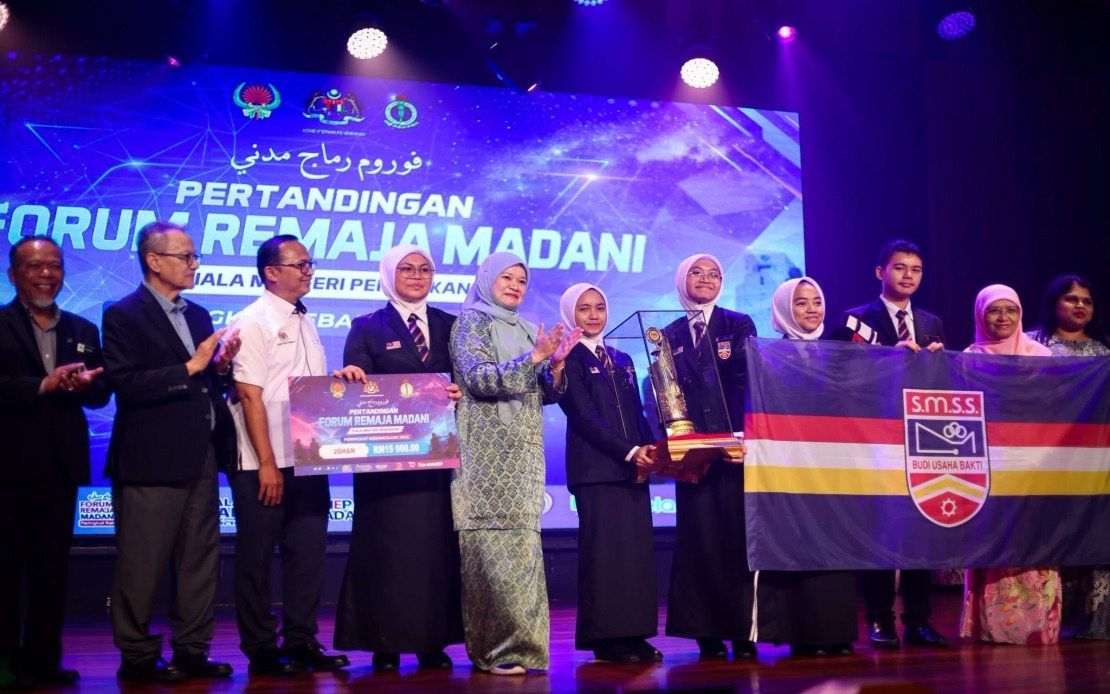
Education Minister Fadhlina Sidek has outlined a vision for character development that prioritizes active engagement and intellectual independence, arguing that schools should foster environments where young people feel empowered to articulate their positions while remaining grounded in courtesy and reasoned debate. Speaking in the wake of the National MADANI Youth Forum, Fadhlina highlighted observations of adolescents learning to defend their viewpoints, weigh alternative perspectives, and communicate their reasoning—capabilities she identified as central to the education ministry's current direction.
The minister's remarks represent a departure from traditional pedagogical approaches that have historically emphasized obedience and conformity. Instead, Fadhlina advocates for a model where students develop agency in their learning and civic participation. At the MADANI forum, she witnessed young participants engaging in substantive dialogue, a dynamic she positioned as evidence that the desired educational outcomes were materializing. This approach aligns with broader shifts in Southeast Asian education toward developing soft skills and emotional intelligence alongside academic achievement.
Central to Fadhlina's philosophy is the distinction between teaching compliance and cultivating character. She explicitly rejected the notion that character education merely involves instructing children to behave well or follow prescribed norms. Rather, the objective encompasses equipping them with confidence to express considered opinions, combined with the intellectual discipline required to support those views with evidence and logic. This formulation acknowledges that mature citizenship demands both courage and thoughtfulness—qualities that cannot develop in rigid, top-down educational systems.
The minister also connected her character education agenda to the promotion and revitalization of the Malay language among younger generations. She argued that linguistic vitality depends on speakers perceiving their language as a capable instrument for expressing contemporary ideas and complex thoughts. If young Malaysians see Malay as limited to traditional domains or formal settings, the language risks becoming disconnected from their intellectual and creative lives. By creating platforms where students use Malay to articulate original perspectives, the ministry aims to demonstrate its flexibility and relevance to modern discourse.
Fadhlina's emphasis on the relationship between language and thought reflects a deeper understanding that communication tools shape how ideas develop and spread. When youth can express themselves authentically in Malay—whether debating policy, analysing current events, or articulating personal experiences—they strengthen the language's contemporary foothold. This has particular significance for Malaysia, where English dominance in professional and academic spheres has historically marginalised Malay in these domains. Reversing that trend requires deliberate investment in spaces where Malay serves as the medium for substantive conversation.
A striking element of the minister's commentary concerns her resistance to prescribing content. She stated explicitly that the education ministry's role is not to determine what young people should say, but rather to ensure that when they do speak, they possess sufficient knowledge to construct coherent arguments and sufficient maturity to listen to others with respect. This distinction carries significant implications for educational autonomy and intellectual freedom. It suggests that the ministry envisions itself as a facilitator of capabilities rather than an arbiter of acceptable opinion.
The emphasis on respectful disagreement deserves particular attention in the Malaysian context, where political and social polarization has intensified in recent years. Fadhlina's framing—that national maturity consists not in consensus but in the capacity to disagree constructively—offers a counternarrative to zero-sum approaches to public discourse. A generation trained in the discipline of listening to opposing views, understanding their logic, and responding with substance rather than dismissal would represent a significant cultural shift.
This educational philosophy also holds implications for Southeast Asia more broadly. Across the region, governments struggle to balance concerns about social stability with the recognition that informed citizenry requires critical engagement. Fadhlina's model suggests one approach: rather than restricting young people's ability to question or debate, equip them with the cognitive and interpersonal skills to do so responsibly. This requires institutional confidence and a willingness to accept that not all speech will reflect official positions.
Implementing such an approach presents practical challenges within Malaysia's existing education ecosystem. Teachers require training in facilitating dialogue rather than lecturing, curricula must incorporate contemporary issues suitable for critical analysis, and school cultures must shift to value questioning alongside respect for authority. The ministry's recognition of these needs, evident in its focus on the MADANI Youth Forum as a model, suggests awareness that aspirational rhetoric alone will not achieve transformation.
The minister's comments also reflect demographic realities shaping Malaysian politics. A youthful population with increasing access to information and global networks will inevitably demand spaces for meaningful participation. Educational systems that fail to accommodate this reality risk alienating citizens at the precise moment when their engagement is most crucial for national cohesion. By explicitly valuing youth voices and critical thinking, Fadhlina positions education as integral to democratic resilience rather than a service merely transmitting existing knowledge.
Looking forward, the success of this educational vision depends on sustained commitment across government, schools, and communities. Character education frameworks require alignment with assessment systems, curriculum design, and teacher professional development. Without such systemic support, even well-intentioned ministerial statements may remain aspirational rather than transformative. Nevertheless, Fadhlina's articulation of the goal—young people who speak with confidence, think with rigor, and listen with respect—provides a valuable benchmark against which progress can be measured.

