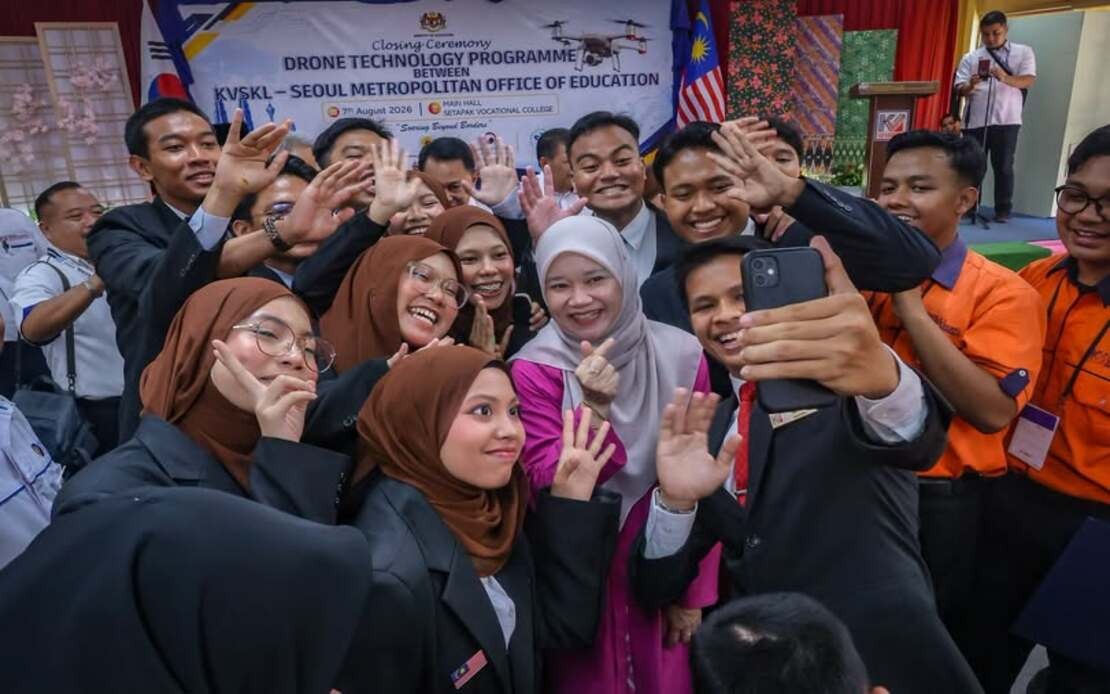
Education Minister Fadhlina Sidek has set an ambitious task for students at Setapak Vocational College: harness drone technology to devise practical security solutions for their own campus. The students have been given a month to research, develop, and pitch their proposals directly to the minister, signalling a broader push to connect classroom learning with real-world problem-solving.
The challenge emerged during a collaborative programme between the Seoul Metropolitan Office of Education and Setapak Vocational College, held in Kuala Lumpur on August 7. South Korean Ambassador to Malaysia Yeo Seung-bae attended the event, underscoring the international dimension of the initiative and Malaysia's willingness to learn from South Korea's advances in vocational and technical training. Such partnerships have become increasingly common as Southeast Asian nations seek to strengthen ties with developed economies in fields where there is clear expertise to transfer.
Fadhlina's framing of the initiative reveals a strategic understanding of how education must evolve. She acknowledged that robotics, drone systems, and artificial intelligence are no longer distant possibilities but immediate realities shaping the job market. Young people entering the workforce today must grasp not merely the operational mechanics of emerging technologies but, more importantly, how to apply them to solve tangible problems in their own communities. This represents a shift from purely theoretical technical training towards applied innovation.
During the collaboration event, the minister observed students in action—flying drones, operating robots, and experimenting with various technologies. She was particularly struck by their resilience in the face of initial failures. Some students succeeded on their first attempts; others encountered setbacks but persisted. Fadhlina highlighted this learning curve as the true educational value, noting that real growth occurs not in moments of flawless execution but in the struggle to overcome obstacles. This observation touches on a vital debate within Malaysian education about fostering grit and entrepreneurial thinking alongside technical competence.
The one-month timeline is deliberate and pressing. Rather than allowing the challenge to drift into an open-ended project, the fixed deadline creates urgency and forces students to prioritise their thinking. They must move quickly from understanding how drones operate to conceptualising how that technology addresses a specific security need on campus—perhaps monitoring perimeter access, detecting unauthorised entry, or assisting with incident response. This compressed schedule mirrors real workplace conditions where solutions must be delivered within defined timeframes.
For Malaysian vocational education, the initiative signals a commitment to elevating the perceived status and actual capability of technical institutes. Vocational colleges have long struggled with an image problem, often viewed as second-tier alternatives to mainstream academic pathways. By positioning vocational students as innovators capable of engaging with cutting-edge technology and contributing solutions to institutional challenges, the education ministry is attempting to reshape how these institutions are perceived—both internally by students and externally by society.
The South Korean partnership carries particular weight in this context. South Korea has built a world-class reputation for vocational and technical education, with strong industry linkages and a cultural emphasis on continuous skills development. The Seoul Metropolitan Office of Education's involvement suggests a structured knowledge-transfer arrangement rather than a one-off visit. Such programmes can expose Malaysian educators and students to different pedagogical approaches and demonstrate how countries with strong manufacturing and technology sectors embed innovation thinking into technical training from an early stage.
Fadhlina's emphasis on solving problems in students' immediate environment reflects international best practices in STEAM education. Rather than abstractly teaching technology, educators increasingly recognise that students engage more deeply when they can see direct applications to their own lives and surroundings. Campus security is a tangible, visible issue that students experience daily, making it an ideal test case. The experience of identifying a need, designing a solution, and pitching it to decision-makers also mirrors entrepreneurial and engineering processes in the real world.
The challenge also raises questions about implementation and next steps. If students present viable drone-based security proposals to the minister, what mechanisms exist to help translate those ideas into pilot projects? Will the college allocate budget to test the most promising solutions? Will successful student designs feed into broader campus security reviews? These questions matter because the gap between innovation competitions and actual deployment is often where good ideas stall. For the initiative to have lasting impact beyond the immediate publicity, there must be genuine follow-through.
For Malaysian educators and policymakers watching this effort, the takeaway is clear: technical education must be active, applied, and connected to real institutional needs. By positioning vocational students not as future employees executing others' instructions but as current problem-solvers contributing to their own institutions, Fadhlina is articulating a vision where technical training develops both capability and agency. Whether this mindset takes root across Malaysia's vocational sector—and whether other institutions adopt similar challenge-based learning approaches—will determine whether this initiative remains a symbolic gesture or becomes a model for systemic change in how technical skills are taught and valued.

