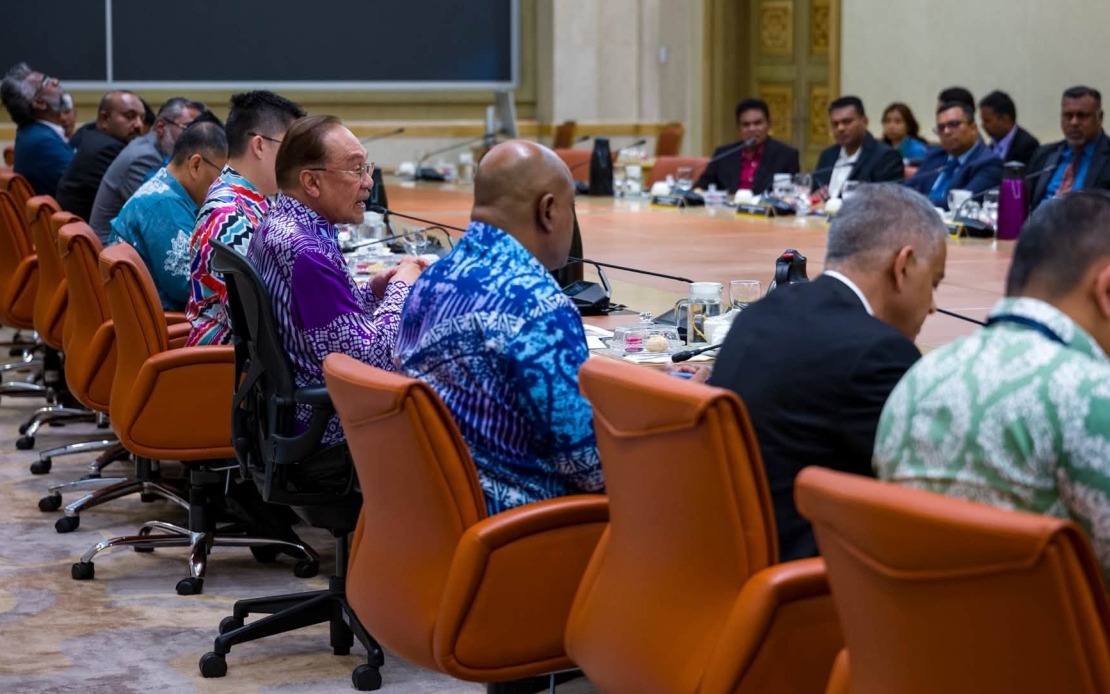
Prime Minister Datuk Seri Anwar Ibrahim has outlined a comprehensive framework for advancing the socioeconomic status of Malaysia's Indian community, centring on four interconnected pillars that he believes will drive meaningful transformation. In remarks shared on social media following discussions with Indian community representatives, Anwar stressed that sustainable empowerment depends on prioritising quality education provision, establishing robust welfare mechanisms, facilitating skills training programmes, and creating pathways to better employment outcomes. The emphasis reflects a strategic understanding that economic mobility for marginalised communities requires coordinated intervention across multiple policy domains rather than isolated, narrow initiatives.
During his meeting with Indian community leaders, Anwar articulated a vision where education serves as the foundational element enabling long-term prosperity and social advancement. Quality schooling, he implied, remains the most effective mechanism for equipping individuals with the competencies necessary to compete in an increasingly knowledge-driven economy. This positioning aligns with broader development theory emphasising human capital accumulation as a prerequisite for reducing wealth disparities and creating inter-generational mobility. For Malaysia's Indian community, which has historically faced disproportionate representation in lower-income brackets and skilled-trade sectors, accessible education represents a tangible mechanism for reversing entrenched patterns of economic disadvantage.
Complementing educational investments, Anwar underscored the necessity of comprehensive welfare systems that provide immediate relief whilst individuals pursue longer-term qualification pathways. The distinction between welfare as a safety net and welfare as a springboard for advancement proved significant in his framing. Rather than portraying social assistance as a permanent condition, his approach envisions welfare programmes as transitional supports enabling individuals to invest in personal development without facing immediate subsistence pressures. This conception reflects evolving international best practices in poverty alleviation, moving beyond passive benefit distribution towards active enablement of self-improvement.
The Malaysian Indian Transformation Unit (MITRA), established as the primary institutional mechanism for addressing community-specific development challenges, featured prominently in Anwar's directive. He urged MITRA and partner agencies to adopt a more proactive engagement strategy at grassroots levels, moving beyond top-down policy implementation towards community-responsive programming. This emphasis on institutional activation suggests acknowledgment that existing frameworks may operate with insufficient awareness of on-the-ground realities, community preferences, and specific local barriers to opportunity. By mandating enhanced grassroots engagement, Anwar implicitly recognised that effective empowerment requires understanding contextual nuances that bureaucratic distance often obscures.
Anwar specifically instructed relevant agencies to prioritise authentic needs assessment, ensuring community members themselves identify their most pressing challenges rather than having solutions imposed by distant policymakers. This participatory approach carries significant implications for programme efficacy, as initiatives designed without sufficient community input frequently miss critical dimensions or fail to address underlying structural constraints. For the Indian community, whose development priorities may vary substantially across urban, suburban and rural contexts, such differentiated assessment becomes particularly valuable. Customised interventions reflecting local circumstances typically generate superior outcomes compared to standardised approaches applied uniformly across diverse populations.
The Prime Minister's insistence that implemented initiatives actually benefit those most in need speaks to a persistent challenge in Malaysian development programming: resource leakage and benefit capture by relatively advantaged groups within target communities. By highlighting accountability in benefit distribution, Anwar signalled recognition that empowerment programmes sometimes inadvertently reinforce existing inequalities by concentrating advantages among already-positioned community members. Targeting the truly disadvantaged—often those facing intersecting barriers including geographical remoteness, inadequate social networks, or limited prior educational attainment—requires deliberate mechanisms ensuring benefits reach intended populations.
Anwar embedded his empowerment agenda within a broader governance philosophy emphasising compassion, accountability and institutional integrity. Compassion, in this context, denotes recognition of community vulnerabilities and historical disadvantages requiring deliberate corrective action. Accountability implies transparent resource management and measurable outcome delivery, ensuring public funds directed toward empowerment programmes actually produce intended results. Good governance encompasses institutional responsiveness, procedural fairness and alignment between stated objectives and operational realities. Together, these principles establish a normative framework suggesting that sustainable development requires not merely resource allocation but also institutional transformation ensuring equitable benefit distribution.
The articulation of leaving no segment of society behind reflects Malaysia's pluralistic development imperative, particularly relevant given the nation's multicommunal composition. Indian Malaysians, constituting approximately 7 percent of the population, have historically experienced economic marginalisation relative to other communities, with systematic underrepresentation in professional sectors and disproportionate concentration in lower-wage occupations. Deliberate empowerment initiatives targeting this community thus advance both equity objectives and broader national development goals by expanding the productive capacity of underutilised human capital. When entire population segments remain economically constrained, the nation forgoes potential economic growth, innovation and tax revenue.
Beyond immediate community benefits, Anwar's framework carries regional significance for Southeast Asia's multicommunal societies grappling with similar equity challenges. Malaysia's approach to targeted community empowerment, implemented through dedicated institutional mechanisms like MITRA and guided by explicit principles, offers a model potentially instructive for neighbouring states addressing minority community development. The emphasis on combining education, welfare and employment support within an accountability framework provides a replicable template for addressing persistent development disparities across Southeast Asian nations with significant minority populations requiring deliberate policy intervention.
The convergence of education, welfare, skills development and employment opportunity within Anwar's empowerment vision reflects recognition that singular interventions prove insufficient. Education alone, without accompanying welfare support and employment pathway clarity, may fail to translate into opportunity for individuals from economically stressed backgrounds. Conversely, welfare without educational investment perpetuates dependency rather than enabling advancement. This integrated approach acknowledges interconnections between policy domains and the necessity of coordinated intervention addressing both immediate material needs and long-term capability building. For the Indian community and Malaysian development more broadly, such comprehensive strategy potentially delivers more substantial advancement than narrower, sector-specific initiatives operating in isolation from complementary policy support.

