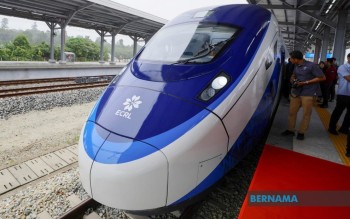
The East Coast Rail Link is poised to reshape the economic landscape of Malaysia's east coast, offering a breakthrough moment for regional entrepreneurs seeking to expand beyond their traditional markets. Deputy Minister of Economy Datuk Mohd Shahar Abdullah has outlined how the infrastructure project, now substantially advanced in construction, promises to create a comprehensive economic ecosystem that extends far beyond basic transportation connectivity. The vision encompasses an integrated network of commercial opportunities spanning construction, logistics operations, warehousing and maintenance services that will generate employment and entrepreneurial prospects throughout the states of Pahang, Terengganu, Kelantan and Selangor.
What distinguishes the ECRL from conventional rail projects is its deliberate integration with broader economic development strategies. Rather than functioning simply as a transportation corridor, the initiative incorporates what Mohd Shahar describes as transit-oriented development, cargo-oriented infrastructure and dedicated industrial parks. This multi-layered approach transforms the railway route itself into a catalyst for concentrated commercial activity, with warehouses, distribution centres and manufacturing facilities clustering along the corridor. The architectural approach recognises that modern logistics success depends on seamless integration between transport infrastructure and supporting commercial facilities, creating efficiencies that would prove impossible under traditional models.
For entrepreneurs currently constrained by geographical isolation or logistical challenges, the ECRL offers tangible competitive advantages. Businesses operating in Pahang, Terengganu and Kelantan have historically faced elevated transportation costs when serving markets in more developed regions or major population centres. The railway's completion promises to radically compress delivery timeframes whilst simultaneously reducing per-unit shipping expenses, fundamentally altering the economics of inter-state commerce. This cost restructuring proves particularly significant for manufacturers producing goods with thin profit margins or perishable products where time-sensitive delivery directly impacts marketability. Smaller enterprises that previously found national distribution prohibitively expensive may suddenly discover new viability in expanded market reach.
The scale benefits emerging from broader market access deserve particular emphasis within the Malaysian context. A manufacturer capable of producing 10,000 units annually for a regional market faces fundamentally different operational mathematics than one scaling production to 20,000 units serving a national customer base. Higher production volumes enable economies of scale that reduce per-unit manufacturing costs, allowing competitive price reduction without sacrificing profitability. This dynamic proves especially consequential for East Coast SMEs competing against established producers in developed regions. The ECRL therefore creates conditions where previously marginalized producers can achieve cost-competitiveness simply through accessing larger customer pools, without requiring technological transformation or massive capital investment.
The supply chain opportunities embedded within the ECRL project itself merit recognition as immediate economic generators. Construction and project implementation phases absorb significant labour and material inputs, whilst subsequent operational and maintenance requirements establish permanent employment streams. These supply chain roles span construction contracting, equipment provision, specialized maintenance services and industrial support functions. Local suppliers positioned to serve these contractual requirements stand to capture substantial revenue flows. The approach differs markedly from extractive infrastructure projects that concentrate wealth among major contractors; deliberate integration of regional suppliers distributes economic benefits more broadly throughout adjacent communities.
Logistics sector transformation represents perhaps the most consequential economic shift accompanying the ECRL. Modern commerce increasingly depends on efficient warehousing networks, distribution hubs and inventory management facilities rather than traditional point-to-point shipping. The railway corridor creates natural anchor points for such infrastructure, with industrial parks and logistics facilities clustering at key stations and junction points. Entrepreneurs capable of establishing or operating these facilities access an entirely new sector essentially non-existent in their regions previously. Warehouse management, logistics coordination, value-added distribution services and cold storage operations all represent commercial opportunities that require relatively modest initial capital compared to manufacturing but generate substantial recurring revenue.
Tourism sector stimulation constitutes an often-overlooked but genuinely significant economic consequence of improved regional connectivity. Enhanced transportation networks facilitate tourist mobility, making peripheral destinations more accessible and affordable for holiday planning. Pahang, Terengganu and Kelantan possess substantial natural and cultural attractions—from Taman Negara to heritage sites—that have historically remained undercapitalized due to limited visitor access. Improved accessibility translates directly into increased tourist spending across accommodation, dining, handicraft retail and experiential activities. Small traders, food establishment operators and artisans—including batik producers and craft manufacturers—benefit from expanded customer volumes without requiring geographic relocation or major business restructuring. This tourism multiplier effect distributes economic gains broadly through community-level service providers rather than concentrating benefits among major tourism corporations.
However, Mohd Shahar's cautionary remarks regarding technological adaptation warrant serious consideration by prospective ECRL beneficiaries. Infrastructure improvements establish necessary but insufficient conditions for business success. Entrepreneurs must simultaneously modernise operational practices, embrace digital commerce capabilities and adopt contemporary supply chain management systems. The warning against remaining wedded to traditional business models reflects recognition that infrastructure advantages dissipate rapidly if companies fail to optimize their operational execution. A producer with improved transport access but antiquated inventory management or rudimentary digital ordering systems captures only partial benefits of enhanced connectivity. The ECRL therefore functions as catalyst rather than cure—enabling opportunity requires simultaneous investment in operational competence.
The project's advancement toward completion strengthens confidence in these projected benefits materializing within realistic timeframes. The Pahang segment has achieved 97.33 per cent construction progress, with the overall megaproject recording 93.66 per cent completion as of April, positioned for December conclusion. This trajectory indicates substantial probability that commercial opportunities will manifest within the next eighteen months rather than remaining perpetually theoretical. Regional entrepreneurs and local governments can begin concrete planning for supply chain participation, facility development and market repositioning with genuine confidence that the transformative infrastructure will arrive as scheduled.
The ECRL ultimately represents a rare opportunity for East Coast Malaysia to fundamentally recalibrate its economic position within the national framework. Rather than functioning as peripheral regions dependent on occasional government investment or external enterprise, Pahang, Terengganu and Kelantan can establish themselves as integrated nodes within national and potentially regional commerce networks. The project's success depends substantially on whether local stakeholders recognize and seize the genuine opportunities being created, positioning themselves as active participants in the emerging logistics ecosystem rather than passive observers of infrastructure passing through their territories.

