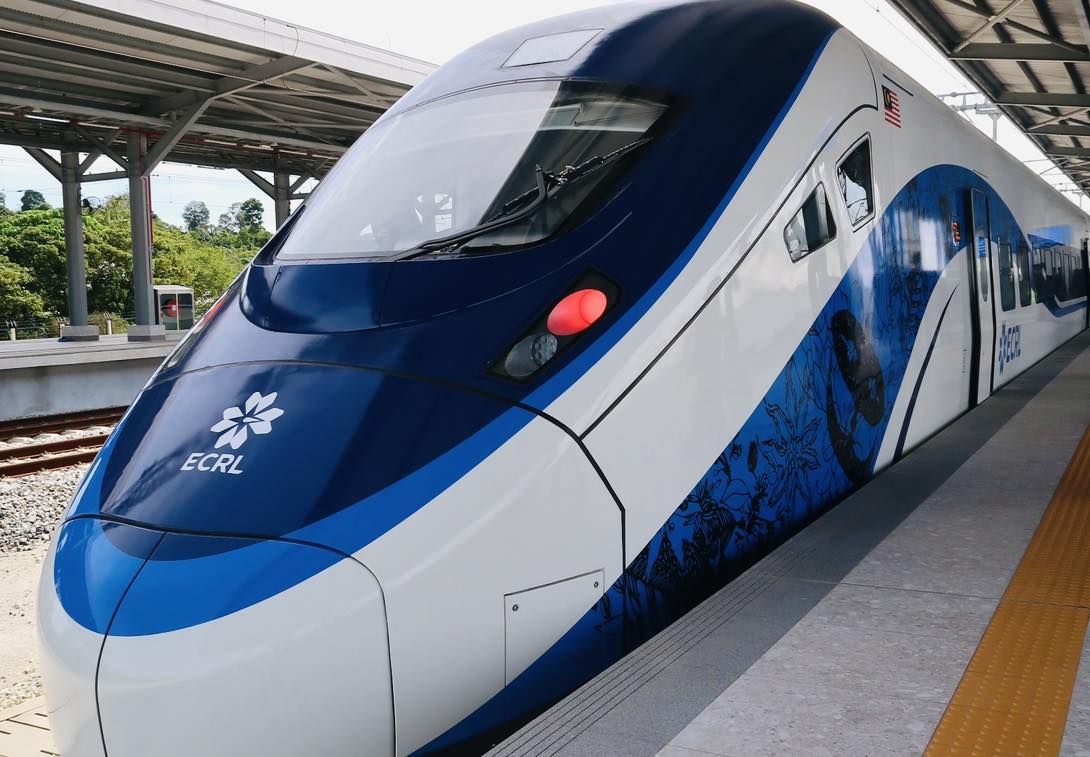
The East Coast Rail Link (ECRL) is poised to become a transformative economic engine for Malaysia's eastern corridor, with government projections indicating a cumulative contribution of between RM80 and RM90 billion to the nation's gross domestic product by 2047. Deputy Economy Minister Datuk Mohd Shahar Abdullah outlined this ambitious economic vision during recent remarks, framing the 665-kilometre rail project as far more than a transportation solution. Instead, the ECRL represents a comprehensive strategy to redirect investment flows toward historically underutilised regions and establish new centers of commercial activity along one of Southeast Asia's emerging economic corridors.
The financial projection rests fundamentally on the development of 21 Economic Accelerator Projects (EAPs) positioned strategically along the rail network. These initiatives are designed to function as economic multipliers, generating investment cascades that extend well beyond the immediate construction phase. By identifying and nurturing clusters of economic activity at key nodes, policymakers hope to transform the East Coast into a competitive alternative to existing commercial corridors, particularly those concentrated on the western seaboard. This approach aligns with broader regional development objectives outlined in Malaysia's 13th Malaysia Plan, which prioritises narrowing geographical disparities in economic opportunity and prosperity.
Three locations have been formally designated as logistics transformation zones, each offering substantial land parcels for integrated supply-chain infrastructure. Pasir Puteh in Kelantan commands 213 acres (86.2 hectares), while Kemaman in Terengganu features 68 acres (27.5 hectares), and Temerloh in Pahang encompasses 50 acres (20.2 hectares). These hubs are envisioned as modern logistical ecosystems rather than traditional warehousing facilities, incorporating value-added services, manufacturing capabilities, and distribution networks. The strategic positioning of these sites relative to ECRL stations creates natural synergies between rail connectivity and cargo handling, potentially reshaping Malaysia's internal trade patterns and reducing reliance on congested western ports.
Mohd Shahar emphasised that the ECRL functions as a catalyst for sustainable economic transformation rather than serving merely as transportation infrastructure. This framing is significant for regional policymakers observing whether large-scale transport investments can genuinely redistribute opportunity or whether they primarily reinforce existing economic hierarchies. The Malaysian government's commitment to employment generation along the corridor suggests an intention to address longstanding concerns about wealth concentration and uneven development across states. By creating quality job opportunities throughout the ECRL zone, authorities hope to retain local talent and attract skilled workers to underutilised regions.
A concrete example of this economic diversification strategy involves Perodua's logistics hub in Paya Besar, Kuantan, where the first phase is scheduled for completion by 2029. This project demonstrates private-sector engagement with the ECRL vision and signals confidence in the corridor's commercial viability. Perodua's investment represents not merely facility expansion but a deliberate repositioning of supply-chain operations to capitalise on improved rail connectivity. As Malaysia's automotive sector faces increasing pressure to enhance logistics efficiency amid regional competition, the ECRL offers manufacturers and distributors new operational flexibility. The Paya Besar hub exemplifies how transport infrastructure can catalyse industrial relocation and strengthen local manufacturing ecosystems.
Mohd Shahar, who represents Paya Besar as Member of Parliament, positioned the ECRL as complementary to rather than competitive with existing international shipping routes. This distinction carries strategic importance, particularly for ports and maritime interests potentially threatened by rail-based alternatives. The narrative framing the ECRL as an enhancement to Malaysia's overall logistics ecosystem rather than a disruptive replacement seeks to build consensus across multiple stakeholder groups. The project aims simultaneously to reduce developmental gaps between the East and West coasts whilst preserving the commercial viability of existing transport corridors. This delicate balancing act reflects the political complexity of infrastructure investment in economically stratified nations.
The project's integration within the broader MADANI Economy framework underscores government intentions to align physical infrastructure with inclusive growth principles. Rather than treating the ECRL as isolated construction, authorities position it within a comprehensive development philosophy emphasising dignity, resilience, and prosperity distribution. This ideological embedding increases the political sustainability of the project and establishes clearer accountability metrics beyond conventional return-on-investment calculations. The 13th Malaysia Plan's deployment of the Malaysia Development Composite Index and MyRMK system represents attempts to ensure resources flow systematically toward underserved regions rather than following only narrow commercial logic.
The ECRL's material specifications underscore its dual passenger and cargo mandate. The project includes allocation of 11 six-car electric multiple unit (EMU) train sets for passenger services alongside 12 electric locomotives (E-Loco) dedicated to freight operations. This balanced approach reflects diverse economic objectives: the passenger service supports regional mobility and enhances accessibility to employment centres, whilst the cargo capacity targets industrial supply chains and logistics operations. The emphasis on electric rather than diesel-powered trains aligns with sustainability commitments and positions Malaysia as environmentally conscious within regional infrastructure development comparisons.
At RM50.27 billion, the ECRL represents one of Malaysia's largest infrastructure commitments, with completion targeted for December 2026 and operational launch scheduled for January 2027. The timeline carries significant implications for East Coast development trajectories. Once functional, the rail network will begin integrating previously fragmented markets, facilitating labour mobility, and enabling manufacturers and distributors to optimise operations across larger geographical areas. The swift transition from construction to operations assumes successful project delivery and sufficient institutional capacity to implement complementary economic initiatives simultaneously. For Malaysian readers and Southeast Asian observers, the ECRL represents a critical test case of whether large-scale infrastructure investment can genuinely reshape regional economic geography or whether structural patterns prove resilient against transportation innovation.

