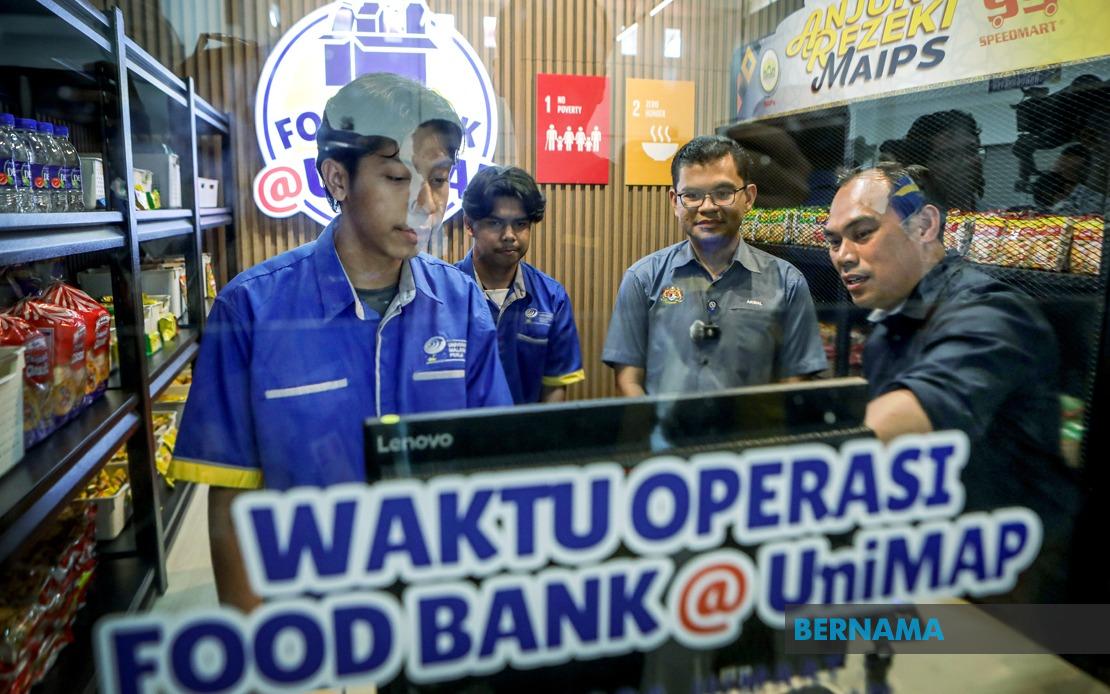
The Ministry of Economy is moving to secure a longer lifespan for the People's Income Initiative – Food Entrepreneur Initiative (IPR-INSAN), a grassroots support scheme targeting low-income business operators and food-insecure consumers. Economy Minister Akmal Nasrullah Mohd Nasir announced the decision to request continuation approval from the Ministry of Finance after conducting an on-site assessment of the programme's effectiveness at Universiti Malaysia Perlis on July 10.
The IPR-INSAN initiative represents a pragmatic intersection of social protection and entrepreneurial opportunity, particularly relevant in Malaysia's ongoing efforts to uplift the bottom 40 per cent of earners. By positioning vending machines stocked with affordable, home-prepared meals within university residential facilities, the scheme creates a low-barrier entry point for small-scale operators to systematically reach a stable customer base. For cash-strapped students, the programme simultaneously ensures reliable access to nutrition at prices far below conventional campus foodcourt offerings. This dual mechanism addresses two persistent challenges in Malaysia's informal economy: the fragility of informal vendor networks and youth food security on campus.
During his visit, Minister Akmal observed two operational vending machines installed at the Tuanku Abdul Rahman Residential College and the Tuanku Tengku Fauziah Residential College. The minister's on-ground inspection underscored the ministry's commitment to evidence-based policy extension, moving beyond pilot assessments to document real-world performance metrics. The visit also encompassed broader student welfare infrastructure, including the university's Food Bank and MADANI Dapur Siswa kitchen programme, signalling the government's integrated approach to student economic vulnerability.
The financial outcomes documented at UniMAP illuminate why the ministry views programme continuation as justified. Norleyana Nordin, operating a homemade food vending operation at the Tuanku Abdul Rahman college, achieved average monthly revenue of RM2,178.80, with peak sales of RM4,905 recorded in January. At the neighbouring campus location, Noor Hasfalela Mohd Noor demonstrated even stronger performance, averaging RM4,595 monthly with a peak of RM10,012 in January, followed by RM5,049 in February and RM4,868 in April 2026. These figures, though modest in absolute terms, represent meaningful income supplementation for household operators in the B40 bracket, where such monthly earnings constitute a significant proportion of total household income.
The income stability evident across multiple months suggests the vending model sustains demand beyond initial novelty. For entrepreneurs typically constrained by limited capital, irregular customer access, and vulnerability to competitor displacement in conventional market environments, the guaranteed campus location and consistent student footfall provide structural advantages unavailable in traditional hawker stalls or pavement vending. Technology integration through the vending apparatus itself reduces labour intensity compared to manual retail operations, allowing entrepreneurs to manage multiple machines or pursue additional income sources simultaneously.
From the consumer perspective, the programme's logic appeals to the university administration's interest in student retention and academic performance. Food insecurity directly correlates with reduced classroom attendance and diminished cognitive performance among tertiary students. By providing meals at RM2 to RM4 per serving—substantially below market alternatives—IPR-INSAN reduces one of the most persistent financial pressures on low-income undergraduates. The partnership structure, involving UniMAP volunteers and institutional coordination, also embeds student welfare infrastructure within the university's operational ecosystem rather than treating it as an externality.
The ministry's decision to pursue formal extension through Finance Ministry channels reflects the programme's growing institutional credibility. Initial pilot phases often operate under temporal constraints or experimental budget allocations; transition to permanent status requires demonstrating both fiscal sustainability and alignment with broader government objectives. IPR-INSAN meets several such criteria: it operationalises the government's commitment to reducing inequality through income generation rather than passive transfer payments; it mobilises existing institutional assets (university properties and student populations) rather than requiring major new infrastructure; and it produces measurable outcomes amenable to routine monitoring and reporting.
However, scaling the programme beyond the university context presents administrative and logistical considerations that may shape the extension approval process. While residential colleges provide controlled environments with predictable foot traffic and institutional oversight, replicating this model in other settings—secondary schools, community centres, office parks—would require fresh risk assessment, operator vetting procedures, and food safety compliance frameworks. The Ministry of Economy's submission to Finance will likely need to address how expansion would be managed without proportional escalation in administrative overhead.
The broader policy context also matters. IPR-INSAN aligns with several government initiatives spanning the previous administration and current MADANI framework, including poverty eradication targets and social safety net enhancement. However, economic pressures and fiscal consolidation priorities may constrain Finance Ministry receptiveness to budget commitments for extended social programmes. The ministry's ability to demonstrate cost-effectiveness—perhaps through revenue-sharing arrangements or operational fee models that reduce direct government expenditure—could prove decisive in securing approval.
For informal economy operators across Malaysia, IPR-INSAN's trajectory carries significance beyond its immediate participants. The programme validates an emerging policy recognition that informal entrepreneurs warrant institutional support and structured market access, not merely tolerance or regulatory minimisation. By providing formal vending infrastructure within regulated premises, the government reduces the traditional informality-legality divide that constrains informal operator growth. This signals potential for similar institutional partnerships elsewhere—hospital canteens, government office complexes, or school facilities—to serve as deployment platforms for dignified income-generation opportunities among B40 populations.
The petition for extension also reflects evolving understanding of undergraduate student welfare as an investment rather than expense category. Universities increasingly recognise that food insecurity directly affects retention and graduation rates, creating downstream impacts on employment and economic mobility. Government support for in-campus food security thus generates returns through improved educational outcomes, justifying social expenditure as human capital development. This reframing strengthens the case for Finance Ministry approval, positioning IPR-INSAN as education policy rather than pure subsidy.
Looking ahead, the extension decision will test Malaysia's capacity to scale tested social innovations. Approving continuation signals commitment to evidence-based social protection; refusing or limiting extension would suggest resource constraints or competing priorities. Given that IPR-INSAN operates at relatively modest cost while addressing multiple policy objectives simultaneously, approval appears likely—though final terms may include performance benchmarks, geographic expansion targets, or financial contribution requirements for participating institutions. The programme's success at UniMAP establishes proof-of-concept; translating that success into sustained national architecture remains the immediate challenge.

