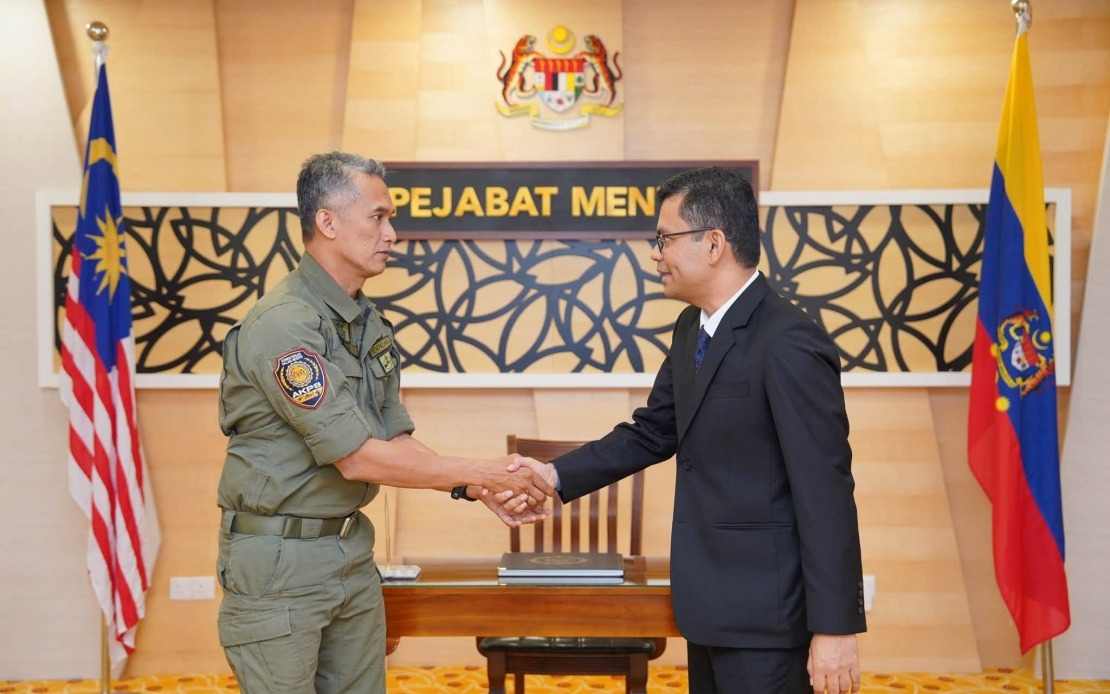
Officials from Malaysia's Economy Ministry have begun mapping out developmental investments needed to bolster the nation's border management infrastructure, meeting with the leadership of the Malaysian Border Control and Protection Agency (AKPS) to align fiscal priorities with operational requirements. The discussions, held in Putrajaya on August 5, brought together Economy Minister Akmal Nasrullah Mohd Nasir and AKPS director-general Datuk Seri Mohd Shuhaily Mohd Zain to examine how budgetary allocation can support the agency's foundational objectives during its inaugural year of full operations.
The centralisation of border functions under AKPS, which commenced operations on January 1, 2025, represents a significant structural reform in how Malaysia manages its entry points and national checkpoints. By consolidating enforcement responsibilities previously distributed across six separate government bodies—the Immigration Department, Royal Malaysian Customs Department, Malaysian Quarantine and Inspection Services Department, Health Ministry, Department of Wildlife and National Parks, and Road Transport Department—the new agency aims to eliminate coordination gaps and streamline cross-border processes. This consolidation is particularly relevant for Malaysia given its position as a major Southeast Asian trading hub and its shared maritime and land borders with Thailand, Brunei, and Singapore.
Central to the ministry's discussions with AKPS is the recognition that operational excellence at border checkpoints directly influences Malaysia's competitiveness as a trade destination. The Economy Ministry's official statement underscored this linkage, noting that investment in AKPS capabilities through structured development planning would facilitate smoother commerce, improve the efficiency of entry and exit procedures, strengthen border security posture, and ultimately contribute to more resilient economic expansion. For Malaysian importers and exporters already navigating complex supply chains across Southeast Asia, enhanced border infrastructure promises reduced dwell times and lower transaction costs.
The infrastructure upgrade component of the discussions addresses a longstanding challenge at many Malaysian entry points, where congestion and aging facilities have periodically created bottlenecks. Physical improvements to border stations, coupled with expanded checkpoint capacity, form the foundation of AKPS's modernisation agenda. These upgrades are not merely cosmetic enhancements but represent strategic investments in the nation's ability to process the increasing volume of goods and passengers crossing its frontiers, particularly as regional trade integration deepens through agreements such as the Regional Comprehensive Economic Partnership.
Technology adoption emerged as the second pillar of the ministry-AKPS dialogue, with particular emphasis on deploying artificial intelligence-driven systems to enhance screening efficiency and security. Mohd Shuhaily outlined AKPS's strategic focus on implementing integrated biometric systems that enable rapid traveller identification, automated cargo scanning technologies that accelerate goods clearance, and real-time data integration frameworks powered by artificial intelligence. These smart border solutions represent a shift from manual processes toward predictive analytics and risk-based screening, allowing border personnel to concentrate resources on genuine security threats rather than routine compliance verification.
The development of strategic assets constitutes the third dimension of the reinforcement strategy. This encompasses not only the procurement of specialised equipment—such as advanced imaging technology, detection apparatus, and mobile scanning units—but also the physical expansion or refurbishment of border facilities to accommodate emerging technologies. For a country managing numerous land crossings, coastal ports, and air terminals, strategic asset development requires careful prioritisation to ensure that critical chokepoints receive resources commensurate with their traffic volumes and risk profiles.
Operational capacity enhancement, the fourth focal point, addresses human resources and institutional capability. Mohd Shuhaily previously indicated that AKPS is prioritising improvements in personnel training, skill development, and workforce planning. The integration of staff from six different agencies means AKPS must establish unified protocols, harmonised training standards, and clear career pathways to build institutional cohesion. This human dimension is often overlooked in discussions of border modernisation but proves crucial for translating technological investments into tangible operational improvements.
The timing of these discussions carries significance given Malaysia's broader economic policy direction. The government has emphasised the importance of trade facilitation and regional integration, positioning Malaysia as a reliable conduit for Southeast Asian commerce. Strengthened border management directly supports this objective by reducing friction in cross-border transactions, enhancing the predictability that international traders value, and demonstrating Malaysia's commitment to professional, efficient border administration. For neighbouring economies such as Thailand and Singapore, Malaysia's border efficiency has direct implications for the viability of regional supply chains.
Moreover, the focus on integrity and operational efficiency that Mohd Shuhaily highlighted reflects international standards for border administration. Malaysia's adoption of advanced technologies and structured development planning aligns with practices in other regional economies and positions AKPS to participate in increasingly sophisticated cross-border information-sharing arrangements with regional partners. This interoperability dimension becomes particularly important as Southeast Asian nations work toward harmonised border procedures and mutual recognition of certain screening outcomes.
The integration of previously separate agencies also presents an opportunity to eliminate redundant screening requirements that traders have historically faced. When immigration, customs, quarantine, health, wildlife, and transport authorities operated independently, cargo and passengers often underwent multiple sequential inspections at the same border post. AKPS's unified framework theoretically enables single-window processing where multiple regulatory requirements are satisfied through coordinated assessment, significantly reducing clearance times.
From a regional perspective, Malaysia's investment in advanced border technology and infrastructure could establish benchmarks for other Southeast Asian nations still managing borders through more traditional means. As Malaysia demonstrates the economic returns from efficient border management, neighbouring countries may face pressure to modernise their own entry points to remain competitive. This competitive dynamic could drive regional improvements in border administration, benefiting the entire ASEAN trade ecosystem.
Looking forward, the Economy Ministry's commitment to funding AKPS's development objectives signals that border management has secured elevated status within Malaysia's economic policy framework. The structured development planning that the ministry emphasised suggests that budgetary allocation will proceed according to prioritised phases rather than ad-hoc appropriations, providing AKPS with the planning certainty needed for sustained modernisation efforts. As Malaysia navigates increasingly complex global trade relationships and security environments, the institutional framework and technological systems being built through this collaborative ministry-agency effort will prove foundational to the nation's competitiveness and security objectives.

