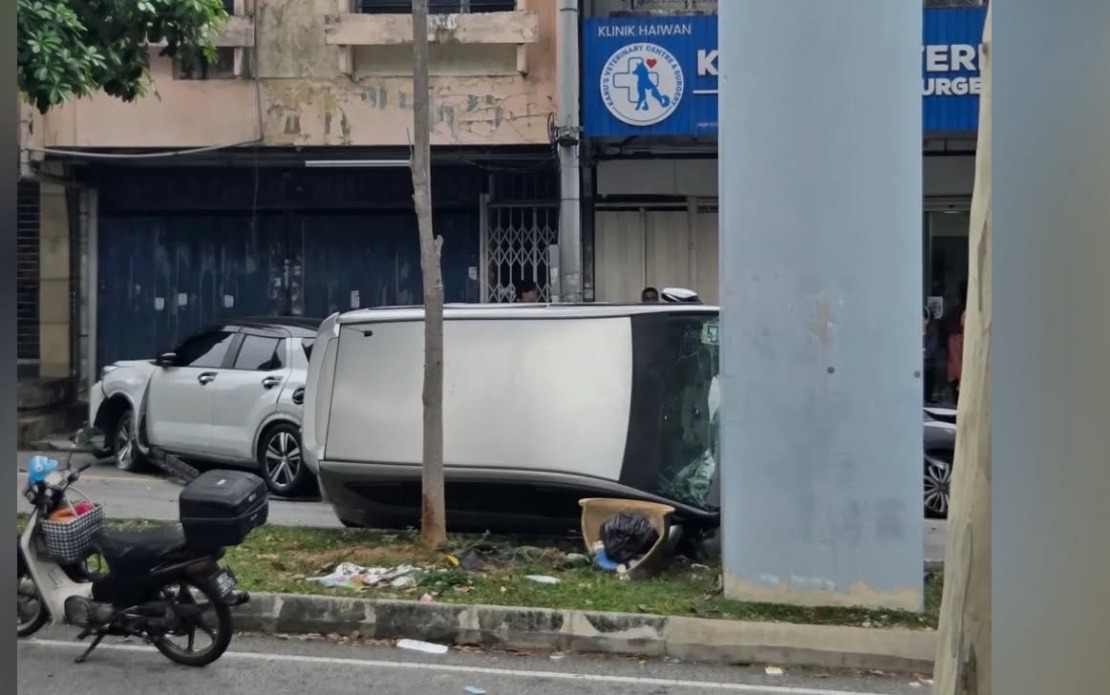
A medical emergency transformed into a traffic incident on Jalan Midah 1 in Cheras early this morning when a 28-year-old driver experienced a sudden seizure whilst operating his BMW 320i, causing him to veer off the roadway and collide with six stationary vehicles parked along the left shoulder. The incident, which unfolded around 8.30 am, has raised fresh questions about the fitness of drivers with chronic medical conditions to continue operating vehicles on Malaysian roads.
According to ACP Mohd Zamzuri Mohd Isa, chief of the Kuala Lumpur Traffic Investigation and Enforcement Department, the driver was en route to his workplace at Taman Midah 1 when the seizure occurred without warning. The loss of consciousness or control that accompanies such episodes meant the vehicle suddenly departed its intended trajectory, mounting the shoulder where it struck the parked vehicles in rapid succession. The severity of impact across six separate vehicles suggests considerable momentum at the point of collision.
The fortuitous aspect of this incident—that none of the six vehicles contained occupants at the time of impact—prevented what could easily have been a far more serious tragedy. The parked cars belonged to four women aged between 29 and 43 years, one 39-year-old man, and one commercial vehicle, according to police records. Had any of these vehicles been occupied, the outcome would almost certainly have been dramatically different, potentially resulting in serious injuries or fatalities.
Woluntary medical examinations conducted immediately after the incident revealed a critical detail: the 28-year-old driver carries a medical history spanning approximately ten years involving recurrent seizures. This long-established pattern of neurological episodes raises significant implications for road safety regulations and licensing protocols in Malaysia. The question of whether individuals with such conditions should be permitted to hold active driving licenses—or whether their licenses should be subject to additional restrictions or medical certification—represents a broader policy question that extends beyond this single incident.
Police conducted a breathalyser test to determine whether alcohol impairment played any role in the accident, though the seizure itself appears to be the primary causal factor. The test returned a completely negative result, with a reading of 0 milligrammes per 100 millilitres of breath, conclusively ruling out alcohol as a contributing element. This finding reinforces that the driver's incapacity stemmed entirely from his documented medical condition rather than any behavioural or substance-related factors.
The classification of the case under Rule 10 of LN 166/59 reflects the procedural framework Malaysian police employ when investigating traffic incidents involving vehicle damage. Although the precise details of this regulatory provision are technical in nature, the classification essentially acknowledges that the incident resulted from a sudden incapacity rather than negligence or reckless driving in the conventional sense. Nonetheless, the ongoing investigation will likely explore questions about medical disclosure on driving license applications and whether the driver had previously reported his seizure history to the Road Transport Department.
The absence of any reported injuries to vehicle occupants or to the driver himself represents a narrow escape from what could have been a multi-vehicle pileup with catastrophic consequences. In urban environments like Cheras, where residential areas abut major thoroughfares and vehicles are frequently parked on shoulders and roadside spaces, the potential for collateral damage when a driver loses control is considerable. The placement of the parked vehicles on this particular stretch of road likely saved lives by preventing any pedestrians or secondary traffic from becoming involved.
This incident intersects with ongoing discussions within Malaysia's transportation and public health sectors regarding the management of drivers with chronic medical conditions. Other nations have grappled with similar challenges, implementing various solutions ranging from mandatory medical certification at regular intervals to restrictions on driving during certain times of day or in high-traffic areas. The Malaysian context, with its rapidly expanding urban centres and increasing vehicle density, demands a comprehensive approach that balances individual mobility rights against public safety obligations.
The police department's call for public witnesses to come forward demonstrates standard investigative procedure, though in this instance the causation appears straightforward. However, gathering comprehensive accounts from nearby residents or other road users might establish whether any warning signs preceded the seizure or whether the driver had exhibited unusual driving behaviour immediately before the incident. Such details, while perhaps peripheral to the main investigation, could provide valuable context for medical and automotive authorities reviewing the case.
Looking forward, this incident will likely prompt discussions between the Ministry of Transport, the Road Transport Department, and medical regulatory bodies about strengthening protocols for drivers with epilepsy or other seizure disorders. Several approaches could be considered: mandatory periodic medical assessments for drivers with histories of seizures, restrictions on driving during hours when seizure risk is elevated based on individual medical profiles, or requirements for drivers to disclose seizure medication changes to transport authorities. Malaysia's insurance sector may also reassess how policies cover incidents directly attributable to driver medical episodes, particularly when prior medical conditions were known but not adequately managed through licensing restrictions.
Investigations remain ongoing as police gather additional evidence and witness statements. The Tun H.S. Lee traffic police station can be reached at 03-2071 9999 for those with relevant information. Beyond the immediate investigation, this case serves as a sobering reminder that modern motoring safety depends not only on infrastructure, vehicle design, and driver behaviour awareness, but also on robust mechanisms for identifying and appropriately managing drivers whose medical conditions significantly elevate public risk.

