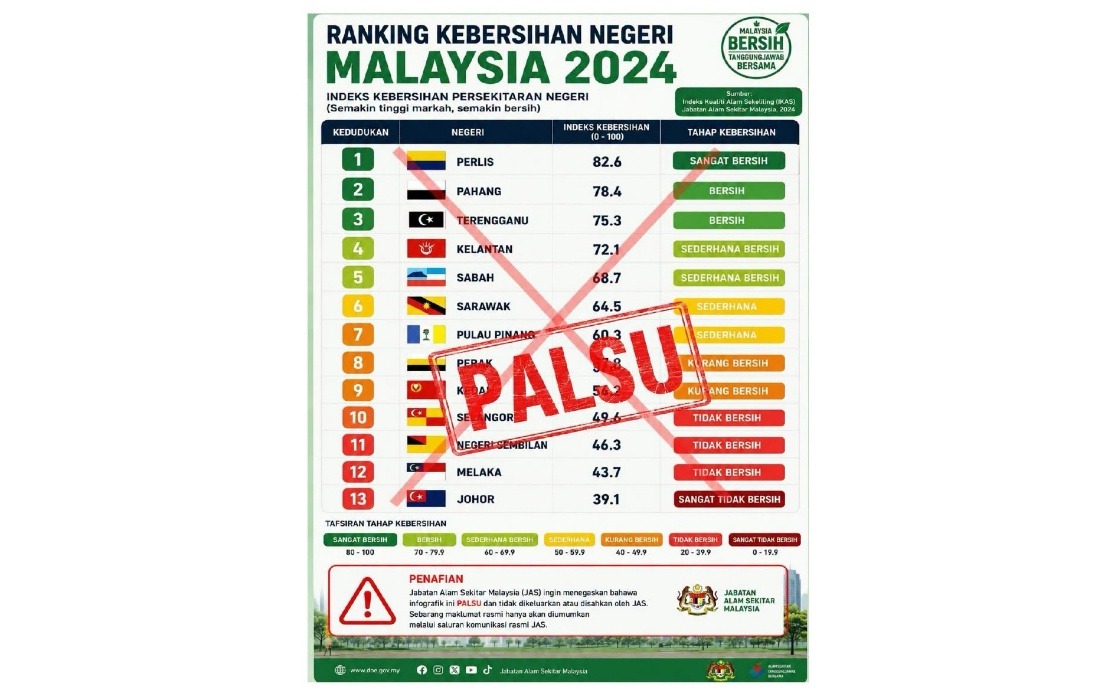
The Department of Environment (DOE) has moved to distance itself from a widely circulated infographic purporting to rank Malaysian states by cleanliness standards, clarifying that the agency played no role in its creation, verification, or distribution. Issued through an official statement on July 7, the denial addresses growing public confusion surrounding the graphic titled "Ranking Kebersihan Negeri Malaysia 2024", which has gained significant traction across social media platforms and messaging applications in recent weeks. The department's swift response underscores concerns about misinformation bearing the implicit authority of government agencies, a pattern that has become increasingly common in the age of digital communication.
The DOE emphasised that it has not released any official media statements, reports, or commentary concerning the purported state rankings as depicted in the disputed infographic. This distinction matters considerably for public understanding, as citizens often assume graphics appearing on social media carry institutional endorsement, particularly when formatted to resemble official government documents. The department has consequently advised members of the public against sharing the infographic or citing it as an authoritative source without first obtaining verification directly from the DOE itself. This guidance reflects a broader challenge facing Malaysian government agencies, which must contend with sophisticated digital manipulation and the rapid spread of unverified claims through informal communication networks.
Beyond the immediate concerns about this particular infographic, the DOE has highlighted the systemic risks posed by unverified information in the environmental management sphere. False or misleading claims about state cleanliness rankings could undermine public confidence in legitimate environmental data and official conservation initiatives, creating downstream consequences for public health policy and ecological stewardship. When citizens cannot reliably distinguish between authentic government information and fabricated content, their ability to make informed decisions about environmental issues becomes compromised. The DOE's statement therefore serves not merely as a denial but as a cautionary note about the fragility of institutional credibility in an era when misinformation spreads faster than fact-checking mechanisms can address it.
The department has established clear protocols for official communications to prevent such confusion in future. All authentic statements, reports, statistics, infographics, announcements and data released by the DOE are published exclusively through its official portal and designated communication channels. This centralised approach aims to create a single, verifiable source of truth that citizens can consult with confidence. By explicitly directing the public toward these official channels, the DOE is attempting to establish a firewall against fraudulent claims while simultaneously acknowledging that not all citizens automatically know where to find authoritative information. The strategy reflects an implicit recognition that misinformation thrives partly due to information asymmetry and public uncertainty about which sources to trust.
The department has signalled its intention to pursue legal remedies against parties found to have misused its name, logo, or corporate identity for distributing misleading information. This enforcement posture represents an escalation beyond mere public advisory statements, indicating that the DOE regards the infographic incident as a serious breach requiring deterrent action. Such threats of legal accountability serve multiple functions: they signal institutional resolve to protect against reputational damage, they warn bad actors about potential consequences, and they attempt to restore public confidence in official information channels. However, the effectiveness of legal enforcement depends heavily on investigators' ability to identify the infographic's originators, a task that proves considerably more difficult when content spreads anonymously across decentralised social media networks.
The incident illuminates broader questions about environmental governance transparency and public communication in Malaysia. Citizens have legitimate interests in understanding how environmental standards are monitored, which regions perform better or worse on cleanliness metrics, and what data supports government environmental policies. The circulation of the false infographic, whether intentionally malicious or simply careless, may reflect public appetite for exactly such information. If the DOE does not regularly publish comparable state-level environmental data or cleanliness assessments, this information vacuum creates opportunity for false information to circulate unchecked. A proactive approach to regular, detailed environmental reporting might serve as an inoculation against future misinformation campaigns.
For Malaysian citizens and regional observers, the incident demonstrates the contemporary challenge of digital literacy and institutional trust. Even when government agencies respond promptly and clearly to refute false claims, scepticism toward institutions remains widespread, and many individuals may discount official denials as self-serving. The speed with which the infographic circulated before the DOE's response suggests that many people encountered and potentially shared the false information before seeing any authoritative correction. This temporal dynamic favours misinformation, as initial exposure often proves more persuasive than subsequent rebuttals. The DOE's statement, however well-crafted, therefore may reach only a fraction of those who already encountered the viral graphic.
The broader context involves the increasing sophistication of information manipulation across Southeast Asia, where government agencies compete with rumour, conspiracy theories, and deliberately fabricated content for public attention and credibility. Malaysia has experienced previous incidents where false environmental claims gained traction, and the DOE's current response reflects institutional learning from these prior episodes. The department's emphasis on its commitment to "accurate, authentic, transparent and credible" information conveys a values-based positioning, attempting to reassure the public that official channels deserve trust. This framing also implicitly acknowledges that trust must be earned through consistent performance, not merely asserted through statements.
The incident carries implications for how Malaysian citizens should navigate environmental information in particular and government communications generally. The DOE's advice to verify information through official channels offers practical guidance, yet implementation requires citizens to possess knowledge of where official channels exist and how to access them. For individuals without regular internet access, limited digital literacy, or scepticism toward institutional claims, this verification process may prove impractical. Addressing misinformation therefore requires not only official denials but complementary efforts to improve digital literacy, increase public awareness of legitimate information sources, and rebuild institutional credibility through transparent, regular communication.
Looking forward, the DOE might consider whether current communication practices adequately meet public demand for environmental information. Regular publication of state-level cleanliness assessments, environmental quality indicators, and conservation progress reports would provide authoritative data that citizens could reference, potentially reducing the appeal of false or unverified infographics. Such proactive transparency could transform the department from a reactive institution responding to misinformation into a leading source of environmental information that citizens naturally consult. The infographic incident, while concerning, may offer an opportunity to recalibrate the DOE's communication strategy toward greater public engagement and information accessibility, ultimately strengthening both institutional credibility and public environmental awareness across Malaysia.

