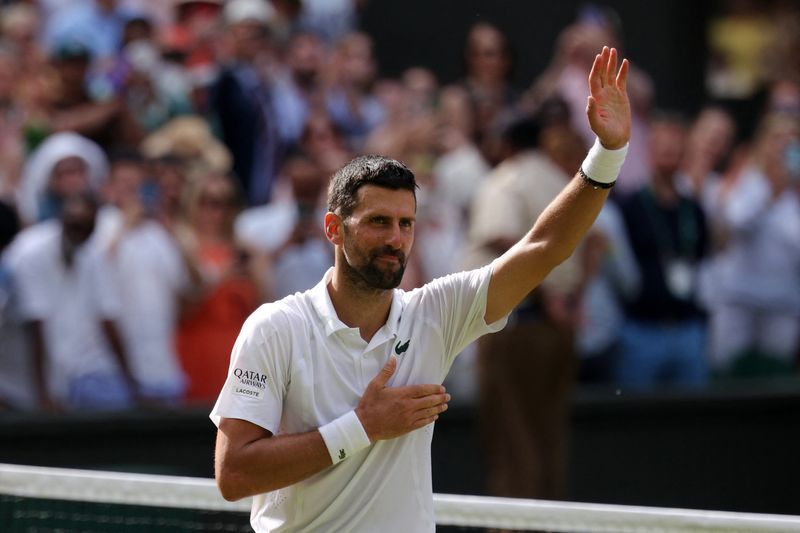
The All England Club's quarter-final stage arrives on Tuesday with two of tennis's most compelling narratives on full display: Novak Djokovic's relentless pursuit of an unprecedented 25th Grand Slam championship and Naomi Osaka's remarkable resurgence as a title contender. The 39-year-old Serbian icon will confront third-seeded Canadian Felix Auger-Aliassime on Centre Court, while the Japanese 14th seed encounters Czech 10th seed Karolina Muchova in what promises to be an equally intriguing women's encounter.
Djokovic has already etched his name further into Wimbledon's record books by securing his 106th victory at the grass-court major following a gruelling three-and-a-half-hour encounter with qualifier Roman Safiullin in the previous round. Yet the champion's path to the trophy remains fraught with difficulty. The physical toll of his recent matches, particularly his progression through four-set battles in consecutive rounds, underscores the stamina demands facing an athlete competing at elite levels well into his fourth decade. Djokovic's acknowledgment that he "won ugly" against Safiullin reveals both his pragmatism and the mounting resistance from younger competitors who refuse to be intimidated by his legendary status.
The Serbian champion's philosophical approach to his continued success offers insight into how elite athletes sustain their performance under mounting pressure. In his post-match reflections, Djokovic characterised the struggle inherent in competitive tennis as something he has learned not merely to endure but to embrace—a perspective that distinguishes champions from talented players. His emphasis on "grinding" and seeking pathways to victory suggests that his remaining edge lies not exclusively in technical prowess but in an almost meditative acceptance of adversity. For Malaysian and Southeast Asian tennis enthusiasts, Djokovic's journey represents a masterclass in longevity within a sport dominated by youth, offering lessons relevant far beyond the grass courts of London.
Auger-Aliassime, at 25 years old, stands at a generational crossroads where he can elevate himself from accomplished player to true challenger of the sport's elite. The Canadian has faced Djokovic twice previously in 2022, splitting those encounters with one victory each. However, his comments before this quarter-final reveal the psychological weight of confronting one of tennis's greatest minds. Auger-Aliassime's genuine admiration for Djokovic's career construction—his reference to the "load of work" accumulated across decades—speaks to how formidable an opponent the Serbian remains. For Canadian tennis, this match represents an opportunity to showcase the next generation's readiness to compete at the highest levels.
On the women's side, Osaka's trajectory this fortnight has captured widespread attention, her recent demolition of world number one Aryna Sabalenka revealing glimpses of the aggressive, confident player who dominated from 2018 through 2021. That Osaka required nearly three years to reach another Grand Slam quarter-final underscores the personal challenges she has navigated, including mental health struggles and maternity leave. Her straightforward characterization of the Sabalenka match as "a practice match"—despite the All England Club's prestigious setting and raucous crowd—demonstrates her ability to maintain psychological equilibrium under circumstances that might overwhelm others. For viewers across the Asia-Pacific region, Osaka represents not merely a tennis champion but a public figure who has normalised conversations around athlete wellbeing and personal boundaries.
Muchova presents a formidable obstacle, despite her inability to advance beyond the quarter-final stage at Wimbledon in three previous attempts. The Czech competitor's strategic preparation, including her deliberate participation in two warm-up tournaments before arriving in London, underscores a methodical approach to peak performance on grass surfaces. Importantly, Muchova secured victory in her only previous grasscourt meeting with Osaka at the Bad Homburg Open last month, suggesting she possesses tactical answers to the Japanese player's aggressive baseline game. Her statement regarding the value of additional match preparation on grass surfaces reflects the technical nuances that distinguish elite tennis competition from casual observation—the surface itself becomes a variable requiring specific tournament preparation rather than mere technical adaptation.
Defending champion and world number one Jannik Sinner enters his quarter-final against German qualifier Jan-Lennard Struff as a heavy favourite, having triumphed in all three previous meetings against the German. At 36 years old, Struff has achieved what many career-long professionals never accomplish: breaking through to a Grand Slam quarter-final for the first time. His victory over Hubert Hurkacz—who retired due to hip injury whilst Struff led 4-2 in the fifth set—came at an age when most athletes have long since retired from professional competition. Struff's own reflection on reaching the quarter-finals of a major tournament at this stage of his career conveys both gratitude and the additional burden of recovery and preparation that accompanies extended matches for athletes beyond their biological prime.
Sinner's measured comments about his progression through the tournament reveal the mental discipline required when defending a major title. His acknowledgment that past results hold no bearing on future contests, combined with his observation that Grand Slam quarter-finals generate distinctive emotional and physical tension, demonstrates the psychological acuity that distinguishes elite performers. For Southeast Asian audiences following the Italian's trajectory, Sinner represents a new generation assuming dominance, having already accumulated four major championships whilst barely into his twenties—a pace of accomplishment that reframes expectations for tennis's future champions.
The quarter-final lineup reflects tennis's contemporary competitive landscape, where even established stalwarts like Djokovic must confront genuine threats from ascending players across all rounds. The presence of American rivals Jessica Pegula and Coco Gauff in separate quarter-final matchups illustrates American tennis's renewed competitive depth on the women's side. For regional readers, these quarter-finals provide compelling evidence that Grand Slam tennis increasingly demands versatility across surfaces, mental resilience across extended competitions, and tactical flexibility against opponents who combine youth with accumulated experience. The matches scheduled across Centre Court and Court Number One on Tuesday will determine which athletes possess the remaining reserves of physical stamina and psychological fortitude to advance toward Wimbledon's ultimate stage.

