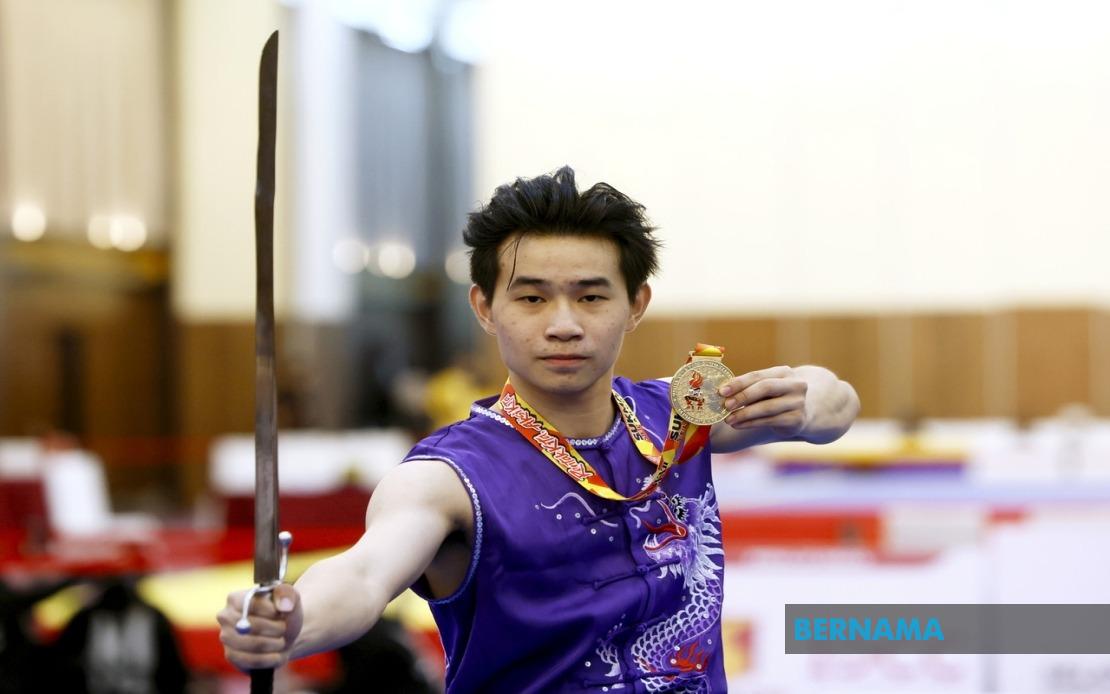
Wee Din Jun's journey to the top of the wushu podium at the 2026 Malaysia Games unfolded as a testament to athletic resilience and mental fortitude. The 21-year-old Penang competitor claimed gold in the men's nandao nangun event at the Ideal Convention Centre in Shah Alam, scoring 9.600 points to outpace Sarawak's John Phang, whose 9.563-point effort earned silver. Selangor's Tan Yu Zhe completed the medals with a bronze performance of 9.550 points. What renders this victory particularly significant is that Din Jun accomplished the feat while managing a hip injury sustained merely one month before the Games commenced, demonstrating the mental resilience required at the highest levels of competitive sport.
Din Jun's trajectory through three SUKMA editions reveals a narrative of struggle, disappointment, and ultimate vindication. His 2022 debut at the Kuala Lumpur Games yielded a bronze medal, establishing himself as a medal contender within Malaysia's wushu programme. However, the subsequent SUKMA in Sarawak during 2024 proved devastatingly difficult. Across three events, the young athlete made critical errors that culminated in returning home empty-handed, a result that left him questioning his abilities and commitment to the sport. The psychological weight of that redemption-free performance had clearly lingered, creating considerable pressure heading into his final SUKMA opportunity.
In reflecting upon his triumph, Din Jun revealed the coaching wisdom that propelled him through the mental hurdles confronting elite athletes. Rather than dwelling on the physical pain of his recent injury or the ghosts of past mistakes, his coach advised him to embrace a state of calm acceptance and performance enjoyment. This philosophical shift proved decisive. By consciously releasing his grip on the outcomes themselves and narrowing his mental focus exclusively to execution quality, Din Jun managed to transcend the technical anxiety that had plagued his 2024 campaign. His comments to Bernama underscore a maturation in his competitive mindset that frequently distinguishes champions from those who stumble when stakes elevate.
The Bayan Lepas-born athlete openly acknowledged the emotional resonance of his gold medal achievement. Throughout his SUKMA career, Din Jun had harbored an intense desire to demonstrate his capacity to claim the sport's highest individual honour at the Games. This was never merely about accumulating medals for his resume; rather, it represented a fundamental need to validate years of dedicated training and sacrifice. The gold medal served as definitive proof that his technical abilities and mental resilience could produce elite-level performances when circumstances demanded them most. The timing of this breakthrough—his final SUKMA appearance—lent the moment heightened poignancy and significance.
Din Jun also honored the coach who had guided him through critical phases of his development, despite being unable to present that mentor with a medal at the prior two Games. This former coach has since relocated to China, creating an additional layer of separation between coach and athlete. By dedicating his gold medal to this influential figure, Din Jun acknowledged the collaborative nature of athletic achievement and the reality that many people beyond the competitor themselves contribute to moments of triumph. Such public gratitude reflects both respect for the coaching profession and recognition that his personal growth as an athlete remains inseparable from those who have invested in his development.
The broader context of wushu at SUKMA 2026 positions Din Jun's achievement within Malaysia's competitive wushu landscape. Wushu represents a distinctive martial arts tradition that has become increasingly professionalized within Southeast Asia over recent decades. The competition at Shah Alam featured athletes from across Malaysia's states, demonstrating the depth of talent available domestically. Din Jun's ability to prevail against rivals like John Phang, a talented competitor from Sarawak, illustrates the caliber of wushu development occurring beyond peninsular Malaysia. The sport's inclusion at SUKMA continues to provide crucial international-level competition experience for Malaysian athletes who may eventually represent the country at continental championships and beyond.
Looking immediately forward, Din Jun faces another opportunity to conclude his SUKMA career memorably. With the nanquan event scheduled for the following day, the young athlete seeks to add additional medals to his Games haul. This final competition represents his last chance to compete at the biennial Games, potentially transforming what has been a mixed career arc into a triumphant conclusion. The nanquan form, distinguished by its more explosive and dynamic techniques compared to the nandao nangun event, could showcase different technical strengths. Should he succeed again, Din Jun would depart SUKMA with consecutive gold medals despite the physical adversity of his pre-Games injury, effectively erasing the bitter memory of his 2024 failure and cementing a positive legacy within Malaysian wushu.
The injury management aspect of Din Jun's story carries particular relevance for Malaysian sports administrators and medical teams. Sustaining a significant hip injury merely weeks before major competition presents substantial challenges, both physically and psychologically. The fact that he competed successfully despite this setback raises questions about the injury assessment protocols, physiotherapy support, and pain management strategies available to elite Malaysian athletes. Many Southeast Asian sports programmes operate with considerably fewer medical resources than developed nations, making Din Jun's performance potentially instructive for how emerging athletes can maximize training despite suboptimal circumstances. His example suggests that proper coaching guidance, mental preparation, and appropriate medical care can mitigate the performance-limiting effects of acute injuries.
For Malaysian sports fans and stakeholders monitoring SUKMA 2026, Din Jun's gold medal represents the type of redemption narrative that elevates the Games beyond mere medal-counting exercises. The human dimension of athletic competition—the setbacks, the doubts, the comebacks—resonates far more powerfully than statistics alone. His journey from 2022 bronze through 2024 disappointment to 2026 triumph encapsulates the resilience that SUKMA purportedly cultivates among Malaysian athletes. As the Games continue, stories like Din Jun's accumulate, collectively defining the tournament's cultural significance within Malaysian sport and contributing to a tapestry of memorable performances that inspire younger competitors entering the system.

