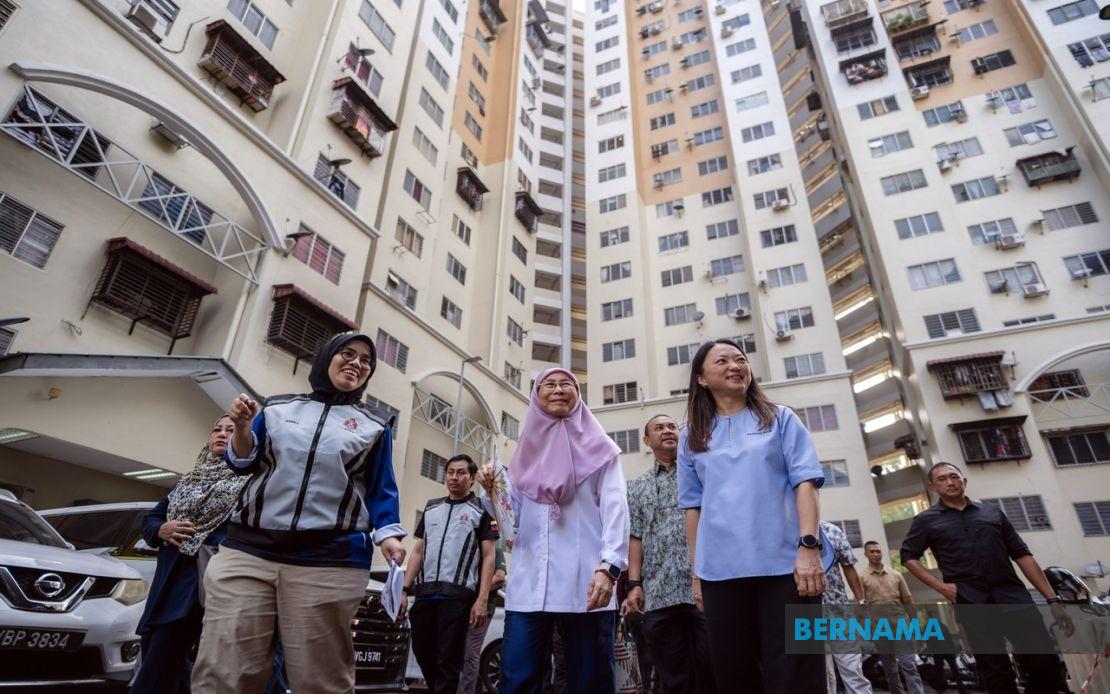
The Desa Tun Razak People's Housing Project (PPR) in Kuala Lumpur has reached completion of its comprehensive upgrading programme, positioned as a significant milestone in the federal government's broader initiative to systematically revitalise all public housing estates in the capital. The completion of this RM9.6 million project underscores the administration's commitment to transforming aging residential complexes, particularly those housing vulnerable populations who have long endured infrastructure challenges in urban centres.
According to Hannah Yeoh, the Minister in the Prime Minister's Department overseeing Federal Territories, this renovation work exemplifies a shift away from piecemeal maintenance approaches towards structured, long-term asset management. The RM300 million annual allocation approved by the government reflects consensus among Kuala Lumpur's parliamentary representatives to prioritise systematic upgrades rather than reactive repairs. This strategic reorientation carries implications for public housing governance across Malaysia, suggesting a template that state governments and local authorities might examine when evaluating their own maintenance protocols for subsidised residential schemes.
The Desa Tun Razak facility, which has served residents since 1998, accommodates more than 8,000 people whose safety and living conditions depend directly on the quality of structural and mechanical systems. Yeoh's emphasis on establishing dedicated maintenance funding mechanisms addresses a persistent weakness in Malaysian public infrastructure management—the distinction between capital project completion and sustained operational care. Without ringfenced budgets, deterioration accelerates, creating safety hazards and eroding the social value of government housing investments.
The specific works undertaken at Desa Tun Razak reveal the acute technical deficiencies that had accumulated across two decades of operation. Electrical wiring replacement addresses fundamental fire risk, while road resurfacing tackles accessibility and safety for residents with mobility limitations. These upgrades were catalysed partly by a series of fire incidents that occurred at PPR facilities during the previous year, incidents that underscored how deferred maintenance directly translates into loss of life and property. The fire safety enhancements, including upgraded riser systems and drainage infrastructure, represent responses to crises that should have prompted preventive investment far earlier.
Kuala Lumpur Mayor Datuk Fadhlun Mak Ujud provided granular detail on resource allocation, revealing that the bulk of spending—RM7 million of the RM9.6 million total—went toward repainting and cosmetic restoration. This distribution suggests prioritisation of visual presentation alongside functional safety, a balance that makes sense for resident morale and community pride but also indicates that purely operational expenditures consumed less than three-quarters of the budget. The RM1.68 million devoted to fire prevention and electrical systems, supplemented by nearly RM1 million for road work, demonstrates that critical safety upgrades remain comparatively expensive relative to aesthetic improvements.
The broader context involves 22 projects already completed from a pipeline of 61 planned upgrades across Kuala Lumpur's public housing stock. Fadhlun's projection that all upgrades would conclude by year-end represents an accelerated timeline that, if realised, would signal genuine administrative capacity and political will. However, the management of 61 concurrent or sequential major renovations across different estates creates logistical complexity and the potential for quality compromise if timelines prove overly optimistic. Malaysian readers familiar with infrastructure delivery will recognise the risks inherent in compressed schedules, particularly when engaging multiple contractors and managing disruption to occupied residential spaces.
Parking scarcity at Desa Tun Razak presents a secondary infrastructure challenge that upgrading projects alone cannot resolve. The commitment by Kuala Lumpur City Hall to identify temporary parking sites acknowledges this constraint while suggesting that permanent solutions remain undetermined. This gap illustrates how PPR residents often experience infrastructure provision as incomplete—they may gain improved electrical systems and better roads yet continue struggling with inadequate parking, limited commercial facilities, and reduced green space compared to residents in mixed-income neighbourhoods. Urban equity considerations thus extend beyond physical asset maintenance to questions of service completeness.
Bandar Tun Razak Member of Parliament Datuk Seri Dr Wan Azizah Wan Ismail's appeal to residents to preserve upgraded facilities touches on a critical dimension of public housing success—user stewardship. Government investment means little if residents lack incentives or cultural frameworks supporting maintenance. This framing of responsibility also contains potential risk: it can shift accountability for facility preservation from institutional managers to residents, particularly in contexts where resident incomes constrain their ability to contribute to collective maintenance. The sustainability of PPR improvements depends on institutional mechanisms rather than exhortations to civic virtue alone.
For Malaysian observers and policymakers, the Desa Tun Razak completion signals an evolution in how federal authorities approach public housing. The emphasis on dedicated funding, multi-year planning, and comprehensive rather than emergency maintenance reflects international best practices in social housing management. Whether this approach proves generalisable to other states, or remains concentrated in federal territories where centralised governance facilitates coordination, will determine its longer-term impact on housing security across Malaysia's lower-income population. The RM300 million commitment, while substantial, remains modest relative to the estimated backlog of deferred maintenance across Malaysia's entire PPR network, numbering in the billions of ringgit.

