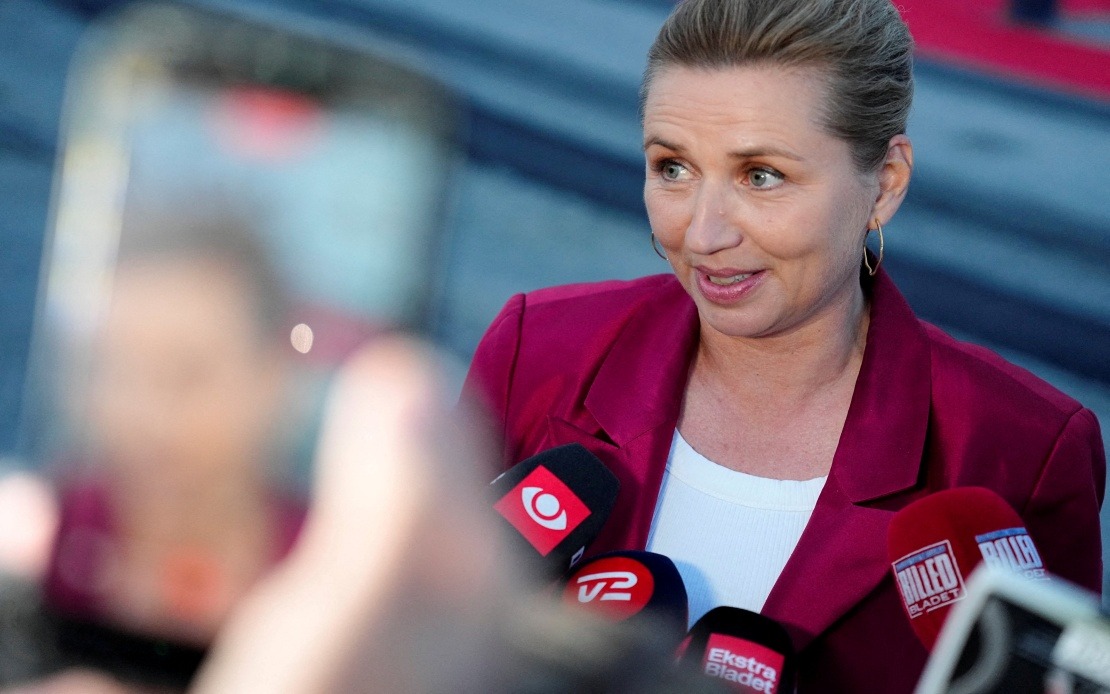
Danish Prime Minister Mette Frederiksen has categorically ruled out any possibility of ceding Greenland to American control, drawing a clear line in response to provocative remarks from US President Donald Trump. Speaking at the NATO leaders' summit in Ankara on Wednesday, Frederiksen stressed that the Arctic territory remains firmly under Danish sovereignty and is absolutely not available for acquisition by any foreign power, regardless of their geopolitical standing.
The Danish leader's unequivocal position came after Trump declared during the same NATO gathering that Greenland "needs to be controlled by the United States, not by Denmark." Trump's statement, delivered in Ankara on Tuesday, rekindled an old proposal that has periodically surfaced in American political discourse. The suggestion that the Nordic nation might somehow transfer its vast northern territory to Washington reflects a view of geopolitics that many European allies find antiquated and unsettling, particularly given the alliance's emphasis on respecting established borders and territorial arrangements.
Frederiksen's response underscored three fundamental principles that undergird contemporary international relations: the inviolability of sovereign borders, the democratic right of peoples to determine their own futures, and the binding commitments embedded in collective security arrangements. She emphasised that all NATO members, including the United States, must respect these pillars. The prime minister specifically highlighted the Greenlandic people's inherent right to self-determination, a principle that resonates deeply across the international community and particularly within the European sphere, where post-war stability has rested upon recognition of territorial integrity.
When directly questioned about Denmark's capacity to defend Greenland militarily against potential threats, Frederiksen invoked Article 5 of the North Atlantic Treaty, the cornerstone of NATO's collective defence architecture. This mechanism stipulates that an armed attack against one member constitutes an attack against all members, binding the alliance to mount a unified response. By explicitly referencing this provision, Frederiksen conveyed a powerful message: any military threat to Greenlandic territory would automatically trigger NATO's collective defence obligations, thereby drawing the entire alliance into the conflict. Her statement essentially placed Greenland under the umbrella of NATO protection, making any unilateral American military seizure virtually unthinkable within the alliance framework.
The Danish prime minister's declaration carries particular significance within Southeast Asian contexts, where territorial disputes and questions of sovereignty remain acutely sensitive. For Malaysian readers and regional observers, Denmark's firmness represents a template for how smaller nations can marshal international law, alliance commitments, and diplomatic clarity to resist coercive pressures from more powerful actors. The region faces its own territorial challenges—from the South China Sea disputes to maritime demarcation disagreements—making Frederiksen's principled stand relevant beyond European boundaries.
Greenland's strategic importance has grown substantially with climate change. As Arctic ice recedes, the massive island becomes increasingly valuable for resources, shipping routes, and military positioning. This explains the recurring American interest in the territory, which stretches back decades. However, the contemporary international legal order firmly prohibits territorial acquisition through coercion or purchase, a norm established precisely to prevent the kinds of imperialist practices that dominated earlier centuries. Trump's suggestion thus represents a significant departure from the diplomatic norms that have governed international conduct since 1945.
Denmark's position also reflects broader European anxiety about American reliability within NATO. Following Trump's previous tenure as US president, during which he questioned American commitment to the alliance and threatened to withdraw from NATO, European members have grown increasingly cautious about the stability of transatlantic commitments. Trump's Greenland remarks, whether serious or rhetorical, reinforce European concerns that the United States may harbour unorthodox views about territorial arrangements and alliance obligations. For NATO cohesion, such pronouncements create friction at a moment when the alliance faces genuine security challenges from Russian assertiveness.
The Greenland question also raises practical questions about how NATO functions when one member's leadership makes territorial claims against another member's sovereignty. Frederiksen's invocation of Article 5 effectively places this question under NATO law rather than bilateral US-Danish relations. This transforms what might otherwise be a diplomatic dispute into a matter touching the entire alliance's foundational commitments. No NATO member can reasonably support one member's territorial claims against another while remaining consistent with collective defence principles.
Frederiksen's calm but firm response contrasts sharply with Trump's provocative tone, establishing Denmark as a voice of principle in transatlantic relations. She did not engage in recriminations or accusations but instead simply restated the legal and moral foundations that underpin modern international order. This approach—combining clarity about Denmark's position with diplomatic restraint—models how smaller nations can defend their interests without unnecessarily escalating tensions.
For Malaysia and other Southeast Asian nations watching this exchange, the takeaway is instructive: alliance commitments, international law, and diplomatic unity represent powerful tools for protecting territorial sovereignty even when facing pressure from militarily superior powers. Denmark's effective invocation of NATO structures demonstrates that membership in strong collective security arrangements provides tangible protection against coercive territorial demands. The contrast between Denmark's clear legal position and Trump's suggestion that territory might be available for purchase under the right circumstances highlights the enduring tension between nineteenth-century great power politics and twenty-first century international norms.

