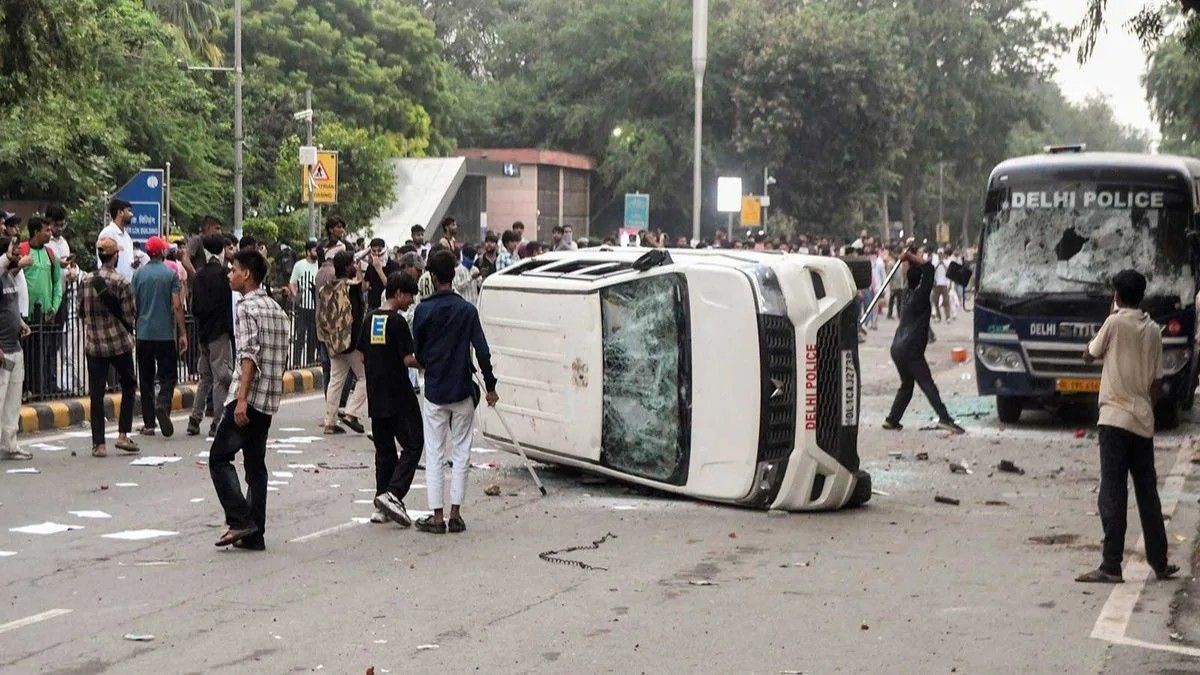
Delhi Police have initiated legal action against demonstrators involved in Monday's violent disruptions linked to the Cockroach Janta Party's parliamentary march, registering ten separate first information reports across multiple jurisdictions in New Delhi's central district. The charges encompass a range of alleged offences including assault against security personnel, unauthorised drone operations, conspiracy, obstruction of government functions, and destruction of public infrastructure. The breadth and distribution of these cases—filed across Parliament Street, Connaught Place, Mandir Marg, Barakhamba Road, and Kartavya Path police stations—suggests authorities are treating the demonstrations as a coordinated challenge to public order rather than isolated incidents.
The protest action centred on demands that Union Education Minister Dharmendra Pradhan resign over allegations of examination system failures. The demonstrators, who maintained their sit-in at Jantar Mantar into Tuesday despite overnight removal of tents and staging by security forces, represent a broader pattern of civil disobedience over governance and institutional accountability issues that resonate across Indian politics. For Malaysian observers, the incident illustrates how street mobilisation in India's capital can escalate quickly when institutional disputes intersect with public participation, contrasting with the more controlled regulatory environment governing demonstrations in Southeast Asia.
A significant complication in the Delhi incident has been the proliferation of unverified videos circulating on social media platforms, prompting the Deputy Commissioner of Police for New Delhi to issue formal clarification denying reports of fresh stone-pelting or police action on Tuesday. The authorities characterised circulating footage as "false and misleading," urging citizens to treat only official police communications as reliable sources. This digital disinformation dimension reflects contemporary challenges facing law enforcement globally, where narrative control has become as contested as physical management of public spaces. The police acknowledgment of needing to counter false claims suggests the Cockroach Janta Party's supporters and sympathisers possessed sufficient social media capacity to generate and amplify alternative versions of events.
Investigative efforts have expanded beyond immediate arrests, with Delhi Police examining more than 250 video recordings to identify participants and assess whether the violence followed a pre-planned conspiracy rather than representing spontaneous crowd reaction. This investigative scope indicates authorities are treating the protest as potentially reflecting organisational strategy rather than organic anger. One particularly serious charge involves an alleged life-threatening assault on a Rapid Action Force personnel during Monday's clashes, suggesting the confrontation between security and demonstrators involved genuine physical danger rather than symbolic posturing.
The unauthorised drone operation during Parliament's session represents a distinct security concern, indicating either demonstrator sophistication or infiltration by elements seeking to weaponise the protest for purposes beyond the stated demand regarding the Education Minister's resignation. This dimension carries particular significance for countries like Malaysia, where aerial surveillance and airspace security remain sensitive issues given terrorism and smuggling concerns affecting the region. The inclusion of drone-related charges under Indian law suggests authorities view this as a security rather than merely political matter.
The Cockroach Janta Party spokesperson Ashutosh Ranka has framed the continuing protest as non-negotiable, maintaining the demonstration will persist until the party's core demand receives satisfaction. Simultaneously, the party has catalogued alleged brutality during Monday's encounters, citing injuries among student activists and volunteers alongside claims that women demonstrators, including Geetanjali J. Angmo—identified as activist Sonam Wangchuk's wife—experienced mistreatment. These counterclaims position the party narrative within a broader discourse regarding proportionality of state force and protection of protest rights, familiar arguments in Indian political discourse but also increasingly relevant across South Asia where street activism remains contentious.
Delhi Police characterisations of Monday's behaviour as "unruly, aggressive and violent" despite multiple warnings and standing prohibitory orders establish the official baseline: demonstrators knowingly violated restrictions and escalated confrontation. The invocation of the newly codified Bharatiya Nyaya Sanhita alongside traditional offences like obstruction of government work and assault frames the case within India's modernised legal framework while maintaining traditional public order concerns. The inclusion of the Prevention of Damage to Public Property Act suggests property destruction formed a material component of the charges rather than merely peripheral consequence.
The heavy continued deployment of Delhi Police and Rapid Action Force personnel at Jantar Mantar on Tuesday signalled authorities' determination to prevent renewed escalation while the site remained occupied. This sustained security posture reflects the challenge of managing indefinite protest occupations in politically sensitive urban locations, particularly when the demonstrators' stated precondition for dispersal—a government minister's resignation—requires political rather than police resolution. The removal and replacement of protest infrastructure overnight demonstrates tactical police adaptation aimed at disrupting organisational capacity without triggering renewed confrontation.
For regional observers in Southeast Asia, the Delhi incident illuminates several dimensions of Indian democratic practice worth noting. First, India's capacity to process protest violence through criminal law remains robust despite scale and complexity; ten coordinated FIRs across multiple stations reflect institutional capacity. Second, the social media dimension—both the spread of unverified videos and authorities' felt need to counter narratives—reflects how contemporary street politics intersect with digital platforms in ways transcending purely physical confrontation. Third, the scale of video analysis undertaken, examining more than 250 recordings, demonstrates the technological infrastructure available to Indian law enforcement for identifying and tracking participants in mass protests.
The distinction between Monday's documented violence and Tuesday's alleged fresh incidents highlights a critical enforcement question: whether police successfully contained the situation through Tuesday or whether the violence genuinely ceased. The very necessity of authorities denying Tuesday incidents suggests sufficient ambiguity existed that social media could generate alternative narratives. This interpretive space, where citizens and officials contest what objectively occurred, remains characteristic of India's polarised political environment where institutional credibility varies considerably across demographic and ideological lines.
The protest's continuation despite overnight security interventions indicates demonstrators possessed sufficient commitment and organisational capacity to maintain pressure after initial confrontation. The positioning of women activists including Sonam Wangchuk's family members suggests the Cockroach Janta Party deliberately incorporated high-profile figures to both legitimise the protest and potentially deter aggressive police response, a tactical sophistication often underestimated by observers of Indian street activism. Whether this political theatre surrounding a specific policy demand ultimately influences ministerial decisions remains uncertain, but the ten FIRs and ongoing investigation ensure the participants will face legal consequences extending well beyond the protest's resolution.

