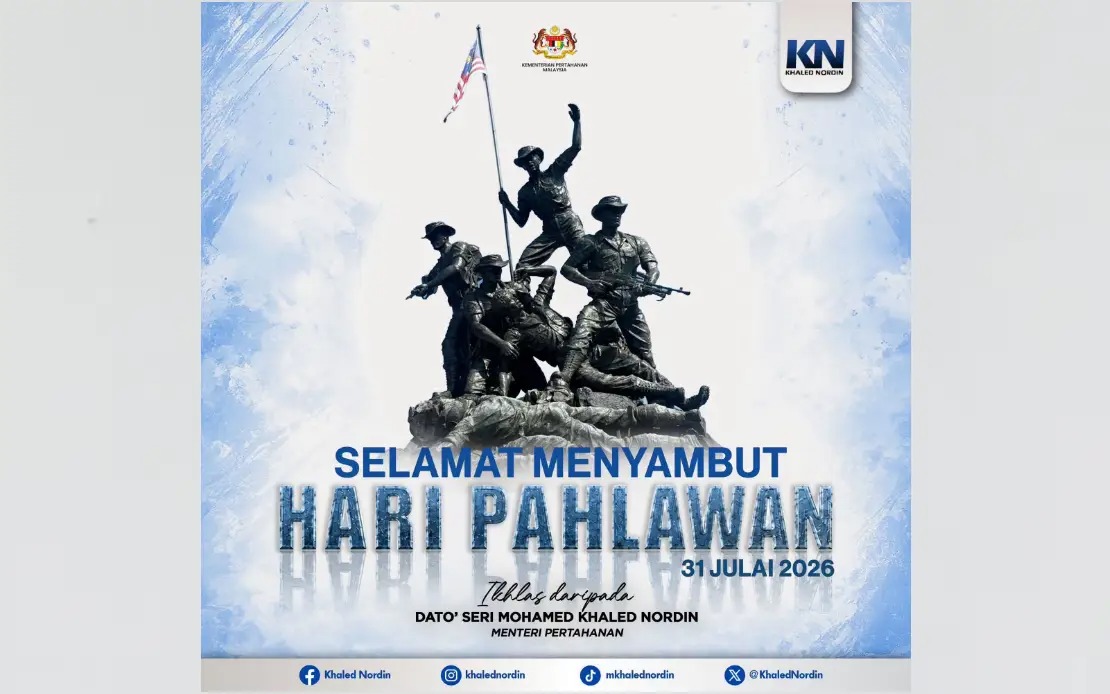
The responsibility for protecting Malaysia's sovereignty extends far beyond the military and police, Defence Minister Datuk Seri Mohamed Khaled Nordin has emphasised, calling for a whole-of-nation approach to national defence and security. In his address commemorating Warriors' Day 2026 on July 31, Mohamed Khaled underscored that every citizen plays a crucial role in ensuring the country's territorial integrity and continued prosperity, even without taking direct military action.
Mohamed Khaled articulated a vision of collective guardianship rooted in the concept of Total Defence, or HANRUH in its Bahasa Malaysia acronym. This framework transcends traditional notions of defence that concentrate authority and responsibility within military and paramilitary institutions. Instead, it recognises that national resilience emerges when communities actively participate in reinforcing the bonds that hold the nation together. The Defence Minister's remarks reflect a strategic pivot towards mobilising the entire population as stakeholders in Malaysia's security architecture, acknowledging that threats to sovereignty manifest across multiple dimensions—not merely at the physical borders or through kinetic military responses.
Citizens can discharge their patriotic duties through several interconnected channels, according to Mohamed Khaled. The cultivation and demonstration of patriotism—a deliberate commitment to the nation's wellbeing and advancement—forms the bedrock of this collective defence posture. Equally significant is the strengthening of national unity, particularly crucial in a multiethnic, multi-religious democracy like Malaysia where social cohesion directly contributes to institutional stability. Supporting the security forces materially and morally, whether through respect, compliance with lawful directives, or public backing for their operations, represents another dimension of civilian participation. Equally important is the obligation to refrain from actions that could undermine sovereignty, such as engaging in sedition, compromising classified information, or pursuing divisive agendas that weaken national resolve.
The Defence Minister's emphasis on Total Defence resonates with a broader Southeast Asian security challenge. In a region traversed by competing geopolitical interests and vulnerable to asymmetric threats ranging from maritime piracy to cyber intrusions, the traditional model of state-centric defence has become increasingly inadequate. Malaysia, with its strategic location along major shipping lanes and its considerable maritime zone, faces multifaceted security pressures that cannot be addressed through military capability alone. The integration of civilian awareness, commercial sector vigilance, and community-level resilience creates multiple layers of protection that complement conventional defence mechanisms.
Mohamed Khaled's address also served to honour the contributions of those who have borne the heaviest burden in protecting the nation. By acknowledging the courage and sacrifices of members of the Malaysian Armed Forces, the Royal Malaysia Police, and veterans, he anchored his call for collective responsibility within a framework of gratitude and remembrance. These figures have built the foundations upon which contemporary Malaysians enjoy relative peace and economic opportunity. Their willingness to place national interest above personal safety demonstrates an exemplary commitment that civilians are encouraged to emulate within their own spheres of influence and capability.
The timing of Warriors' Day 2026, observed annually on July 31, provided an appropriate moment to refresh this conversation about national defence and collective responsibility. The ceremonial marking of this day serves not merely as historical commemoration but as an annual opportunity to rekindle national consciousness about sovereignty and the ongoing effort required to maintain it. For many Malaysians, particularly younger generations who have known only peacetime, the significance of these commemorations can fade unless actively reinforced through sustained messaging and education.
The Defence Minister's vision extends beyond contemporary circumstances to project concerns about long-term sustainability of Malaysia's sovereign status. As the region faces evolving security challenges—from transnational criminal networks to environmental pressures affecting territorial claims—the psychological and social infrastructure that binds citizens together becomes increasingly valuable. A population that collectively understands and accepts responsibility for sovereignty becomes more resistant to internal fragmentation and external manipulation. This represents a sophisticated understanding of national security that recognises its social and psychological dimensions alongside its material and technological aspects.
The call for universal participation in defending sovereignty also carries implications for governance and state-society relations in Malaysia. When the government explicitly identifies citizens as partners in national defence rather than merely subjects to be protected, it establishes a more reciprocal relationship predicated on mutual obligations. Citizens accept responsibilities for national wellbeing; in return, the state commits to serving the public interest and maintaining the conditions necessary for prosperous coexistence. This framing can strengthen civic engagement and potentially enhance social cohesion during periods of external stress or internal tension.
For Malaysian businesses and institutions, Mohamed Khaled's remarks carry practical significance. The private sector's role in maintaining infrastructure security, protecting critical information systems, and reporting suspicious activities contributes directly to national resilience. Educational institutions shape the patriotic consciousness of future generations. Media organisations help maintain an informed citizenry capable of recognising and rejecting propaganda or divisive messaging. Cultural organisations preserve and transmit the shared values that underpin national identity. Each sector, through its particular functions and influence, participates in the broader defence of sovereignty.
The Defence Minister's vision ultimately reflects an understanding that in an interconnected world, sovereignty is not primarily threatened by full-scale invasion but by gradual erosion—through economic dependency, informational manipulation, social fragmentation, and institutional decay. Defending against these diffuse threats requires the alertness, integrity, and commitment of the entire population. When every Malaysian internalises responsibility for protecting the nation's interests and wellbeing, the cumulative effect creates resilience that no military force, however well-equipped, could achieve in isolation. Mohamed Khaled's emphasis on Total Defence thus represents not merely a rhetorical flourish but a strategic necessity for a modern nation navigating complex security environments.

