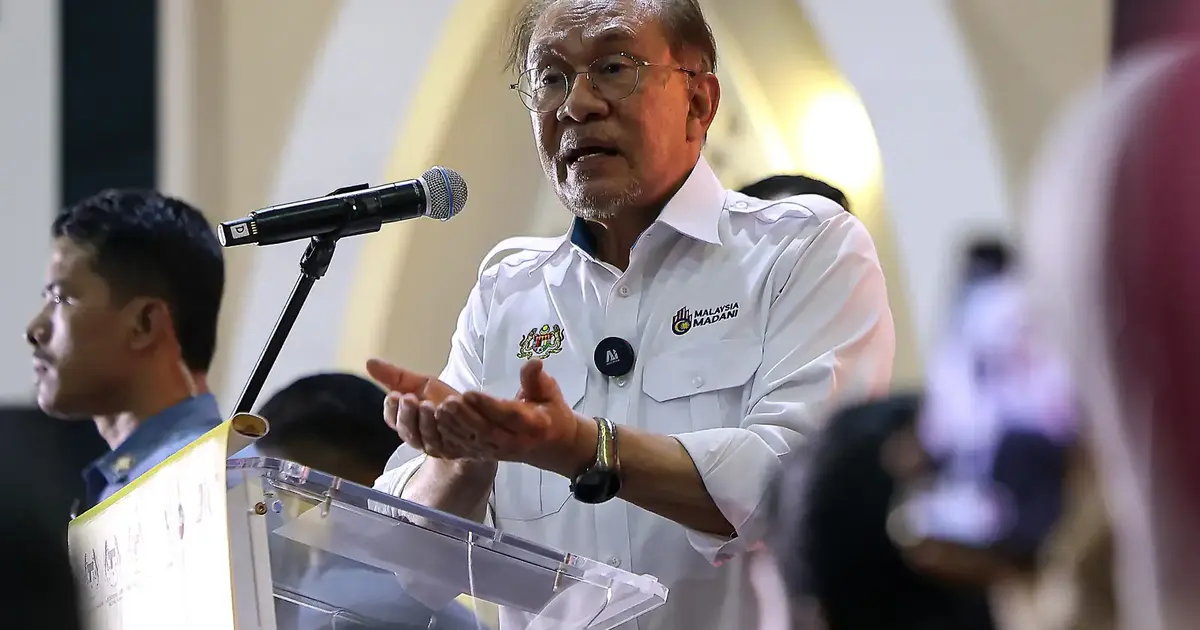
Prime Minister Anwar Ibrahim has pushed back against the notion that championing the rights and interests of Malaysia's Chinese and Indian communities necessarily erodes the constitutional protections afforded to the Malay-Muslim majority, offering a carefully calibrated argument about pluralism and constitutional federalism that sits at the centre of Malaysian political discourse.
Anwar's remarks represent an attempt to navigate the historically fraught terrain of communal politics in Malaysia, where tensions between majority protections and minority safeguards have long defined electoral competition and policy debates. His position suggests that advancing the welfare of non-Muslim, non-Malay citizens need not come at the expense of Article 153 of the Federal Constitution, which enshrines special provisions for Malays and Islam, a cornerstone arrangement since independence in 1957.
The prime minister's intervention appears calculated to address anxieties within segments of the Malay-Muslim electorate who fear that his administration's emphasis on inclusive governance and human rights standards could gradually erode the constitutional bargain that has underpinned Malaysia's stability. These concerns have been periodically articulated by conservative politicians and civil society groups who view any expansion of minority rights as an implicit contraction of Malay prerogatives, creating what they frame as a zero-sum competition for constitutional space and political influence.
By asserting that minority protection is compatible with Malay-Muslim constitutional privilege, Anwar is attempting to rebrand multiethnic cooperation not as a threat to majoritarian interests but as a framework that strengthens social cohesion and economic productivity. This framing reflects his broader political philosophy, which emphasises cross-communal dialogue and shared governance rather than the explicit communal mobilisation that has characterised much of Malaysian politics since the 1969 racial riots.
The controversy around minority rights protection reflects deeper anxieties within Malaysian society about demographic change, economic competition, and the interpretation of the Federal Constitution. For many Malays, particularly in rural areas and among younger voters seeking greater religious observance in public life, any dilution of Article 153 protections represents an existential threat to their historical privileges and religious sovereignty. Anwar's statement thus functions partly as reassurance that his administration respects constitutional boundaries even as it pursues a more inclusive political agenda.
However, his position also faces scepticism from both ends of the political spectrum. Opposition groups have occasionally suggested that he has been insufficiently aggressive in defending minority interests, while conservative Malay-Muslim politicians argue that any prioritisation of non-Muslim concerns represents a departure from the founding constitutional arrangement. This dual criticism reflects the genuine difficulty of balancing competing communal interests within Malaysia's plural but constitutionally asymmetrical system.
For Chinese and Indian Malaysians, Anwar's reassertion of minority advocacy holds particular significance. These communities, who constitute roughly 24 per cent and 7 per cent of the population respectively, have historically experienced periods of political marginalisation and discrimination in education, employment, and business licensing. Their representation in government remains proportionally limited, and their concerns regarding vernacular education, religious freedom, and economic opportunity frequently receive secondary consideration in policy-making processes dominated by Malay-Muslim voices.
Anwar's coalition government depends significantly on support from non-Malay, non-Muslim voters and political parties, particularly from Chinese-majority constituencies and the Malaysian Indian Congress. Any retreat from his stated commitment to minority welfare would therefore carry immediate electoral consequences, threatening the delicate balance of his parliamentary majority. His reaffirmation of this position reflects not merely ideological conviction but also the hard mathematics of coalition politics in a fractionalised parliament.
The timing of his remarks suggests a response to recent political pressure from Malay-Muslim constituencies expressing concern about perceived preferential treatment of minorities in government appointments and policy implementation. Some youth wings of ruling coalition parties have voiced nationalist sentiments that echo calls for greater protection of Malay-Muslim prerogatives, reflecting generational shifts in how communal identity interacts with political competition. Anwar's intervention attempts to establish a rhetorical framework wherein both majority protection and minority welfare can coexist within constitutional bounds.
From a Southeast Asian perspective, Malaysia's experience with managing majority-minority relations offers both lessons and warnings. Unlike other regional democracies facing similar plural societies, Malaysia has embedded constitutional protections for majorities while nominally extending rights to minorities—a model that theoretically permits inclusive governance without dismantling foundational privileges. However, the practical implementation of this model has often resulted in minority marginalisation, as majorities have leveraged their constitutional advantages to monopolise state resources and policy direction.
Anwar's articulation of a complementary rather than competitive relationship between majority and minority rights thus carries implications beyond domestic Malaysian politics. If successfully operationalised, it could demonstrate a governance model for plural societies elsewhere in Southeast Asia and globally. Conversely, if communal tensions intensify despite his rhetorical efforts, Malaysia's experience would suggest that formal constitutional arrangements alone cannot sustain intercommunal peace without active political commitment to substantive equality and minority inclusion.
Moving forward, the credibility of Anwar's position will depend on observable policy outcomes and resource allocation across communal lines. Rhetorical affirmations of minority rights carry limited weight if not accompanied by institutional reforms, equitable civil service recruitment, and equitable funding for minority-language education and community development. The prime minister's intellectual framework may be sound, but its acceptance hinges on whether Malaysian citizens of all communities perceive tangible benefits flowing from his stated commitment to balanced constitutional pluralism.

