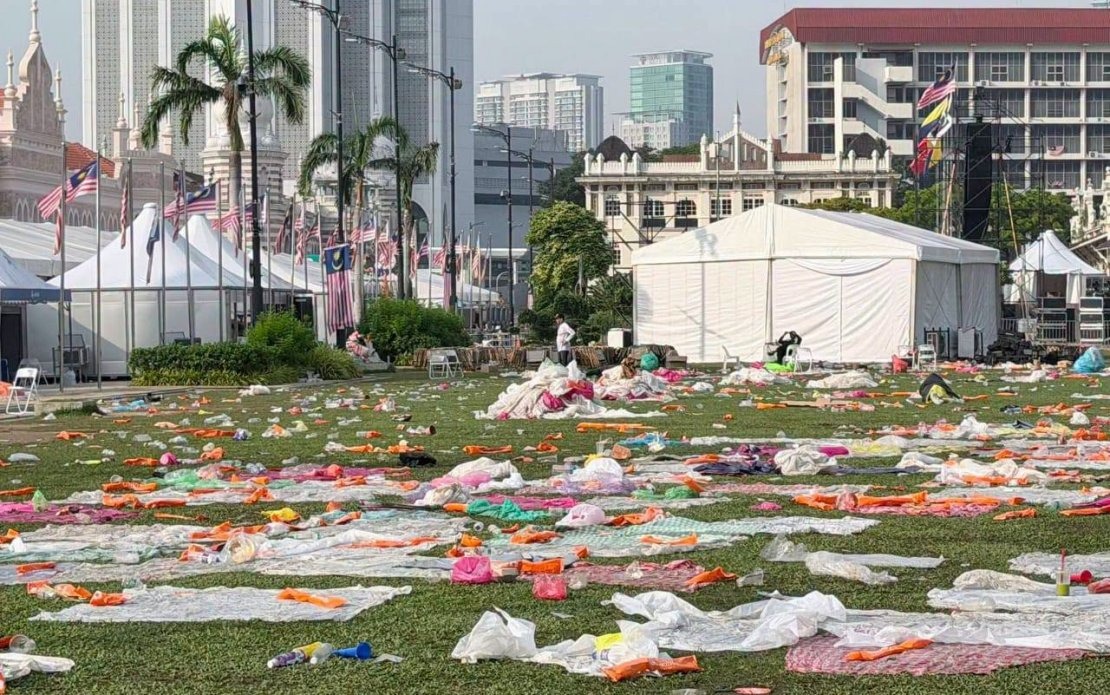
Kuala Lumpur City Hall (DBKL) is mobilizing its cleaning teams to restore Dataran Merdeka following the departure of massive crowds who gathered early yesterday morning to watch Spain defeat Argentina 1-0 in the 2026 FIFA World Cup final. The iconic venue, which holds deep symbolic significance as a symbol of national pride and history, became an impromptu open-air stadium for the occasion, drawing more than 25,000 enthusiastic football supporters. However, the celebration came at a cost: the grounds were left strewn with litter, prompting DBKL to address what it describes as an unfortunate consequence of the event.
In a Facebook statement, DBKL acknowledged the cleanup operation while delivering a pointed message about civic responsibility. The authority expressed dismay at the condition of the site following the festivities, noting that although thousands had gathered in the early hours to celebrate the sport and share in the excitement, the departure of those crowds left behind a landscape marred by accumulated waste. This disconnect between the joy of the occasion and its aftermath became the focal point of DBKL's public communication, suggesting that the authority views the incident as symptomatic of a broader issue affecting the capital's cleanliness and image.
The statement from DBKL articulated a philosophical concern about the relationship between public spaces and collective responsibility. Officials stressed that the tidiness of Malaysia's capital city cannot and should not be measured solely by the cleanup efforts of municipal staff, but rather by the conscious choices of citizens and visitors themselves. In framing the matter this way, DBKL sought to shift accountability back to the public, emphasizing that relying on government workers to restore shared spaces after they have been soiled represents a failure of individual civic consciousness.
Dataran Merdeka holds particular resonance in Malaysia's national narrative. As the historic field where independence celebrations took place and where national ceremonies continue to be held, the venue embodies the dignity and heritage of the country. DBKL's messaging emphasized that how residents and visitors treat this space—and by extension, all public areas—reflects their valuation of the nation itself. The authority framed the issue not merely as a cleanliness problem but as one touching on national identity and collective pride.
The underlying argument in DBKL's statement carries implications that extend beyond the immediate cleanup required after the World Cup broadcast event. Officials suggested that celebrating with enthusiasm and expressing joy at sporting events are entirely legitimate, but that such freedom comes with corresponding responsibilities. The phrase "the freedom to be happy does not mean the freedom to dirty a shared space" encapsulates this perspective, positioning environmental stewardship as an intrinsic component of responsible citizenship rather than an optional courtesy.
For Malaysian readers, the incident at Dataran Merdeka raises questions about how the nation manages the growing intersection of large public gatherings and environmental maintenance. As sports events increasingly attract crowds to public spaces throughout the region, cities face escalating challenges in balancing access and celebration with preservation. The World Cup final broadcast drew an unusually large assemblage for a screening event, suggesting that global sporting occasions have the capacity to mobilize unprecedented numbers of people in public venues.
The authority's call for the public to view Kuala Lumpur as their own home that requires collective care reflects a governance philosophy increasingly common across Southeast Asian cities. Rather than positioning municipal staff as solely responsible for public space maintenance, DBKL is attempting to cultivate a culture where citizens internalize stewardship obligations. This approach, however, requires sustained public education and cultural shift—changes that cannot be achieved through single events or isolated appeals.
The incident also illuminates the practical challenges that rapid, large-scale crowd management presents to urban authorities. When more than 25,000 people converge in a single location with limited notice—as occurred during the World Cup final broadcast—providing adequate waste management infrastructure and collection points becomes logistically complex. Whether DBKL had anticipated such numbers and positioned sufficient rubbish receptacles at Dataran Merdeka remains unclear from available statements, though the scale of littering suggests potential gaps in preparedness.
Moreover, the timing of the World Cup final broadcast—described as occurring early in the morning—raises questions about the balance between celebrating international sporting moments and maintaining public space integrity. As Malaysia and other Southeast Asian nations increasingly host live public broadcasts of global events, cities must develop protocols that enable celebration while minimizing environmental impact. This could involve advance coordination with potential attendees, provision of waste collection volunteers, and post-event recovery procedures.
For DBKL and municipal authorities throughout Malaysia, the Dataran Merdeka incident offers a teachable moment about the need for comprehensive public space management strategies. Such approaches might include clearer signage about waste disposal during events, deployment of additional collection teams during anticipated large gatherings, and public messaging that preemptively emphasizes civic responsibility. The authority's current statement, while morally pointed, represents reactive communication rather than proactive management.
The broader context for Malaysian urban governance involves reconciling the desire to host major public celebrations and foster community engagement with the practical realities of maintaining shared spaces. Citizens increasingly expect their cities to facilitate public gatherings while authorities must balance this expectation against operational and environmental constraints. The resolution of this tension requires both institutional investment in infrastructure and genuine shifts in public consciousness about shared civic responsibilities.

