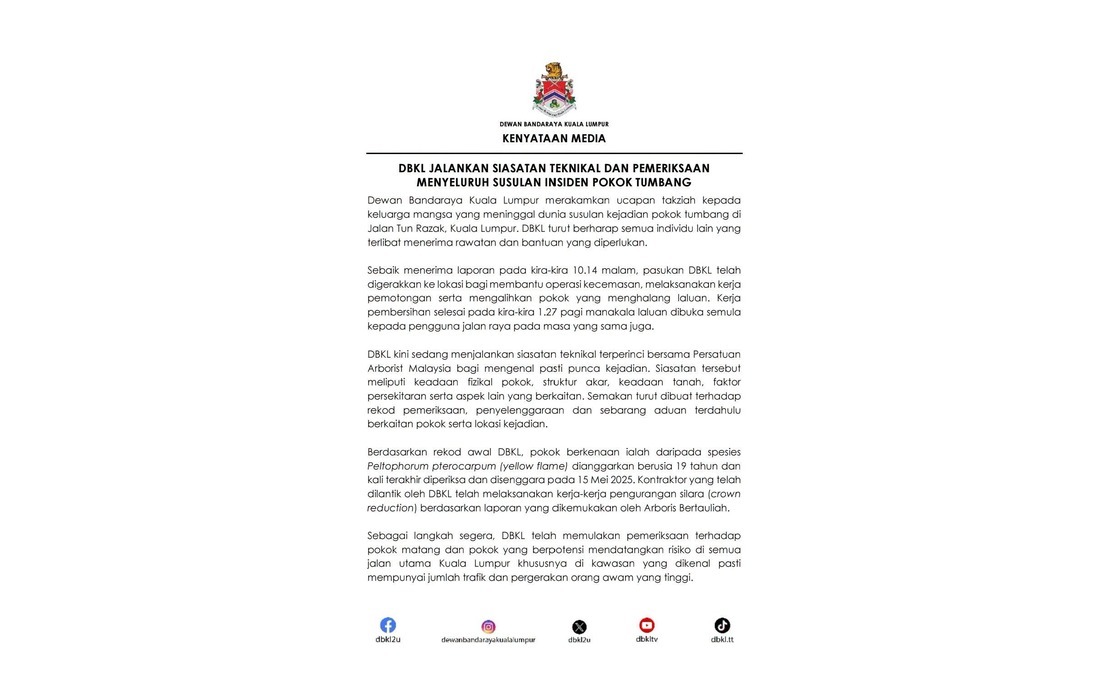
A fatal tree fall on Jalan Tun Razak in Kuala Lumpur has prompted city authorities to undertake an extensive technical investigation into what caused the 19-year-old Peltophorum pterocarpum—commonly known as Yellow Flame—to topple suddenly and claim the life of a local resident. Kuala Lumpur City Hall (DBKL) is collaborating with the Malaysian Society of Arborist to conduct a thorough examination of multiple contributing factors, signalling a serious commitment to understanding how such a preventable tragedy occurred and what systemic improvements are needed to protect the public.
The investigation will scrutinise the tree's structural integrity, including its root systems and the surrounding soil composition, whilst also analysing environmental pressures that may have destabilised the specimen. Investigators will review all prior inspection records, maintenance logs, and any previous complaints lodged about the tree or its location. This multifaceted approach reflects growing recognition among municipal authorities that tree failures rarely stem from a single cause but rather from a convergence of biological, environmental, and maintenance-related factors that compound over time. The incident occurred at 10.14 pm on July 19, prompting an immediate emergency response that cleared the roadway by 1.27 am the following morning.
According to DBKL records, the Yellow Flame tree had last undergone inspection and maintenance on May 15, just two months prior to the incident. The appointed maintenance contractor had previously executed crown reduction works—the selective pruning of upper branches—based on assessments conducted by a certified arborist. Despite these interventions, the tree evidently harboured structural weaknesses that remained undetected. This discovery raises uncomfortable questions about the adequacy of current inspection protocols and the expertise of personnel conducting such assessments, particularly given that crown reduction is typically performed to reduce wind resistance and load on a tree's main structure.
The tragedy has catalysed a sweeping urban forestry initiative across Kuala Lumpur's commercial and residential corridors. DBKL has initiated urgent inspections targeting mature trees and specimens deemed to carry heightened risk of failure along the city's principal thoroughfares, with particular attention to routes experiencing heavy vehicular traffic and concentrated pedestrian movement. The preliminary inspection programme encompasses Jalan Ampang, Jalan Sultan Ismail, Jalan Raja Laut, Jalan Datuk Keramat, and further sections of Jalan Tun Razak itself. Eight dedicated teams, comprising five qualified arborists alongside supporting staff, have been mobilised to complete this initial assessment phase within a ten-week timeframe—a compressed schedule reflecting the urgency of the situation.
Looking beyond immediate crisis management, DBKL is pursuing a medium-term preventive strategy centred on technological innovation. The authority is awaiting certification from SIRIM, Malaysia's standards and industrial research institute, to deploy 400 advanced tree monitoring sensors throughout the city in phased installations. These devices represent a paradigm shift in urban forestry management, moving away from periodic manual inspections toward continuous real-time surveillance of tree health and structural stability. The sensors will track soil conditions, moisture retention levels, and any movement within the tree's structural framework, whilst simultaneously monitoring the cumulative stress imposed by severe weather events such as torrential rainfall and flash flooding—increasingly common phenomena in Malaysia's tropical climate.
The sensor deployment strategy is being concentrated initially at four strategically important locations: Jalan Bangsar, Dataran Merdeka, Jalan Ampang, and Jalan Raja Chulan. These sites were presumably selected based on high foot traffic volumes, proximity to commercial or residential zones, and historical data suggesting elevated risk profiles. By instrumenting these zones first, DBKL can gather baseline data on sensor performance and refine installation protocols before rolling out the broader network. This pilot approach suggests lessons learned from the Jalan Tun Razak incident will be systematically applied rather than merely addressed through reactive emergency measures.
The incident underscores a critical vulnerability in Malaysia's urban infrastructure management—the gap between resources allocated to tree maintenance and the sheer volume of specimens requiring oversight in rapidly urbanising cities. Kuala Lumpur's verdant canopy, whilst contributing significantly to air quality, temperature regulation, and aesthetic appeal, demands coordinated horticultural expertise and funding that frequently falls short of actual requirements. The Yellow Flame tree's collapse, occurring despite recent professional maintenance, suggests that current inspection intervals may be insufficient to detect deteriorating conditions before they reach critical failure thresholds, particularly for ageing specimens that may have sustained root damage or internal decay invisible to visual assessment.
For Malaysian residents, this incident carries broader implications regarding the relationship between municipal infrastructure maintenance and public safety. Trees lining major roads represent an essential component of urban design, yet they simultaneously pose latent risks when their condition is inadequately monitored or when maintenance proves inadequate. The discovery that a tree inspected merely two months before its failure still collapsed catastrophically indicates that current best practices may require recalibration. This has prompted Kuala Lumpur's administration to acknowledge implicitly that traditional supervision methods have limitations and that advanced monitoring technology offers a necessary complement.
DBKL's statement extending condolences to the victim's family and pledging full cooperation with police investigations reflects a measured institutional response aimed at reassuring the public whilst maintaining credibility. The municipal authority's openness regarding its inspection records and maintenance history, rather than adopting a purely defensive posture, suggests acceptance of some responsibility for circumstances surrounding the incident. Nonetheless, the investigation's findings will likely determine whether accountability rests with neglected maintenance, insufficient inspection frequency, inadequate arborist expertise, inherent structural weaknesses undetectable through conventional means, or some combination thereof.
The broader significance of this incident extends beyond Kuala Lumpur into wider Southeast Asian urban management practices. As cities throughout the region grapple with balancing green space preservation with public safety, the Malaysian capital's response—combining immediate hazard mitigation, comprehensive investigation, expanded preventive inspections, and sensor technology deployment—provides a template for systematic risk management. The investment in 400 monitoring devices, whilst substantial, reflects cost-benefit calculations acknowledging that preventing even one fatality justifies considerable expenditure on infrastructure safeguarding. This philosophy, if sustained and properly resourced, could reshape how tropical cities approach the ongoing challenge of maintaining protective urban vegetation whilst ensuring public safety.

