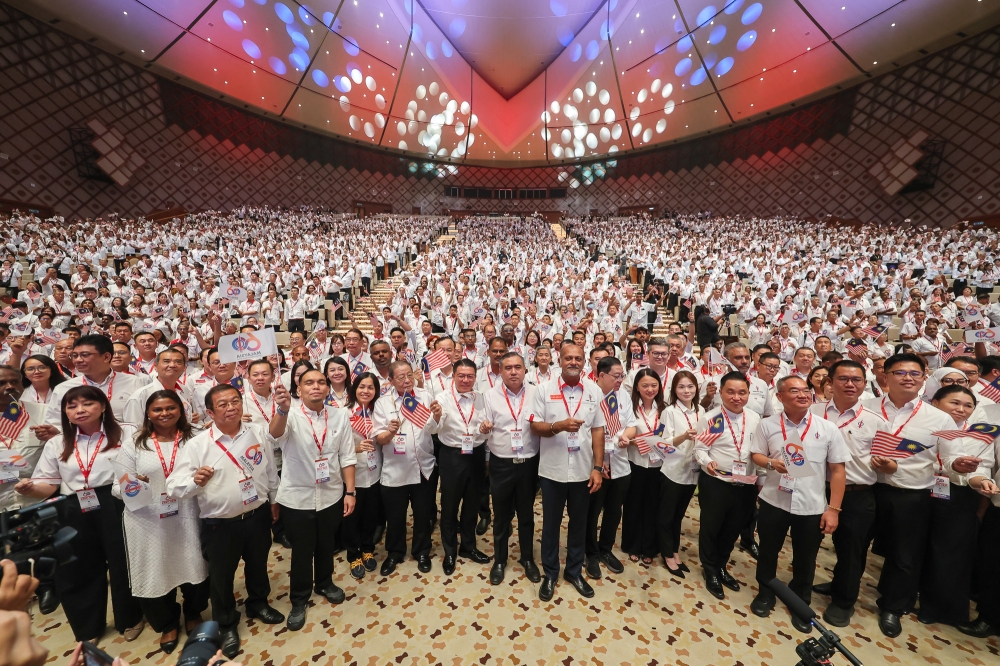
The Malaysian political landscape entered turbulent waters as Wanita DAP legal bureau chief Sangeet Kaur Deo delivered a pointed critique of the party's strategic alignment at the DAP congress in Putrajaya on August 16, calling for a comprehensive reassessment of the coalition's direction and the government's approach. Her intervention at the party's highest decision-making platform signals mounting internal concerns about the sustainability of the current political arrangement and the governing coalition's ability to deliver on its foundational promises.
Sangeet's central argument rested on the proposition that Prime Minister Anwar Ibrahim's stewardship of the administration has introduced fractures within Pakatan Harapan that were not previously evident to the same degree. The legal expert contended that divisive policy decisions and leadership actions have created an environment of mistrust and misalignment among coalition partners who ostensibly share a common political vision. This critique carries particular weight coming from a senior party figure tasked with constitutional and legal oversight, suggesting the concerns extend beyond rhetoric into substantive governance questions.
A significant portion of Sangeet's address focused on what she characterized as the unintended consequences of current governance direction, particularly regarding the strengthening of Umno's political position. Rather than positioning itself as the natural custodian of reform and anti-corruption efforts—the hallmark of Pakatan Harapan's 2018 election victory—the government apparatus has inadvertently created conditions favourable to Umno's resurgence as a major political force. This paradox reflects a fundamental strategic miscalculation that has haunted the coalition since taking office in November 2022.
The appeal for a rethinking of ties with Anwar, while diplomatically framed, represents an escalation in internal party debate that has previously simmered beneath the surface of public discourse. DAP, as the most electorally successful Chinese-majority party and a long-standing advocate for institutional reform and secular governance, finds itself in an awkward position where supporting the coalition's current trajectory contradicts its founding principles. Sangeet's intervention provides a vehicle for articulating these tensions without directly challenging party leadership's public stance.
For Malaysian observers, Sangeet's remarks illuminate the structural vulnerabilities within the current administration. Pakatan Harapan's coalition mathematics have always been delicate, requiring careful balancing between DAP's urban, reform-oriented base, Amanah's Islamic progressive positioning, and PKR's heterogeneous membership spanning Malay, Indian, and Chinese communities. Anwar's premiership was intended to transcend these divisions through technocratic competence and developmental vision. Instead, policy implementation appears to have widened rather than bridged coalition fault lines.
The invocation of Umno's resurgence carries particular resonance in the Southeast Asian context, where dominant parties have historically consolidated power through strategic co-optation of rival factions. By drawing Umno figures into consultative roles and demonstrating flexibility on issues traditionally associated with opposition platforms, the government may be inadvertently legitimizing the very forces it was elected partly to constrain. This dynamic has been observed in other regional democracies where coalitions fail to maintain programmatic coherence.
Sangeet's emphasis on a comprehensive reassessment suggests that ad hoc adjustments and incremental policy modifications are insufficient to arrest the coalition's deterioration. What is required, in her implicit analysis, is a fundamental recalibration of political strategy, clearer articulation of coalition values, and a decisive repositioning that reinstates the distance between Pakatan Harapan's reform agenda and Umno's establishment network. Without such clarity, coalition partners face the prospect of either passive dissolution or more active reconfiguration.
The timing of these remarks—nearly two years into Anwar's premiership—indicates that patience within DAP regarding the coalition's direction has worn thin. Initial hopes that administrative competence and economic management would validate the government's political choices have given way to frustration about persistent institutional dysfunction and governance challenges. Sangeet's intervention at the party congress essentially signals that DAP's membership expects leadership to articulate a clearer strategic vision going forward.
For Anwar Ibrahim personally, Sangeet's critique represents a significant political development that cannot be dismissed as peripheral dissent. Her position within DAP gives her platform and credibility, while her legal expertise lends analytical weight to the assertion that governance has strayed from coalition founding principles. The Prime Minister faces mounting pressure to demonstrate that his administration can deliver tangible policy victories that vindicate the coalition's political gamble in supporting his leadership.
The broader implications for Southeast Asian politics are noteworthy. Malaysia's experiment with opposition-led coalition governance has attracted international attention as a potential model for democratic accountability in a region where power transfers are rare. However, the apparent fracturing of Pakatan Harapan raises uncomfortable questions about the sustainability of reform-oriented coalitions when facing the complexities of national governance, economic pressures, and entrenched institutional interests that inevitably confront any administration.
Looking forward, Sangeet's call for strategic reassessment may precipitate deeper discussions within DAP about the coalition's future. Whether these discussions result in constructive reform of governance approaches or accelerate movement toward coalition reorganization remains uncertain. What is clear is that the comfortable narrative of united opposition-turned-government no longer captures Malaysian political reality, and senior party figures increasingly feel compelled to voice their reservations publicly rather than contain them within closed-door meetings.

