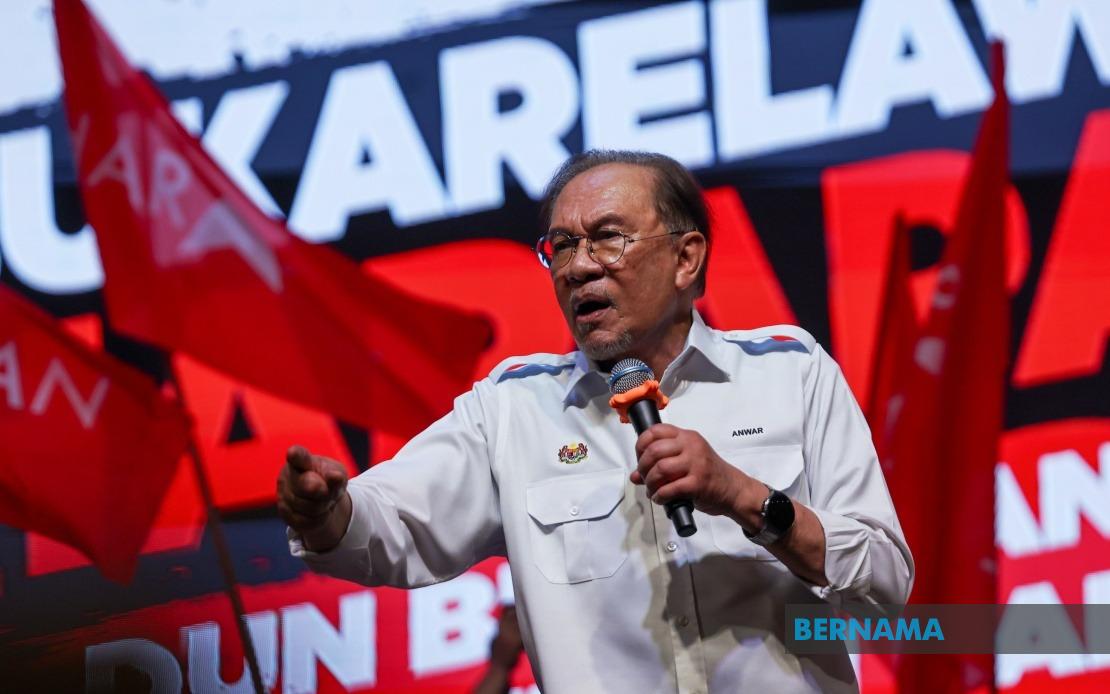
Prime Minister Datuk Seri Anwar Ibrahim moved to dispel growing perceptions that the Democratic Action Party harbours anti-Malay sentiments, asserting instead that the party has consistently respected constitutional protections for the Malay community. Addressing supporters in Muar on July 5, Anwar presented the party's stance on Malay Reserve Land as evidence of its genuine commitment to Malay-Muslim rights, countering a narrative that certain political quarters have actively promoted to undermine the coalition's multiracial credentials.
As chairman of the Pakatan Harapan coalition, Anwar highlighted a specific case demonstrating DAP's acceptance of Malay-centric policies: the party's absence of objection to gazetting 20.23 hectares in Bandar Malaysia as Malay Reserve Land. This pragmatic acceptance, Anwar suggested, contradicts the characterization of DAP as a party fundamentally opposed to Malay interests or constitutionally-protected privileges. The significance of this example lies in its tangibility—it represents an actual policy decision rather than merely rhetorical assurance, providing concrete rather than abstract evidence of the party's position.
The Prime Minister positioned his broader argument within the framework of his leadership responsibilities within the Unity Government coalition. Anwar acknowledged that ensuring equitable treatment across racial lines is not merely an ideological preference but a constitutional and moral obligation incumbent upon those holding executive power. He articulated a vision in which economic opportunity and social provision need not operate as a zero-sum competition between communities but rather as complementary aspects of inclusive national development.
Anwar's defence of DAP emerged particularly against the backdrop of persistent accusations from political opponents who have sought to weaponize the party's non-Malay-dominated composition into a liability. By emphasizing DAP's willingness to support Bumiputera initiatives and funding increases for institutions such as Perbadanan Usahawan Nasional Berhad, Anwar demonstrated that coalition members across racial and religious lines can collaborate on programmes designed specifically to benefit Malay and indigenous communities without ideological friction.
The Prime Minister drew a distinction between targeted community development and the principle of universal fairness. While acknowledging that programmes benefiting Malay and Bumiputera entrepreneurs merit full support, he equally insisted that initiatives serving Chinese and Indian populations—particularly impoverished households—must proceed without obstruction. This formulation reframes the debate from a binary choice between communities to a more sophisticated understanding of inclusive governance in which multiple communities receive appropriate attention simultaneously.
Anwar's comments carry particular weight given Malaysia's history of communal tensions centred on rights, privileges, and resource distribution. The articulation that political leadership entails responsibility to all populations rather than merely those within a politician's own ethnic or religious group represents a moderating voice amid increasingly polarized discourse. In a nation where electoral politics frequently operates along primordial lines, his insistence that prosperity must be shared across communities constitutes a deliberate challenge to divisive framing.
The Prime Minister connected these governance principles to broader economic philosophy, emphasizing that growth itself has little meaning if concentrated among privileged individuals or specific groups. He argued that the current period of economic expansion presents an opportunity to translate macroeconomic gains into tangible improvements in living standards for ordinary citizens across all communities. Adequate housing, functional infrastructure, and quality education represent universally valued outcomes that transcend ethnic boundaries, providing common ground for coalition partners with different electoral bases.
Anwar's framing of political leadership as a trust rather than a privilege deserves particular attention in the Malaysian context. His assertion that politicians occupy positions of responsibility to serve rather than to enrich themselves implicitly critiques patterns of patronage and rent-seeking that have characterized Malaysian politics across multiple administrations. By casting politics as fundamentally about service rather than personal accumulation, he articulates an alternative moral framework for political conduct.
The timing of these remarks within the campaign cycle for the 16th Johor state election—where 172 candidates competed for 56 assembly seats with voting scheduled for July 11—suggests strategic calculation. Johor has traditionally been a Malay-dominant state where concerns about communal interests carry significant electoral weight. By publicly defending DAP's respect for Malay rights and emphasizing the coalition's commitment to equitable development, Anwar addressed voter anxieties that might otherwise translate into support for ethnically-oriented opposition parties.
These comments also reflect internal coalition dynamics within Pakatan Harapan. DAP's participation in a government coalition with Malay-majority and Islamic parties requires navigation of multiple constituencies with sometimes competing interests. Anwar's public articulation of the party's genuine commitment to constitutional Malay-Muslim protections serves to reassure both coalition partners and broader Malay-Muslim electorate that DAP participation does not imperil established rights or privileges.
The broader significance of Anwar's intervention extends beyond immediate electoral considerations to the fundamental question of whether Malaysian politics can transition toward governance frameworks that transcend purely communal appeals. His insistence that fair treatment and economic distribution need not pit communities against one another, and his repeated assertion that poverty and inadequate services affect people across racial lines, point toward a development model that avoids zero-sum competition.
For Malaysia's continued political stability and economic development, the question of whether multiracial coalitions can genuinely govern in inclusive fashion—rather than merely managing ethnic group interests—remains critical. Anwar's defence of DAP and reiteration of the Unity Government's commitment to all communities represents one articulation of how this balance might be achieved. Whether such rhetoric translates into substantive policy outcomes demonstrating equal commitment to development across communal boundaries will ultimately determine the credibility of such claims.

