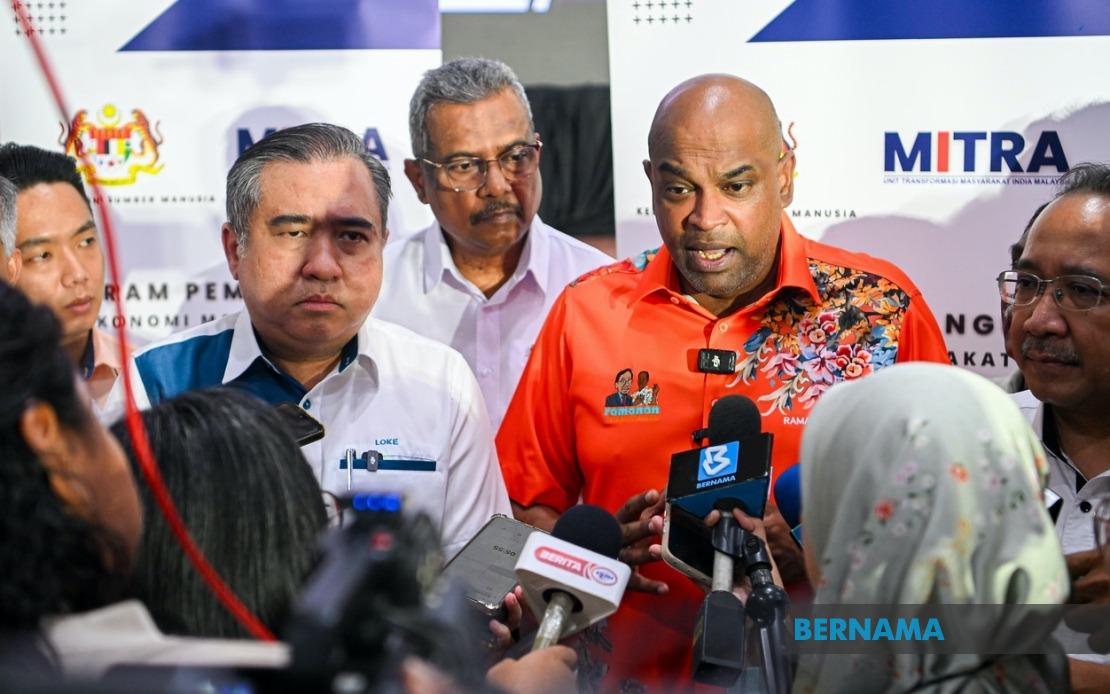
Anthony Loke, the secretary-general of the Democratic Action Party, has pushed back forcefully against recurring allegations that the DAP dominates decision-making within the Pakatan Harapan administration, characterising such claims as a tired political tactic designed to erode public confidence in the ruling coalition. Speaking in Seremban on July 7, Loke stressed that governance at both federal and Negeri Sembilan levels operates through a collaborative framework where no single party exercises unilateral control over outcomes.
The Transport Minister's remarks reflect growing frustration within DAP ranks over what party leaders perceive as a systematic campaign to delegitimise the coalition by portraying it as captured by a single political force. This narrative, particularly prevalent among opposition figures and certain segments of the Malay-Muslim electorate, has persisted since Pakatan Harapan first took federal power in 2018 and has resurged with renewed intensity following the coalition's return to government in 2023. Loke's comments underscore the challenge facing the multiethnic and multiparty coalition in maintaining public trust across diverse demographic groups with conflicting political interests.
According to Loke, the decision-making architecture of the federal government ensures that all component parties—including DAP, UMNO, and PKR—receive a genuine hearing before Prime Minister Datuk Seri Anwar Ibrahim finalises policy positions. This collective approach, he suggested, reflects the constitutional and political realities of coalition governance, where no party possesses sufficient parliamentary seats to govern alone. The Transport Minister rejected the premise that expressing party positions in cabinet discussions constitutes improper influence, noting that such participation is inherent to the ministerial responsibilities of coalition partners.
The specific grievance Loke addressed relates to perceptions among certain quarters that DAP, despite being a non-Malay led party, exerts disproportionate influence over issues affecting the Malay-Muslim majority. This anxiety has manifested in occasional defections of UMNO and PKR legislators, allegations of marginalisation, and periodic calls for the coalition to be reconstituted without DAP participation. By emphasising that Prime Minister Anwar Ibrahim retains ultimate decision-making authority, Loke appeared to be reassuring potential coalition critics that no single partner can override the Prime Minister's prerogatives or impose ideologically driven policies on unwilling government members.
In the Negeri Sembilan context, Loke highlighted that the state Menteri Besar, Datuk Seri Aminuddin Harun, employs the same consensual model when determining state policy. This observation carries particular significance given Negeri Sembilan's compact Malay-Muslim majority and the state's reputation as a bellwether for broader political sentiment in peninsular Malaysia. By demonstrating that the state administration functions smoothly under a Malay Menteri Besar who maintains collegial relationships with DAP and other partners, Loke sought to neutralise arguments that DAP influence automatically translates into marginalisation of Malay-Muslim interests or institutions.
The allegation that Malays face systemic threat within Negeri Sembilan under Pakatan Harapan rule represents another front in the broader political contest. Loke characterised such claims as repetitive scare tactics devoid of empirical substance, pointing to the continuation of Malay leadership in the state and the preservation of policies safeguarding community interests since 2018. This defence touches on underlying anxieties within Malay-Muslim politics regarding representation, cultural preservation, and the role of vernacular parties within multicultural governance. Pakatan Harapan's challenge lies in demonstrating that inclusivity does not entail subordination of Malay-Muslim aspirations or constitutional protections.
The broader context of Loke's remarks reflects structural tensions within the Malaysian coalition system. Pakatan Harapan comprises parties with divergent support bases, ideological orientations, and policy preferences. DAP draws predominantly urban, non-Malay, and secular-leaning voters; PKR encompasses a more heterogeneous constituency including reform-minded Malays; and UMNO traditionally represents the Malay-Muslim establishment. These differences create genuine policy disagreements and make the coalition vulnerable to narratives of domination by whichever party proves most ideologically assertive or operationally effective.
Opposition groups have invested considerable effort in weaponising the DAP dominance narrative, framing Pakatan Harapan governance as a vehicle for marginalising Malay-Muslim interests under the guise of pluralism. This strategy has proven rhetorically potent in rural Malay-Muslim heartlands where DAP's prominence generates cultural and religious discomfort among certain constituencies. By insisting on the primacy of collective decision-making and the Prime Minister's ultimate authority, Loke was attempting to recalibrate this narrative and reassure sceptical Malay voters that their interests remain protected within the current governance framework.
The Transport Minister's defence also implicitly acknowledges that Pakatan Harapan must continuously justify its coalition model to an electorate accustomed to single-party dominance. The contrast with the Barisan Nasional era, when UMNO exercised near-total control, makes coalition governance unfamiliar to many Malaysian voters. Coalition partners' public advocacy of their positions—which would have been suppressed under UMNO's rule—can appear to external observers as evidence of chaos or capture. Loke's clarification that such advocacy reflects normal ministerial accountability rather than party domination attempts to reframe coalition transparency as a feature rather than a liability.
Looking forward, Pakatan Harapan will likely continue encountering these accusations as it navigates the competing demands of its coalition partners and the broader electorate. Loke's reassurance regarding Prime Minister Anwar Ibrahim's decision-making supremacy signals an effort to establish clear hierarchy within coalition governance, arguably to address concerns that consensus-seeking might paralyse administration or cede excessive influence to the most vocal coalition member. Whether such clarifications sufficiently assuage Malay-Muslim anxieties about DAP influence will ultimately depend on policy outcomes and whether Pakatan Harapan can demonstrate tangible delivery of services and opportunities to all communities.
The recurrence of this narrative debate highlights the precarious equilibrium required to maintain Malaysia's multiparty coalition governments. As electoral competition intensifies and opposition parties sharpen their messaging around identity politics, Pakatan Harapan faces mounting pressure to articulate a compelling vision of multiethnic governance that transcends accusations of hidden agendas or implicit domination. Loke's intervention represents one salvo in what will likely prove to be a sustained campaign to defend coalition legitimacy and redefine public understanding of how power is distributed and exercised within Malaysia's plural political system.

