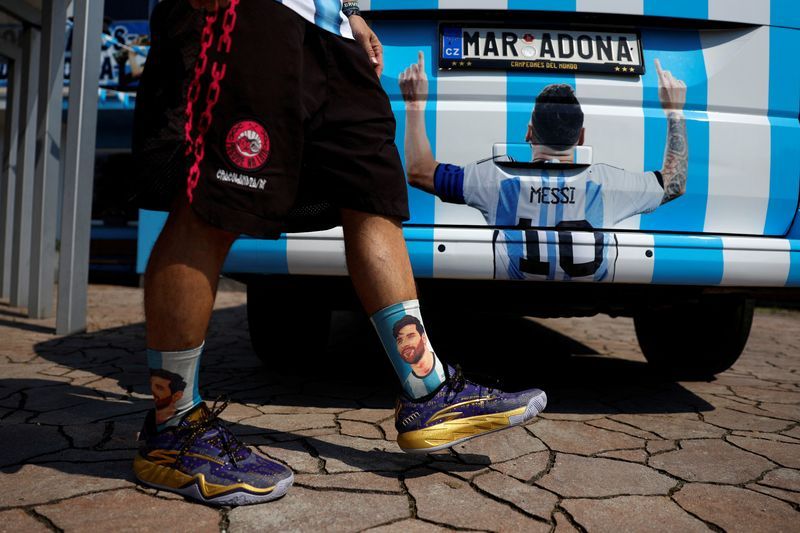
In the countryside village of Bukovka, situated roughly 90 kilometres east of Prague in the Czech Republic, one man's passion for Argentine football has quite literally painted the landscape. Miloslav "Curby" Urbanec, a 51-year-old music promoter, has transformed his three-storey residence into a monument to his unwavering devotion to La Seleccion, the Argentine national team, creating what amounts to a personal shrine dedicated to the nation's most iconic players and sporting achievements.
The transformation is impossible to miss. Urbanec's home is rendered entirely in the sky-blue and white colours of the Argentine flag, with the massive golden sun emblem—the central symbol of Argentina's national banner—emblazoned prominently across the wall. This colour scheme extends beyond the exterior walls; it encompasses every visible surface of the property, making the dwelling instantly recognisable from considerable distances and serving as a beacon of Argentine pride in the heart of central Europe.
The statuary adorning the residence reflects Urbanec's deep reverence for football history. A life-size bronze statue of Diego Maradona guards the courtyard, while an oversized mural depicting Lionel Messi dominates the rear of the building. These installations represent more than mere decoration; they function as testaments to Urbanec's belief in the transcendent power of football and the legacies of two generational talents who defined the sport for millions worldwide. Behind the main house sits a regulation-standard all-weather football pitch, its perimeter decorated with photographic tributes to the stars of Boca Juniors, the historic Buenos Aires club where Maradona achieved legendary status.
Urbanec's commitment extends into his everyday life. His personal vehicle—a van painted in the same distinctive sky-blue and white—bears custom artwork featuring Maradona hoisting the World Cup aloft and Messi in action, accompanied by the declaration "In Messi we trust". The number plate reads simply "MARADONA", leaving no ambiguity about his primary life interest. This mobile advertisement of his passion transforms a simple utility vehicle into a rolling artwork that carries his message across Czech roads.
The roots of this extraordinary devotion stretch back more than four decades. Urbanec vividly recalls being a four-year-old child in 1978, watching his father's television coverage of Argentina's World Cup triumph. The flowing hair and dynamic playing style of forward Mario Kempes and his teammates captivated the young Czech boy, igniting a passion that would shape the trajectory of his entire existence. That initial spark kindled during a distant broadcast would eventually blossom into a comprehensive lifestyle centred entirely around Argentine football culture.
Perhaps no decision better exemplifies Urbanec's commitment than his choice of names for his children. When his second son was born seven years ago, Urbanec selected the name Lionel—a deliberate homage to Messi. In explaining this decision, Urbanec observed that even years before Messi's subsequent achievements and global recognition, it was apparent that "this guy is absolutely special". The naming choice demonstrates how thoroughly Argentine football has permeated his identity and influenced even the most intimate family decisions.
Urbanec's optimism regarding Argentina's prospects in major tournaments remains unwavering. When discussing the national team's capabilities, he expresses absolute confidence bordering on certainty. He describes the current iteration of La Seleccion as "absolutely amazing" and declares with conviction that victory is inevitable, not merely possible. His reasoning extends beyond simple patriotic sentiment; he frames Argentine football as inherently superior in aesthetic terms, arguing that the country's players execute "the most beautiful football" compared to any competing nation.
This perspective carries particular resonance given Argentina's history of magnificent attacking play and technical sophistication. The nation has produced multiple generations of players renowned for their artistry and creativity, from the pioneering tactics of the 1920s through to the modern era. Urbanec positions himself within a global community of supporters who appreciate not merely winning football, but football executed with style and elegance—a philosophy deeply embedded in Argentine footballing tradition.
Urbanec anticipates that Argentine success will trigger celebrations extending far beyond his village setting. He envisions a worldwide jubilation accompanying any triumph, with parties erupting across continents as fans unite in shared joy. This perspective reflects the genuinely global nature of football fandom in the contemporary era, where a supporter in rural Czech Republic can feel as emotionally invested in an Argentine team's success as supporters in Buenos Aires or Córdoba. The sport has created transnational communities of passion, connected across vast distances by shared devotion to particular nations, colours, and players.
The 2024 Copa América tournament has attracted worldwide attention, with Argentina among the favourites to advance deep into the competition. Urbanec's unwavering belief in the team's capabilities epitomises the emotional investment that passionate supporters maintain regardless of objective circumstances or recent form. For someone who has dedicated decades to studying Argentine football, who has named his child after its greatest contemporary player, and who has physically reconstructed his domestic environment as a tribute to the nation's sporting heritage, confidence in eventual victory represents the only psychologically sustainable position.
Urbanec's case illustrates the remarkable capacity of football to transcend geographical boundaries and cultural differences, creating powerful emotional bonds between individuals separated by continents. His village home, visible for miles around in its distinctive Argentine colours, stands as testament to this phenomenon—a solitary monument to global fandom erected in the Czech countryside, proclaiming that La Seleccion's reach and appeal extends far beyond South America's borders into the hearts of devoted supporters across Europe and the world.

