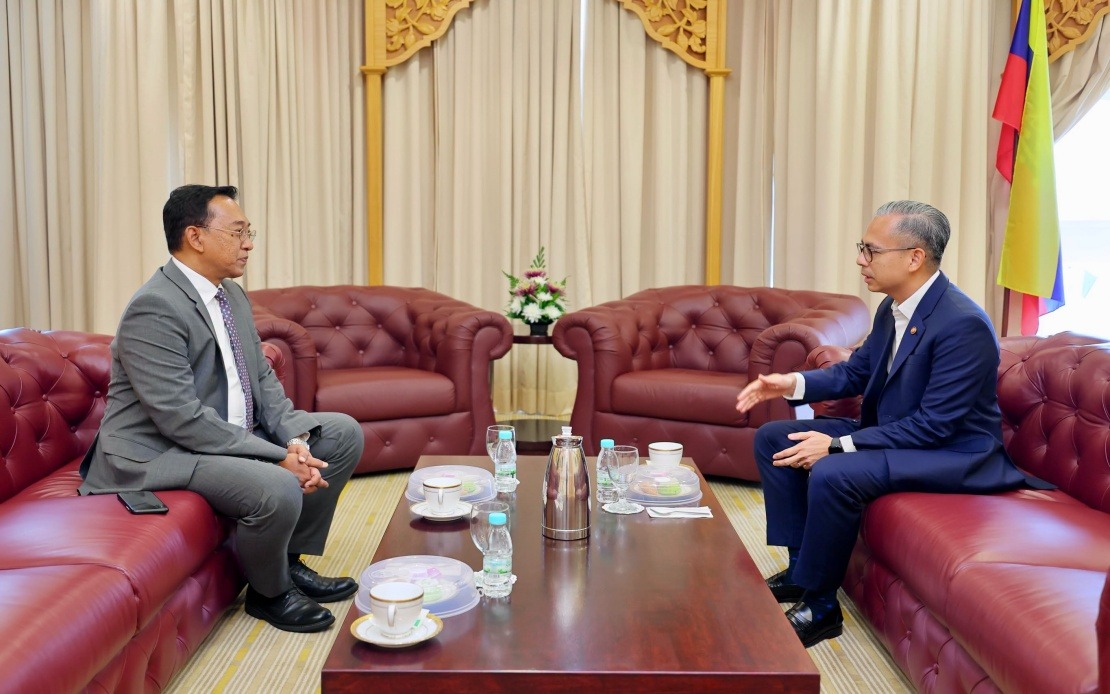
Communications Minister Datuk Fahmi Fadzil recently held discussions with Anwar Udzir, Malaysia's freshly appointed Ambassador to Lebanon, during a courtesy visit to the ministry in Kuala Lumpur. The meeting underscored the government's commitment to maintaining robust bilateral and multilateral relationships across key regions, particularly in the Middle East where Malaysia maintains significant diplomatic and economic interests.
Anwar Udzir received his formal letter of appointment from His Majesty Sultan Ibrahim, King of Malaysia, on May 18, 2026, formally vesting him with the responsibilities of representing the nation's interests in Lebanon. His posting comes at a time when Malaysia continues to strengthen its presence and engagement across the Arab world, where economic partnerships, cultural exchanges, and political coordination have become increasingly important for regional stability.
During the meeting, Fahmi and Udzir discussed the importance of maintaining and deepening Malaysia's working relationship with Lebanon, a country with whom Malaysia has longstanding diplomatic connections. The conversation extended beyond ceremonial pleasantries to encompass substantive issues affecting Malaysia's international standing and the promotion of Malaysian interests at the global level. Such ministerial-level engagements serve as crucial touchpoints for aligning strategic objectives between the Foreign Ministry and relevant government departments.
Fahmi expressed confidence in Udzir's ability to effectively discharge his ambassadorial duties, emphasizing hopes that the diplomat would achieve considerable success in his representation of Malaysia in Beirut. The Minister's endorsement reflects the government's confidence in Udzir's capabilities and diplomatic experience, qualities essential for navigating the complex political dynamics of Lebanon and advancing Malaysian interests within the broader Arab and Mediterranean context.
The two officials drew upon an existing professional relationship that had developed through collaborative efforts on international telecommunications governance. Specifically, Fahmi recalled how Anwar and his diplomatic team had provided valuable assistance in organizing the Asia-Pacific Telecommunity Ministerial Meeting held in Tokyo, Japan, during the previous year. This prior collaboration demonstrated the ambassador's competence in coordinating complex international forums and managing multilateral engagements—skills directly transferable to his ambassadorial portfolio.
The courtesy call represents a standard diplomatic practice wherein newly appointed ambassadors present themselves to relevant ministers before departure for their posting, establishing rapport and understanding mutual expectations. For Malaysia's communications sector, maintaining strong ties with diplomatic missions is particularly relevant given the interconnected nature of telecommunications infrastructure, digital governance, and international standards-setting bodies that often operate across borders.
Lebanon, as Malaysia's diplomatic posting, occupies significant geopolitical importance. The country serves as a gateway to broader Arab and Middle Eastern affairs, and Malaysian representation there facilitates engagement with multiple regional actors, international organizations, and diaspora communities. A competent ambassador can substantially amplify Malaysia's diplomatic reach, influence, and ability to advocate for national interests on issues ranging from trade and investment to cultural diplomacy and people-to-people exchanges.
For Malaysian businesses and citizens operating in Lebanon or the broader Levantine region, a well-functioning embassy under strong ambassadorial leadership provides essential support services, from consular assistance to business facilitation. The presence of an experienced diplomat like Anwar Udzir reassures the Malaysian community abroad that their interests receive adequate institutional attention and advocacy at the highest diplomatic levels.
The meeting also highlights the Communications Ministry's role in supporting Malaysia's broader foreign policy objectives. While the ministry primarily focuses on domestic and regional telecommunications policy, effective international engagement on technology and communications standards requires coordination with the diplomatic service. Fahmi's willingness to meet with newly posted ambassadors demonstrates how various government agencies contribute to comprehensive national diplomacy.
Anwar Udzir's appointment arrives during a period of evolving Middle Eastern geopolitics, where Malaysia seeks to maintain balanced relationships and pursue pragmatic engagement with multiple stakeholders. His diplomatic acumen, tested through previous international assignments and conference organization, positions him well to navigate these complexities while promoting Malaysian commercial interests, cultural understanding, and political objectives in Lebanon and throughout his region of accreditation.
The engagement between Fahmi and Udzir ultimately exemplifies the collaborative mechanisms through which Malaysia's government ensures coherent diplomatic strategy across different ministries and postings. By facilitating direct conversations between communications leadership and ambassadorial staff, the government strengthens institutional knowledge transfer and ensures that ambassadors understand contemporary priorities within their home country before representing it abroad. This approach enhances Malaysia's diplomatic effectiveness and contributes to the nation's ability to advance its interests in an increasingly complex international environment.

