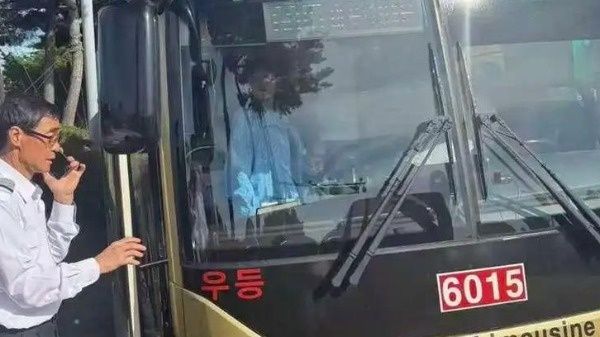
A group of Chinese women tourists has won widespread acclaim across social media platforms in East Asia for their rapid response and composure when a coach driver suddenly lost consciousness while operating a bus carrying more than twenty people on a major Seoul highway. The incident unfolded on Saturday afternoon aboard the No 6015 airport shuttle, which was transporting passengers from central Seoul towards Incheon International Airport when the driver unexpectedly became incapacitated, causing the vehicle to veer dangerously and strike a roadside guardrail.
Sun Qian, a healthcare professional in her mid-thirties from Nanjing in Jiangsu province, was seated directly behind the driver when the crisis emerged. Witnessing the bus beginning to lose stability as it drifted towards the barrier, she made an instantaneous decision to intervene. Without hesitation, Sun lunged forward and seized the steering wheel to prevent further deterioration of the vehicle's trajectory. Her decisive action would prove critical in preventing what could have become a catastrophic accident involving dozens of passengers.
Working in concert with Sun's efforts to stabilize the vehicle's direction, another passenger immediately began searching for the bus's braking system. Within mere seconds of recognizing the emergency, the group had successfully brought the coach under control by activating the emergency brake and engaging the handbrake mechanism. Despite acknowledging her familiarity with driving a standard vehicle, Sun described the experience as deeply unsettling, noting that the substantial steering wheel on the large coach intensified her anxiety during those fraught moments.
Du He, thirty-three years old and a fellow resident of Nanjing who was travelling beside Sun, swiftly recognized that the situation demanded immediate medical intervention beyond merely halting the bus. She initially attempted a traditional first-aid technique by applying pressure to the driver's philtrum, but quickly observed alarming symptoms including cessation of breathing and a dramatic discoloration of his complexion to purple. This realization triggered the shift from crash prevention to emergency medical response.
What followed was an impromptu but coordinated effort to resuscitate the stricken driver. Multiple passengers took turns performing cardiopulmonary resuscitation, working in rotation to maintain chest compressions while others coordinated their efforts. Sun, whose fluency in the Korean language proved invaluable, utilized the driver's mobile telephone to contact emergency services and provide critical information about their location and circumstances. Her linguistic ability transcended the immediate language barrier that would have paralyzed most foreign visitors in such circumstances.
Despite the concerted rescue attempts by the passengers and the subsequent arrival of professional medical personnel, the driver could not be saved. Emergency responders transported him to hospital, where he remained under intensive treatment for approximately two hours before ultimately succumbing to what authorities suspect may have been acute cardiac failure. South Korean police continue their investigation into the precise medical cause of the driver's collapse.
Du reflected on how narrowly the situation avoided becoming exponentially worse, recognizing that the relatively light traffic conditions on the highway at that moment prevented secondary collisions that could have multiplied casualties. The passengers, all scheduled to board flights, subsequently flagged down an alternative bus to continue their journey to Incheon, allowing them to reach their intended destination despite the traumatic interruption.
Both women acknowledged that their emotional responses to the ordeal were delayed. While their minds remained occupied with immediate survival and rescue tasks during the actual event, the full weight of what had occurred only crystallized once they arrived at the airport terminal. Du described experiencing genuine fear in retrospect, reflecting on how the unfolding crisis resembled the scripted drama of a television production rather than the reality they inhabited. The adrenaline that sustained them through the emergency gradually receded, replaced by an appreciation of how close the outcome could have been to tragedy.
When confronted with the extensive praise circulating on social media platforms spanning both China and South Korea, both women deflected credit with characteristic humility. Du maintained that their actions represented nothing more than instinctive human behavior, suggesting that any capable individual in their position would have responded identically to the crisis. She articulated a broader philosophy about collective responsibility and mutual aid, emphasizing that Chinese people possess an inherent cultural inclination towards unity and spontaneous assistance during emergencies.
Sun emphasized that attributing the successful prevention of disaster to any single individual would misrepresent the reality of what occurred. She highlighted how multiple passengers contributed essential elements to the outcome—the individual who located the brake controls, the successive participants in the resuscitation attempts, and the collective cooperation that transformed a chaotic emergency into an organized response. Her reflection underscored how crisis situations frequently transcend individual heroism to reveal the capacity for coordinated community action among strangers.
The incident has resonated powerfully across digital platforms in both nations, generating substantial commentary and admiration. South Korean social media users have expressed particular astonishment at how these foreign visitors maintained exceptional composure and moved with such decisiveness despite confronting a language barrier in an unfamiliar environment. Chinese netizens responding on platforms including Xiaohongshu have similarly celebrated the account, perceiving in it an affirmation of cultural values emphasizing solidarity and mutual protection during moments of extreme adversity.
For Malaysian and Southeast Asian readers, this episode offers compelling insights into the reality of travel safety and the unpredictable nature of transportation systems across the region. While formal safety protocols receive priority in most professional transportation operations, the incident demonstrates that human intervention during equipment or medical failure can mean the difference between tragedy and survival. The geographical accessibility of South Korea to Malaysian travellers, combined with the substantial number of regional visitors utilizing international airport services, renders such scenarios uncomfortably plausible for tourists and business travellers alike.

