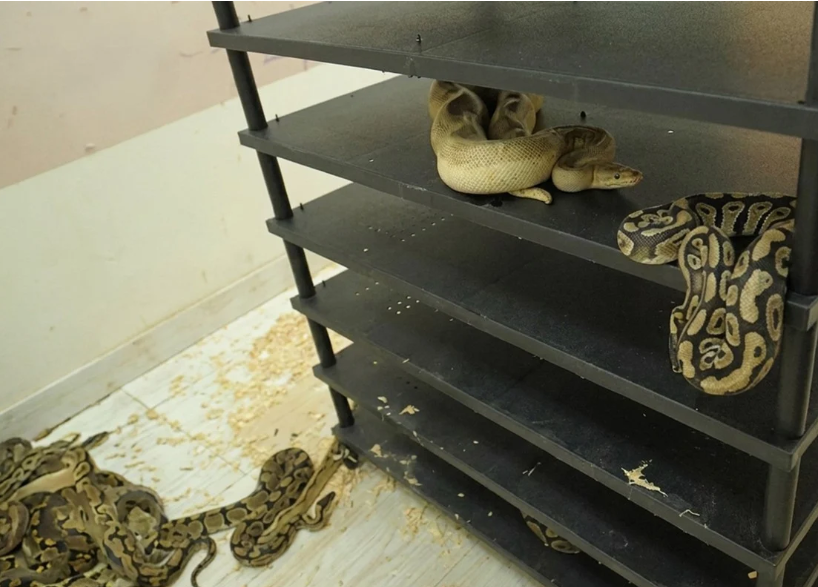
A man living alone in Taizhou, Zhejiang province in eastern China has been sentenced to prison for operating an illegal python breeding operation inside his residential flat, marking a significant enforcement action against wildlife trafficking in the country. The case, which came to light in June through state broadcaster CCTV, exposed a sophisticated underground network that had bred, sold, and distributed over 300 of China's protected reptiles from a seemingly ordinary apartment. The operation highlights how determined wildlife violators can exploit gaps in enforcement and the creative investigative methods Chinese authorities employ to uncover such schemes.
The discovery began innocuously in March 2024 when an elderly resident in the area reported finding an unusually large snake at the base of a nearby mountain. The tawny reptile, as thick as an adult human arm, appeared out of place in the region, prompting the senior citizen to alert local police. Initial police analysis suggested the snake had escaped from captivity rather than occurring naturally, as pythons are not indigenous to the area and their physiology makes them largely dormant during March when outdoor temperatures remain cool. This reasoning would prove correct and became the thread that unravelled an entire illegal breeding enterprise.
Chinese law classifies pythons as Grade Two protected animals, placing them in a category where acquisition, sale, breeding, and transportation without official government permission constitutes a serious criminal offense. Recognising that escaped pythons require controlled conditions to survive, investigating officers consulted with a professional reptile keeper who provided crucial insight: pythons depend entirely on artificial heating systems to maintain survival within the 20 to 30 degrees Celsius temperature range. This revelation transformed the investigation into a hunt for residents whose electricity consumption patterns revealed the telltale signs of maintaining large-scale heated environments. Police cross-referenced local power usage data with resident information and eventually identified a man surnamed Guo as their primary suspect.
Guo's profile fit the investigative pattern perfectly. Living alone, unmarried, and unemployed, he had minimal legitimate reasons for the substantial electricity draw his flat was consuming. Further surveillance uncovered that Guo frequently received visits from another man named Di, who regularly collected parcels from courier stations. These packages, upon investigation, contained small white mice ordered from online sellers. Police contacted the mouse suppliers, who confirmed they routinely sold animals to customers breeding reptiles as food. The digital evidence trail proved invaluable: Guo had shared images of snakes on social media platforms and made oblique references to selling pythons, while transaction records documented that Di had sold at least two pythons to a third party for 1,000 yuan, approximately US$150 per animal.
With sufficient probable cause established, authorities arrested both Guo and Di and executed a search warrant on Guo's apartment. Officers were reportedly startled by what they discovered: the entire flat had been converted into a python breeding facility. Guo had compressed all his personal furniture and living essentials into a single bedroom, dedicating the remaining two bedrooms and the living room entirely to stacked plastic containers, each housing individual pythons. The sheer scale of the operation became apparent as police documented and removed 309 pythons from the residence, which were subsequently transferred to a local zoo for care. The apartment itself served as an indoor breeding farm, operating continuously to maintain the precise environmental conditions these reptiles require.
Guo's motivation appeared rooted in genuine passion rather than purely commercial interest, though both elements were present. He revealed to investigators that his fascination with snakes stretched back a decade, beginning when he purchased four pythons in 2014. Since that initial investment, Guo had immersed himself in snake breeding research and took considerable pride in his ability to cultivate pythons displaying different colour variations and patterns. In a telling statement to police, Guo described himself as feeling "like a creature creator" when discussing his work, suggesting he viewed his operation through a lens of scientific curiosity and accomplishment rather than solely criminal enterprise. However, the commercial dimension was undeniable: police records showed that Guo and Di had successfully sold 80 pythons to date, generating substantial revenue from their illegal activities.
The investigation expanded further when authorities identified additional participants in the supply chain. A shop owner named Deng, who had originally sold four pythons to Guo in 2014 and thus catalysed the entire operation, was also arrested. Police located 47 additional pythons in Deng's residence, indicating he maintained his own breeding operation to supply customers like Guo. The combined scope of the three-person network ultimately encompassed 436 pythons valued conservatively at over 30 million yuan, equivalent to approximately US$4.4 million at contemporary exchange rates. This valuation demonstrates the significant commercial stakes involved in protected species trafficking and explains why such operations persist despite legal prohibitions.
A local court in Taizhou convicted all three defendants—Guo, Di, and Deng—and sentenced them to imprisonment, though the court did not publicly disclose the specific prison terms imposed on each individual. The sentences derive authority from China's Criminal Law, which stipulates that violations involving Grade Two protected animals carry maximum penalties of five years imprisonment. The court's decision to prosecute all three parties reflects the seriousness with which Chinese authorities treat wildlife protection violations, particularly involving creatures classified as endangered or rare.
This case carries significant implications for Southeast Asian nations grappling with reptile trafficking and broader wildlife crime. The supply chain for illegal python breeding often extends across borders, with animals and breeding stock sourced internationally. Malaysia and other regional countries frequently encounter traffickers attempting to transport live snakes across borders for breeding operations in China and other markets. The investigation's success in unmasking Guo's operation through electricity consumption data and courier package analysis offers a template for regional law enforcement agencies seeking to identify similar hidden operations. As demand for exotic reptiles continues to drive trafficking networks across Asia, the case underscores the importance of cross-border intelligence sharing and consumer awareness about purchasing captive-bred reptiles only from legitimate, legally-sanctioned sources.