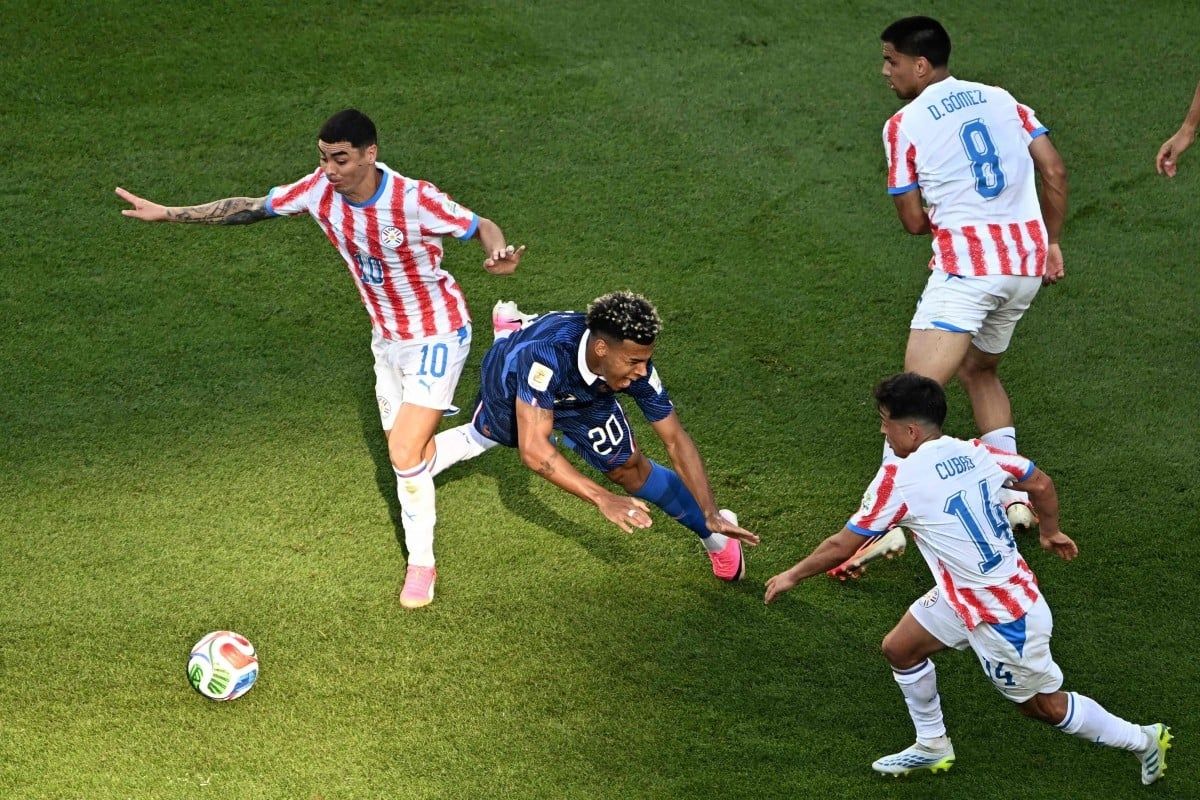
Paraguay's disappointing World Cup exit against France has ignited heated debate among Chinese football enthusiasts, who expressed frustration at both the South American side's physical approach and the perceived inconsistency of the match official. The encounter in Philadelphia on Saturday highlighted a stark contrast between the disciplinary standards Chinese fans are accustomed to and what unfolded on the pitch, with Ma Ning, a referee known for his strict enforcement, becoming the unlikely focal point of social media commentary.
France's progression to the quarter-finals came courtesy of Kylian Mbappe's penalty kick with twenty minutes remaining, but the match itself was defined less by attacking brilliance than by Paraguay's apparent determination to impose physical dominance. Rather than generating meaningful scoring opportunities, the Paraguayan contingent appeared preoccupied with aggressive body contact and confrontational play, transforming what should have been a showcase of technical football into something markedly more combative.
Uzbek official Ilgiz Tantashev's management of the encounter drew particular criticism from Chinese observers, who felt his disciplinary approach fell short of what the match conditions demanded. Distributing merely four cards throughout ninety minutes—three of which went to France—seemed grossly inadequate to Chinese fans accustomed to Ma Ning's reputation as the "card master" for his willingness to maintain control through decisive action. This discrepancy became the primary talking point across Weibo and other platforms, with one user sarcastically suggesting that had Ma Ning officiated, Paraguay would have been reduced to their goalkeeper.
The disparity between expected and actual refereeing standards provoked intense speculation among Chinese social media users, many of whom questioned whether Tantashev, a FIFA referee since 2013, was somehow sympathetic to Paraguay's approach. Some commenters suggested the official appeared almost to be wearing a Paraguay jersey, while others drew parallels to Paraguay's upset victory over Germany in the previous round, implying a pattern of physical play that went inadequately punished. This perceived inconsistency generated frustration that transcended the match itself, with observers noting that when the focus shifts entirely to referees rather than the quality of play, it signals profound failure in match management.
Mbappe himself became the primary target of Paraguay's attention throughout the encounter, yet the French star maintained composure and provided insight into the psychological dimensions of such contests. In post-match comments, he acknowledged that France had anticipated the confrontational nature of the fixture and had mentally prepared accordingly. Rather than being rattled by the physical onslaught, Mbappe indicated that his team was capable of matching Paraguay's intensity and tactical ruthlessness, suggesting they possessed the capacity to "get their hands dirty" when circumstances demanded. His comments that France knew "how to play ugly football" and could adopt an aggressive approach if necessary reflected a pragmatic understanding of World Cup football's demanding realities.
France's manager Didier Deschamps corroborated these observations, revealing that unsporting behaviour extended beyond the playing field into the technical areas. The former World Cup-winning coach described Paraguay's approach as exhausting every possible trick available, whilst emphasising that this particular style of football lacks the aesthetic appeal that typically attracts spectators to stadiums. Deschamps drew a distinction between teams playing according to their chosen styles versus the crossing of lines into disrespect, specifically referencing insulting remarks directed from the Paraguay bench that he found objectionable and unnecessary.
A particularly telling incident occurred at the final whistle when Paraguay goalkeeper Orlando Gill was captured on camera throwing a ball at Mbappe's back after the French forward did not acknowledge him. Gill subsequently attributed this behaviour to the intensity and frustration of the moment, characterising it as an impulsive reaction to defeat. However, Chinese social media users were sceptical of this explanation, viewing the incident as symptomatic of Paraguay's broader lack of professionalism and sportsmanship throughout the encounter. Comments suggested that losing both the match and their dignity, coupled with childish conduct, compounded the South American side's humiliation.
The episode illuminates broader contrasts between refereeing philosophies across different football cultures and the expectations of various fan communities. Chinese audiences, shaped by experiences with officials who exercise firm control and punish infractions promptly, found the lenient approach jarring and counterproductive. The extensive social media discussion reflects how international football serves as a cultural mirror, where different nations' approaches to discipline, authority, and competitive conduct become apparent and subject to comparative analysis.
For Southeast Asian and Malaysian viewers, the Paraguay-France encounter demonstrates how World Cup football continues to generate passionate responses across Asia, extending well beyond regional participants. The intensity of Chinese fan engagement with European World Cup matches indicates the tournament's remarkable global penetration and the way international sporting contests become platforms for discussing standards, integrity, and what constitutes acceptable conduct in modern football. The comparison to Ma Ning's strict approach also highlights how regional referees are viewed with pride and acknowledged as potential competitors on the world stage, even when their methods are unconventional by international standards.
Ultimately, the match showcased how tactical physicality intersects with refereeing discretion to shape outcomes and shape perceptions, particularly when audiences accustomed to stricter standards observe different interpretations in play. The episode serves as a reminder that football's global nature means matches are witnessed through multiple cultural lenses, each bringing distinct expectations regarding discipline, professionalism, and the boundaries of acceptable aggressive play. The French team's advancement to face Morocco in the quarter-finals proceeded despite the disruptive elements, but the match will be remembered as much for the controversy it generated among distant observers as for the actual football played.

