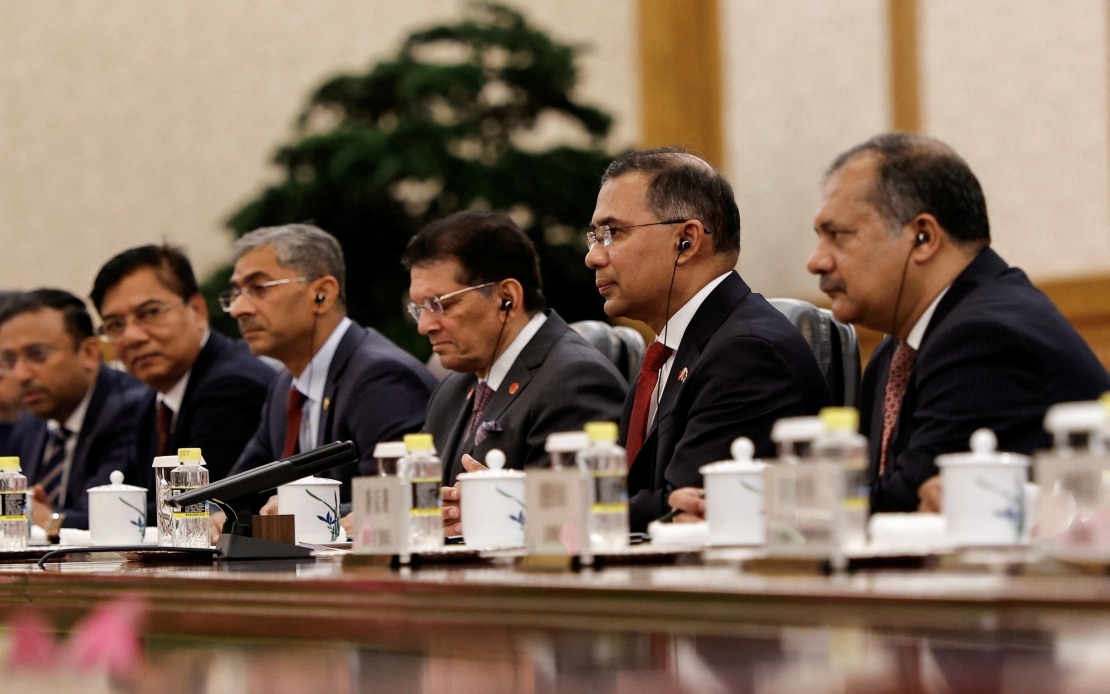
Bangladesh's newly constituted government is laying the groundwork for a significant deepening of economic ties with China, with twelve major Chinese enterprises proposing a combined investment portfolio worth US$9.2 billion during Prime Minister Tarique Rahman's week-long official visit to Beijing in late June. The investment announcements reflect Beijing's strategic interest in strengthening its position in South Asia while simultaneously providing Dhaka with access to much-needed capital for infrastructure modernisation and industrial expansion.
The proposed investments cut across multiple economic sectors that are critical to Bangladesh's development trajectory. The country's government has explicitly signalled its receptiveness to Chinese participation in energy production, port infrastructure, logistics networks, manufacturing facilities, and higher education institutions. Officials estimate that these projects, once implemented, would generate employment for tens of thousands of Bangladeshi workers across construction, operations, and manufacturing phases. This employment creation is politically significant for a new administration seeking to establish legitimacy and demonstrate tangible economic benefits to its population.
The partnership framework outlined in the joint communiqué issued following Rahman's visit emphasises trade expansion, e-commerce cooperation, supply chain integration, and industrial development. The two nations have committed to collaborative efforts aimed at enhancing Bangladesh's export capacity while reinforcing support for the multilateral trading system—language that reflects broader geopolitical positioning amid ongoing trade tensions between major powers. China's willingness to engage in these comprehensive cooperation agreements underscores its strategic calculus regarding Bangladesh's importance as both a market and a production hub within South Asia.
Portuate modernisation emerges as a central pillar of the bilateral economic agenda. Mongla Port, situated in southwestern Bangladesh approximately 230 kilometres from Dhaka, stands to undergo substantial expansion and modernisation through joint initiatives. The China Civil Engineering Construction Corporation has committed US$650 million specifically toward developing and operating the Mongla Port Economic Zone, encompassing warehousing facilities, logistics infrastructure, and specialised handling systems. This investment targets Bangladesh's historically underutilised port capacity and positions Mongla as a potential alternative to congested facilities in Chattogram, thereby distributing regional trade pressures and opening commercial opportunities in southwestern regions.
Highway infrastructure represents the largest single component of the proposed investment slate. The Sichuan Road and Bridge Group is pledging US$4.5 billion to modernise and expand the critical Dhaka-Chattogram highway corridor through a public-private partnership model. This arterial route connects the capital to the country's primary port and manufacturing hub, and its upgrade holds implications for regional supply chains and intra-ASEAN trade flows. Improved transportation infrastructure would enhance connectivity not only within Bangladesh but potentially facilitate movement of goods across South Asian borders.
Energy security and environmental remediation projects demonstrate how Chinese investors are addressing Bangladesh's most pressing infrastructure deficits. Shanghai SUS Environment Company plans to deploy US$890 million toward developing waste-to-energy plants that would simultaneously address waste management challenges while generating electricity. China Future Energy Group Holding Limited is targeting natural resource development with a US$250 million gas exploration and development initiative. The Huaxin Textile Company's US$190 million commitment to construct a 200 megawatt captive solar power facility within the Payra economic zone reflects the broader global pivot toward renewable energy generation, even within foreign direct investment contexts.
Circular economy and advanced manufacturing initiatives feature prominently in the investment portfolio, indicating Chinese strategic intent to position Bangladesh within regional value chains focused on resource recovery and technology-intensive production. The Zhongxin Environmental Protection Group has proposed a US$1.65 billion investment in electronic waste recycling within the Payra Port Industrial Zone on the Bay of Bengal. This represents one of the largest individual commitments and reflects global market realities regarding electronic waste management alongside Bangladesh's growing role as an electronics destination. Huaxin Textile's plans to expand recycled cotton and yarn production alongside lithium battery manufacturing signal diversification within traditional textile sectors.
Logistical and commercial technology infrastructure rounds out the investment mix. Shenzhen Kaifa Technology's US$250 million commitment to manufacturing electric smart metres addresses Bangladesh's need for modernised utility infrastructure and billing systems. The SF Express US$180 million cold-chain logistics and warehouse facility project in Mongla targets Bangladesh's agricultural export potential and perishable goods handling capabilities, areas where infrastructure deficits have historically constrained economic expansion.
The bilateral agreement also encompasses the establishment of a dedicated Chinese industrial park within Chattogram. This represents a scaling-up of special economic zone models that have proven successful elsewhere in South Asia, providing Chinese manufacturers with integrated facilities encompassing production, warehousing, and export infrastructure while maintaining tariff advantages and regulatory coordination. Such facilities typically function as nodes within broader supply chain networks extending across multiple countries.
Bangladesh's Commerce Minister Khandakar Abdul Muktadir has publicly articulated the strategic rationale underlying these investment negotiations, emphasising that accelerated Chinese engagement directly addresses the country's persistent and substantial trade deficit with China. Bangladesh's imports from China have consistently outpaced exports, creating macroeconomic pressures that complicate the country's external accounts. Officials project that expanded Chinese investment would eventually translate into increased demand for local inputs, worker employment, and value-added production that would gradually rebalance bilateral trade dynamics. However, this projection assumes successful implementation of announced commitments and competitive positioning of Bangladesh-based manufacturing facilities within Chinese corporate supply chains.
For Malaysia and broader Southeast Asia, these developments underscore the intensifying competition for Chinese investment capital and the strategic importance of infrastructure connectivity within the region. Bangladesh's aggressive pursuit of Chinese capital mirrors similar initiatives across ASEAN member states, suggesting that Chinese firms are systematically deploying capital across the region to secure raw material access, establish manufacturing footholds, and integrate South Asian economies into Chinese-centric supply networks. The types of investments Bangladesh is attracting—port development, highway modernisation, energy generation—mirror infrastructure priorities across Southeast Asia, indicating how regional economies are collectively positioned within Chinese strategic planning.
The timing and scale of these investments also reflect shifting geopolitical considerations within South Asia. Bangladesh's transition following recent political upheaval has created openings for enhanced Chinese engagement at a moment when the country's external partners are reassessing relationships and investment commitments. The demonstrated confidence of twelve major Chinese enterprises suggests that Beijing's assessment of Bangladesh's investment climate and long-term stability has improved, despite or perhaps because of recent political transitions.
Successful implementation of these proposals would substantially reshape Bangladesh's economic infrastructure and regional trade positioning. The combined effect of port modernisation, highway upgrades, energy generation capacity expansion, and manufacturing zone development would create qualitatively different competitive conditions for Bangladesh-based production. Whether Bangladesh can translate these investments into sustained economic growth while managing labour standards, environmental concerns, and debt sustainability remains an open question that will shape how regional observers evaluate the long-term consequences of deepening Bangladesh-China economic integration.

