China faces a critical bottleneck in its artificial intelligence advancement: the country cannot manufacture the sophisticated laboratory equipment necessary to generate the high-quality experimental data that powers modern scientific research. This structural weakness, exposed at a recent Shanghai conference, reveals a fundamental vulnerability in Beijing's ambitions to lead the global AI race, as precision instruments remain stubbornly dependent on foreign suppliers while the United States increasingly weaponises export controls to slow Chinese technological progress.
Weinan E, a distinguished mathematician at Peking University and member of the Chinese Academy of Sciences, articulated the problem with striking clarity at the "AI for Science" conference. Without access to domestically manufactured precision instruments such as mass spectrometers, Chinese researchers find themselves unable to collect the pristine experimental data required to train, validate and refine advanced AI models. E's observation—that operating AI research without homegrown equipment is "like cooking without rice"—captures the existential constraint facing China's scientific ambitions. The creator of the "AI for Science" concept in 2018, E understands intimately how the quality of input data directly determines the performance of output models.
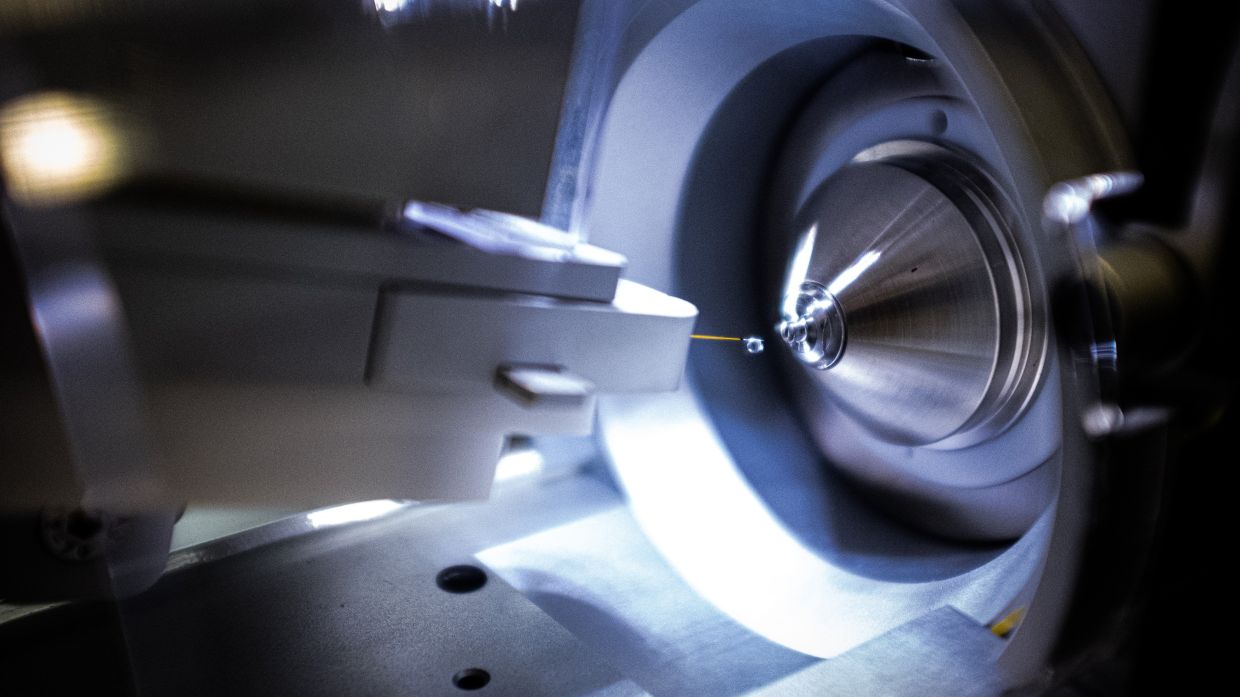
The scale of China's import dependence is staggering. In 2024 alone, the country imported nearly US$17 billion worth of scientific equipment, with more than three-quarters of the major research instruments deployed across Chinese laboratories originating from foreign manufacturers. These are not routine items but sophisticated tools fundamental to contemporary research. Mass spectrometers identify molecular compositions with extraordinary precision; chromatographs separate chemical mixtures for detailed analysis; spectrometers measure material properties through light interaction. A 2024 analysis by consultancy LeadLeo found that China relies on imports for 83 per cent of mass spectrometers and chromatographs, and 75 per cent of spectrometers. Additionally, optical instruments and biological tissue analysis equipment are almost exclusively foreign-sourced.
This vulnerability extends beyond mere inconvenience. Reliance on imported equipment creates cascading operational problems that undermine research productivity. Maintenance cycles stretch longer, after-sales support lags, and equipment costs consume disproportionate portions of research budgets. For a nation intent on establishing scientific supremacy, these inefficiencies represent a hidden tax on innovation. Every laboratory hour spent waiting for foreign servicing teams is an hour Chinese researchers cannot spend advancing their field.
The situation has deteriorated markedly due to deliberate American policy. The United States has systematically tightened restrictions on exports of precision scientific instruments to Chinese institutions, viewing such equipment as potential dual-use technology that could advance Beijing's military capabilities. By December 2020, more than 42 per cent of China-related entries had been added to relevant control lists. These restrictions have intensified during Donald Trump's second presidency, with January 2025 bringing fresh export controls specifically targeting high-parameter flow cytometers and advanced mass spectrometry equipment. American officials explicitly justified the measures by warning that these technologies could "generate high-quality, high-content biological data" suitable for developing biological design tools and AI systems.
The confluence of domestic manufacturing weakness and external sanctions creates a strategic trap. China cannot build the equipment domestically at the technological level required, yet cannot easily purchase it from abroad. This constrained position directly threatens the country's ability to develop competitive AI systems, since artificial intelligence systems trained on inferior data produce inferior results. The geopolitical dimension adds urgency: as the United States systematically closes off access to precision instruments, China loses not only current capability but falls further behind in the technological race.
Beyond equipment constraints, E identified a second critical vulnerability in China's AI development strategy: significant gaps in foundational models compared to American systems. This gap, he warned, "cannot be overlooked" and represents "a reality that must be confronted." The divergence stems from fundamentally different approaches. American companies have concentrated on building powerful general-purpose foundation models and integrating them with automated research infrastructure that can be applied across multiple scientific domains. China, by contrast, adopted an application-driven strategy, constructing scientific AI systems that bundle data, software, computing resources and automated equipment before applying them to specific research problems. While application-focused development offers speed-to-market advantages, it creates narrower, less flexible systems that struggle with novel challenges.
E observed that simply grafting scientific capabilities onto existing open-source models through post-training fine-tuning represents a "false premise." Solving genuinely complex scientific problems requires fundamentally stronger underlying models, not merely surface-level modifications. This technical reality means China cannot easily leap-frog American progress through clever engineering; it must address foundational deficiencies in model architecture and training methodology. The implication weighs heavily: catching up demands sustained, systematic investment rather than incremental improvements.
To navigate these interconnected challenges, E proposed a comprehensive restructuring of China's research ecosystem tailored to the AI era. He advocated for three "breaks" in traditional structures: dissolving disciplinary boundaries to encourage cross-field research, bridging the longstanding divide between theoretical and experimental work, and breaking down barriers between academic institutions and industry. These organisational changes aim to create the institutional flexibility required for AI-driven science. Additionally, E called for overhauling research evaluation systems that currently prioritise academic publications above all else. Under reformed systems, contributions to data infrastructure, software development and research platforms would receive commensurate recognition and reward, creating incentives for scientists to invest in foundational tools rather than chasing publication volume.
For Southeast Asia and the broader region, these Chinese vulnerabilities present both opportunities and cautionary lessons. The equipment import dependence and US sanctions affecting China create potential openings for regional manufacturers to develop indigenous capability, though the technological barriers remain formidable. Simultaneously, the episode underscores how geopolitical competition increasingly weaponises scientific and technological access. Nations throughout Asia pursuing advanced research face similar questions about supply-chain resilience, foreign restrictions, and strategic autonomy. Malaysia and other regional economies investing in scientific infrastructure cannot assume uninterrupted access to the world's most sophisticated instruments; building diverse sourcing strategies and exploring domestic manufacturing capacity has moved from luxury to necessity.

