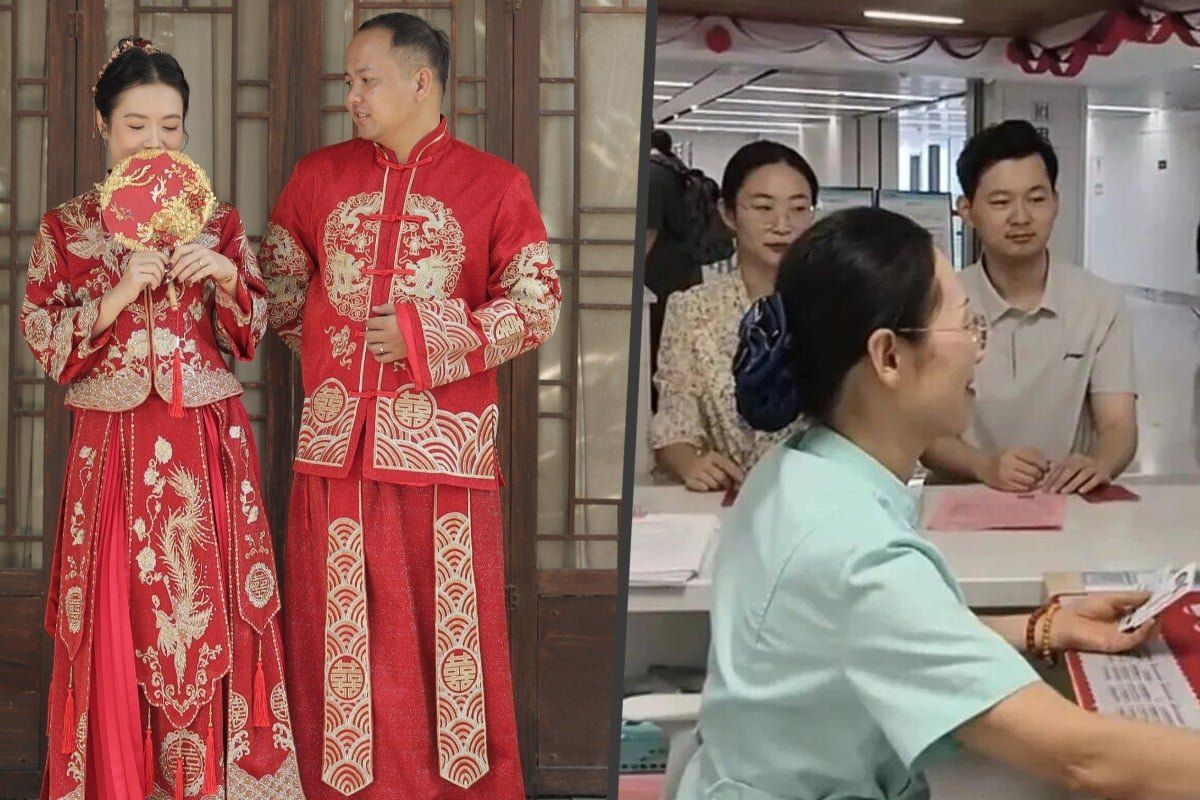
China's government is pursuing an unconventional strategy to reverse its declining marriage rates by partnering with unexpected institutions to streamline the registration process. A hospital in Shandong province and a bank in Tianjin now join an expanding network of temples, nightclubs, airports, and metro stations offering marriage certification services—a creative response to what officials perceive as bureaucratic friction preventing couples from formalizing their relationships.
The shift began in earnest following regulatory reforms introduced in May last year that fundamentally transformed how couples marry across the country. Previously, people were bound by their household registration, or hukou, when selecting where to marry, and were required to present physical hukou booklets as documentation. The new rules eliminated these constraints, allowing couples to register anywhere without presenting household registration documents. This administrative simplification created an opening for government agencies to partner with private businesses and public institutions, transforming marriage registration from a purely bureaucratic function into an experience embedded within retail, leisure, and service environments.
The Postal Savings Bank of China's Tianjin branch became the country's first financial institution to offer marriage registration services in August, drawing amusement from online observers who joked that coupling banking with romance represented an odd combination. Their humor proved prescient—that same month, during Qixi Festival, the Maternal and Child Health Hospital of Linzi District in Zibo City announced its own marriage services, claiming the co-location of registration, premarital medical examinations, and preconception counseling would simplify logistics for newlyweds. The hospital's pitch reflects a deeper logic: if couples must complete medical screening anyway, why not bundle it with registration?
The proliferation of unconventional venues accelerated rapidly. In January, Guangzhou Baiyun International Airport in Guangdong province became China's first airport to issue marriage certificates, sweetening the offer with complimentary observation deck access where couples can watch aircraft operations. Earlier, temples in Beijing and Nanjing began facilitating traditional-attire ceremonies within centuries-old structures, while Hefei's metro system established a registration station—a national first for transport infrastructure. Shanghai's partnership with a local nightclub to host certification ceremonies within club premises exemplified the government's willingness to embrace unexpected partnerships.
By May this year, one year after regulatory changes took effect, the scale of this expansion had become substantial. Official figures indicated more than 500 dedicated marriage registration sites now operated outside traditional civil affairs bureaus, with an additional 1,300 outdoor locations collaborating with authorities to issue certificates. This network reflects a deliberate strategy to eliminate perceived obstacles to marriage formalization, transforming registration from an isolated bureaucratic errand into an activity integrated with tourism, entertainment, healthcare, and transportation.
Initial results appeared encouraging. During the third quarter of last year, 1.61 million couples registered marriages nationwide, representing a 22.5 percent increase year-on-year. Full-year figures for last year showed 6.76 million marriages, up 657,000 from the previous year. However, momentum could not be sustained. The first half of this year witnessed a reversal, with marriage registrations dropping 7.5 percent compared to the same period previously, encompassing 3.28 million couples. This trajectory suggests that convenience alone may not overcome the deeper hesitations deterring young Chinese from marriage.
The asymmetry between registration expansion and actual marriage trends reflects a fundamental misdiagnosis of the problem. While the government streamlined procedures for marriage registration, it has been substantially slower to expand divorce services at the new venues, citing documentation requirements. This restriction hints at the policy's underlying objective: to reduce friction specifically around marriage formation, not dissolution. Yet critics on Chinese social media have questioned whether procedural convenience addresses the actual barriers preventing young people from marrying.
Social media commentary reveals skepticism toward the government's approach. One user directly challenged the premise: "Do people not get married because they can't find a place to register?" Another deployed sharp satire, suggesting that the civil affairs bureau establish divorce services atop Mount Everest—implying that making divorce maximally inconvenient while making marriage maximally convenient reflects a troubling asymmetry. A third commenter articulated a more sophisticated critique: "What holds young people back from marriage is not complicated procedures, but the confidence to face the life challenges they may encounter in the coming decades."
Understanding Chinese youth perspectives on marriage requires acknowledging the complex anxieties that procedural reform cannot address. Young people simultaneously fear the financial burdens marriage imposes—particularly housing costs, which remain prohibitively high across major cities—the potential for family conflicts, and the loss of personal autonomy that marriage traditionally entails in Chinese culture. Simultaneously, younger generations no longer view marriage as a non-negotiable life milestone, reflecting a genuine philosophical shift away from viewing adult identity as necessarily coupled or familial.
The contradiction in China's approach mirrors broader demographic challenges facing East Asian societies. South Korea and Japan have implemented similar convenience measures, yet both nations continue experiencing declining marriages and births. The underlying causes operate at structural and psychological levels that venue diversification cannot remedy: housing affordability, workplace culture that penalizes parenthood, gender inequality in domestic labor distribution, and cultural transition toward valuing individual fulfillment over familial obligation. These factors operate independently of whether someone can register marriage at a hospital, bank, or nightclub.
For Malaysia and other Southeast Asian nations observing China's experience, the case offers instructive lessons about policy implementation. Expanding access and removing procedural friction remain worthwhile governance goals, but misidentifying root causes of social trends can misdirect resources and create false impressions of action without substance. If young people across the region cite economic insecurity, unequal spousal expectations, and housing costs as marriage barriers, then government responses must address these fundamentals rather than focusing exclusively on bureaucratic streamlining.
China's marriage registration expansion demonstrates that creativity in service delivery and willingness to partner with unconventional institutions can modernize administration. Yet the persistence of declining marriage rates despite these innovations underscores that convenience in formalizing relationships cannot manufacture the underlying confidence, economic security, and cultural consensus necessary to sustain marriage as a normative life choice. As societies across Asia confront similar demographic pressures, policymakers must look beyond procedural solutions to the economic structures and gender dynamics that fundamentally shape young people's relationship choices.

