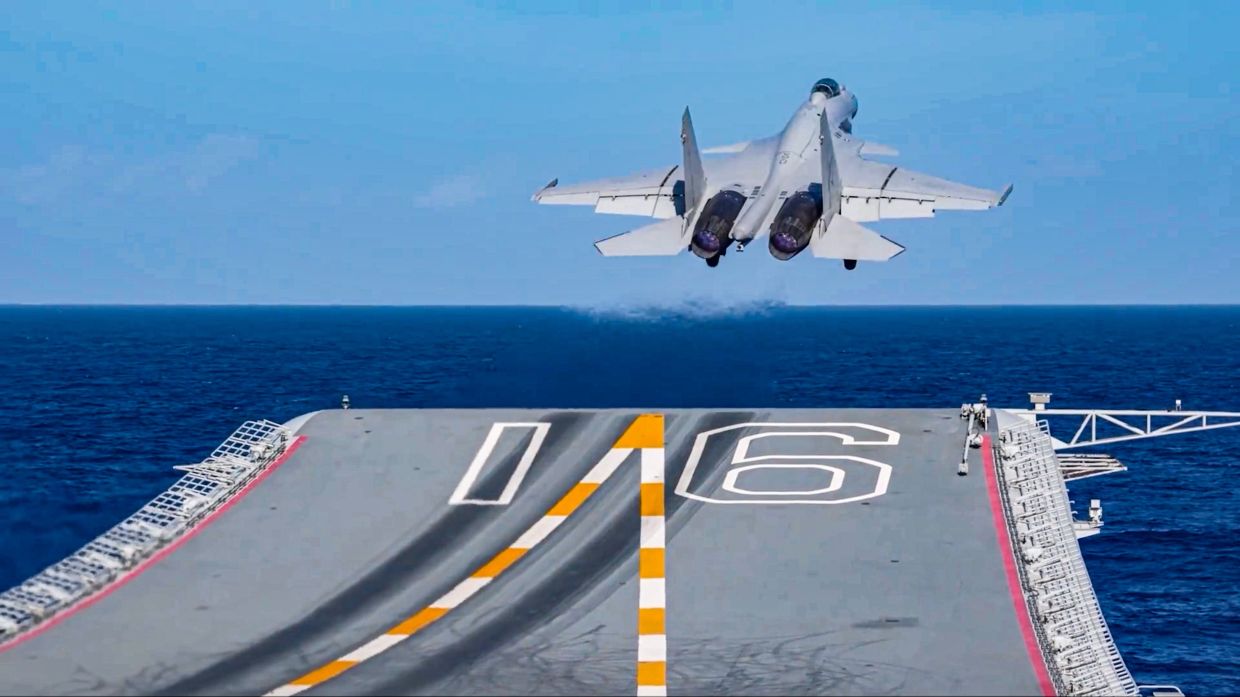
China's accelerating construction of aircraft carriers represents a cornerstone of its regional military ambition, yet strategists increasingly identify undersea warfare as a critical vulnerability that could undermine the effectiveness of these high-value assets. As Beijing projects power further across the Indo-Pacific, the navy's comparative weakness in submarine detection and anti-submarine operations threatens to become a strategic liability that adversaries can exploit through coordinated strikes at sea lanes and choke points vital to Chinese operations.
A comprehensive analysis from Washington-based Centre for Strategic and International Studies has articulated a multi-layered "cost-imposition" strategy targeting Chinese carrier groups, encompassing land-based strike networks, long-range aircraft supported by satellite surveillance, cyber and electromagnetic disruption, and coordinated drone assaults. Yet among these overlapping threat vectors, submarine ambushes emerge as the element where Chinese naval capability demonstrates the most pronounced deficiency. The strategic advantage held by US attack submarines, which operate with exceptional stealth across the western Pacific, represents perhaps the single most consequential asymmetry in any potential conflict scenario affecting regional stability.
The geographic layout of the Indo-Pacific reinforces this naval vulnerability in ways that directly concern Beijing. Strategic maritime passages form natural chokepoints where opposing forces can concentrate their efforts and concentrate firepower on transiting vessels. Submarines and other advanced platforms could systematically threaten Chinese carrier groups as they navigate these critical waterways, whilst carrier-based aircraft equipped with satellite-guided weapons systems could simultaneously conduct strikes from greater distances. Coordinated attacks on sensors and communications infrastructure would compound these challenges by degrading the operational awareness essential for coordinated naval manoeuvres and defensive coordination.
Christopher Sharman, director of the China Maritime Studies Institute at the US Naval War College, acknowledges that the undersea vulnerability identified in recent strategic analyses "remains significant today," though he cautions against treating it as immutable. The People's Liberation Army Navy has channelled substantial resources into developing capabilities intended to enhance awareness of the undersea environment, reflecting an acknowledgement within Beijing's military establishment that this represents a critical gap requiring urgent remediation. Nonetheless, critical limitations persist that constrain Chinese operational effectiveness, particularly in the most demanding undersea battlespace extending beyond the first island chain where environmental conditions become more challenging to predict and monitor.
A particularly telling indicator of Chinese strategic concern involves meteorological and oceanographic capabilities. According to Sharman's analysis, specialists affiliated with the PLAN recognise that China's existing meteorological and oceanographic knowledge still trails significantly behind that possessed by the United States Navy. This comparative disadvantage proves particularly consequential for undersea operations, as understanding ocean temperature gradients, salinity variations, acoustic properties and currents directly determines the detectability of submarines. The impediment this creates to both submarine and anti-submarine warfare operations extends beyond waters within the first island chain and compounds as Chinese forces operate farther from the mainland.
Beijing has launched ambitious programmes to systematically address this knowledge gap. The Transparent Ocean initiative, originally proposed over a decade ago, represents perhaps the most comprehensive response to undersea intelligence deficiencies. This programme establishes an extensive network incorporating satellites, oceanographic research vessels, autonomous buoys, underwater gliders and seabed-mounted sensor arrays distributed across strategically vital waters including the western Pacific, South China Sea and Indian Ocean. Chinese authorities have explicitly connected this project to national security imperatives, whilst Ocean University of China has documented the deployment of hundreds of deep-sea observation systems with monitoring networks now extending from regional waters into the broader western Pacific theatre.
Simultaneously, the PLAN has undertaken systematic improvements to anti-submarine warfare capabilities. The maritime studies institute has documented expansion of fixed-wing maritime patrol aircraft fleets, deployment of Type 927 ocean-surveillance vessels equipped with sophisticated towed-array sonar systems, and systematic upgrades to sensors fitted across maritime patrol aircraft and helicopter platforms used for submarine detection and engagement. These investments reflect high-level recognition that submarine threats present not merely a tactical concern but a fundamental challenge to securing operational freedom across maritime domains essential to broader strategic objectives.
Analysts emphasise that undersea warfare transcends the narrow question of protecting surface carrier groups. Rather, it constitutes a core pillar of broader PRC naval strategy with implications extending across multiple geographical zones and conflict scenarios. Within the first island chain, undersea warfare capabilities prove critical to achieving the PLAN's fundamental objective of sea control during wartime conditions. Beyond that boundary and extending into the Indian Ocean, PLA strategists regard effective undersea operations as essential for countering enduring US naval superiority and complicating potential third-party intervention in regional conflicts, particularly any scenario involving Taiwan. This strategic imperative explains why Beijing invests so heavily in submarine capabilities whilst simultaneously rushing to address detection vulnerabilities.
Taiwan's political status generates particular operational considerations shaping how Beijing views undersea challenges. The mainland regards the island as integral Chinese territory and has explicitly rejected renouncing military force as a reunification instrument. Whilst most international actors including the United States decline to recognise Taiwan's independence, Washington maintains formal legal obligations to supply defensive weaponry and opposes any attempted military conquest. Japanese intervention would elevate complexities substantially, as Tokyo possesses advanced submarine and anti-ship capabilities that could target Chinese naval forces operating in nearby waters, fundamentally altering force balance calculations in any conflict scenario.
Timothy Heath, head of defence research firm Perceptum, identifies anti-submarine warfare as a persisting operational challenge for Chinese forces, particularly given that American submarines rank among the world's quietest vessels, rendering them extraordinarily difficult to detect and track. This technical disadvantage becomes more pronounced if Japan enters any conflict, potentially allowing Tokyo to systematically attack Chinese warships operating adjacent to Japanese territory. Whilst some strategic theorists suggest deploying Chinese carriers farther into the western Pacific might provide enhanced air cover for naval forces attempting to counter third-party intervention, Heath cautions such deployment would prove strategically foolish given the multiple vectors through which the United States could target and destroy these platforms far from mainland protection.
Instead, China's land-based intermediate-range ballistic missiles represent comparatively more effective instruments for threatening US vessels across extended distances to the second island chain. Deploying carrier groups at such extended ranges would expose extraordinarily valuable and expensive platforms to unacceptable vulnerability without corresponding operational benefit, a calculation that fundamentally constrains how aggressively Beijing can project its carrier fleet into disputed waters. This reality demonstrates how undersea warfare vulnerabilities cascade through broader strategic planning, forcing difficult compromises on force deployment and operational reach.
US strategists and allied defence planners argue that Beijing's carrier protection challenges should directly shape procurement priorities and military investment strategies for the United States, Japan and Australia. Enhanced investment in advanced torpedoes, undersea drone systems and missile production represents the strategic response these nations are pursuing. Rather than matching Chinese carrier ambitions through surface-to-surface competition, allied defence establishments increasingly emphasise undersea asymmetries and land-based strike capabilities that render extended carrier deployments prohibitively risky. This strategic reorientation reflects recognition that submarine warfare remains perhaps the most consequential determinant of regional naval balance, with profound implications for how Beijing can exercise military leverage across the Indo-Pacific.

