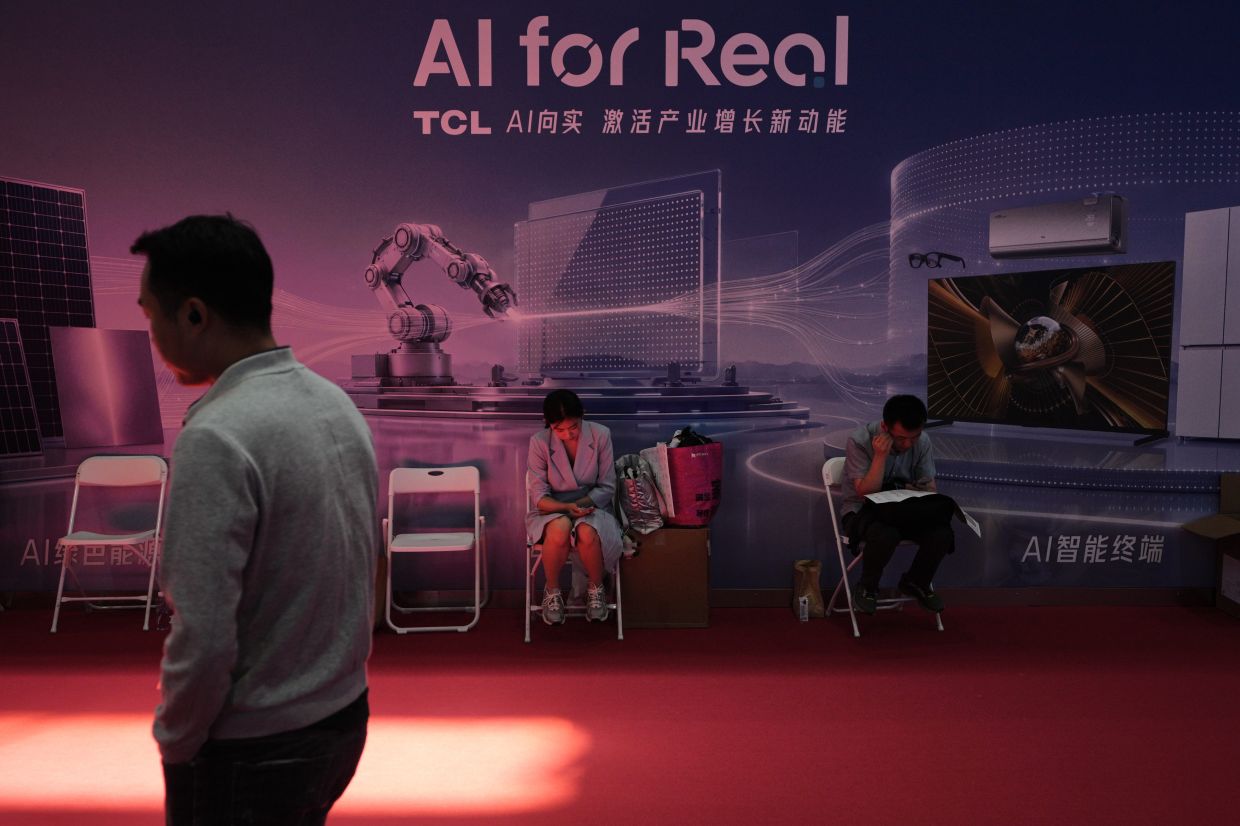
China's workforce faces an unprecedented challenge as the government accelerates artificial intelligence adoption across the economy, fundamentally altering employment prospects in ways that ripple far beyond the country's borders. The transformation reflects Beijing's deliberate strategy to maintain technological supremacy against the United States, but the social consequences—including widespread job anxiety and potential economic instability—are emerging as serious policy complications that economists and policymakers increasingly struggle to address.
The scale of AI integration in Chinese businesses has become staggering. Industrial enterprises deploying AI models and intelligent agents surged from 9.6 percent in 2024 to 47.5 percent last year, according to market intelligence firm IDC. This acceleration stems from deliberate government encouragement through the "AI Plus" initiative and five-year plans extending through 2030, which systematically inject artificial intelligence into manufacturing, services, and creative sectors. Unlike other nations where AI adoption proceeds more organically through market competition, China's top-down approach ensures broader penetration across diverse industries at remarkable speed. The availability of robust open-source AI ecosystems has enabled even smaller enterprises to implement automation without prohibitive initial investment, democratizing the technology in ways that accelerate displacement across skill levels.
Displacement is already visible across multiple sectors. In creative industries, the short-video market contracted dramatically—live-action short and vertical video series designed for mobile phones dropped roughly 75 percent in the first quarter of this year compared to the previous year. Translation wages have been cut by more than half in recent years as AI-powered tools mature. Foreign language programs at prestigious universities are declining in popularity as students recognize that specialized linguistic expertise faces automation. Software developers, once considered among the most secure professional cohorts, increasingly recognize their vulnerability. Fei, a 40-year-old programmer, now candidly acknowledges that mid-level coding positions are "essentially replaceable in most of the cases," reflecting a hard-won acceptance among technologists that their expertise has become commodified and vulnerable to algorithmic substitution.
What distinguishes China's AI transition from similar technological disruptions elsewhere is the pronounced lack of public resistance. According to Shujing He, a senior analyst at advisory firm Plenum based in Beijing, there appears substantially less anti-AI sentiment in China compared to Western countries. Most Chinese workers express positive, neutral, or mildly interested attitudes toward artificial intelligence. Paradoxically, individuals already displaced by automation have become eager experimenters with AI-enabled entrepreneurial ventures and independent projects. This acceptance, rather than reflecting enthusiasm for job displacement, appears to stem from a pragmatic recognition that resistance proves futile when government policy and business incentives align toward automation. Workers understand they must adapt rather than protest, fostering a cultural environment where AI adoption proceeds with minimal social friction.
Young workers face disproportionate challenges. China's overall urban unemployment hovers near five percent, but youth unemployment for those aged 16 to 24 (excluding students) stands roughly triple that figure. This generational disparity reflects both the rapid automation of entry-level positions where younger workers traditionally gain experience and the broader economic slowdown that has reduced job creation across sectors. The combination of technological disruption and sluggish economic growth creates particularly acute pressure on workers with limited career capital or established networks.
Women face elevated displacement risks according to International Labour Organization research. Because women remain concentrated in roles particularly amenable to automation—electronics assembly, routine data processing, customer service—and remain underrepresented in science and technology fields where new opportunities emerge, they encounter asymmetric vulnerability. The gender dimension of AI-driven displacement in China deserves urgent policy attention but remains largely secondary in government planning focused primarily on productivity gains and technological competition.
The economic implications extend beyond individual hardship into macroeconomic territory. China's economic growth has already decelerated substantially, partly because consumer spending has lagged as households adopt precautionary savings behaviors rooted in employment anxiety. Workers worried about losing jobs reduce spending on discretionary goods and services, dampening the demand that drives growth. This dynamic compounds existing headwinds from the prolonged housing market downturn that undermined household wealth accumulation. Economists including Cornell University professor Eswar Prasad worry that rapid AI displacement, rather than generating compensatory new employment, could "worsen the employment growth problem and result in a detrimental effect on social stability." Chinese technology giants themselves have illustrated this dynamic, cutting or restructuring tens of thousands of positions partly because AI enabled workforce reduction, demonstrating that innovation need not create jobs even as it increases productivity.
Some workers are experimenting with transition strategies. Wang Zhicheng, a 32-year-old scriptwriter, used AI extensively for brainstorming and fact-checking before his company's parent corporation eliminated half of its writing staff. Rather than remaining in diminishing roles, he resigned to create illustrated children's books independently, treating AI as a supplementary tool while maintaining creative decision-making authority. Du Qinchun, a part-time translator, now trains AI translation models while performing translation work—at least temporarily receiving more work hours even as industry wages collapse. These adaptive strategies reflect rational responses to technological disruption but cannot absorb the scale of displacement occurring across sectors.
Demographic factors may ultimately reshape how China's AI transition unfolds. The country's 1.4 billion population is aging and declining more rapidly than most developed nations. By 2050, China will likely have fewer than two working-age adults supporting each retiree, compared with more than 2.5 in the United States. This inverted demographic pyramid means that automation, rather than pure technological unemployment, might partially offset severe labor shortages. Xuenan Cao, professor at San Francisco Bay University whose research focuses on technology and society, suggests that "automation could partially offset a shrinking workforce rather than being purely a threat to it." In this alternative scenario, AI adoption accelerates employment for remaining workers while maintaining living standards despite population contraction. Whether this optimistic trajectory materializes depends on whether Chinese policymakers successfully retrain workers for emerging roles and whether economic growth rebounds sufficiently to generate new opportunities.
Yet near-term challenges remain formidable. The combination of rapid technological disruption, demographic headwinds, and sluggish consumer demand creates a precarious economic environment where social stability depends on managing worker transitions effectively. Southeast Asian nations observing China's experience should prepare for similar waves of AI-driven disruption, recognizing that without deliberate policy intervention, technological productivity gains may concentrate wealth while displacing workers faster than economies can generate replacement employment. For Malaysian and regional policymakers, China's unfolding AI transition offers cautionary lessons about ensuring automation benefits distribute broadly rather than exacerbating inequality and social tension.

