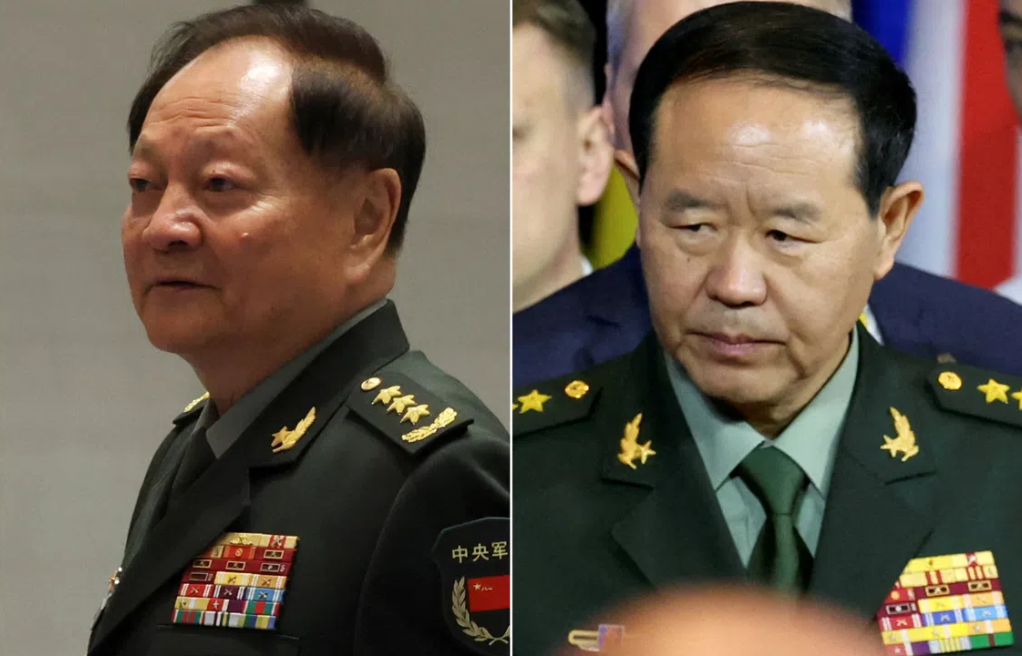
China's governing bodies have removed two of the country's most senior military figures from its top defence institution in the latest phase of a sweeping anti-corruption offensive directed by President Xi Jinping. The State Council announced on Friday that Zhang Youxia and Liu Zhenli had been stripped of their positions following investigations into alleged serious breaches of discipline and legal standards, according to reports from state media Xinhua. The removals, which were formalised through the Standing Committee of the National People's Congress, represent another significant blow to China's military hierarchy at the highest level.
Zhang held one of the most powerful positions in the Chinese military apparatus as vice-chairman of the Central Military Commission and was only second to Xi himself within the defence establishment. His prominence extended beyond military circles—he also sat on the Politburo, the Communist Party's top decision-making body, placing him among China's most influential figures. Liu, meanwhile, occupied the substantial role of chief of staff at the Joint Staff Department, a critical operational position within the military command structure. Together, their removal leaves the state Central Military Commission with only two active members remaining, a dramatic reduction from its previous seven-member composition.
The departures underscore the magnitude of Xi's anti-corruption initiative, which commenced in 2012 and has fundamentally reshaped China's military establishment over more than a decade. During this period, scores of senior commanders and defence officials have faced investigation, removal, or expulsion from their posts as part of a systematic effort to root out what Beijing characterises as pervasive corruption within the armed forces. Earlier last month, Xi personally called on senior Communist Party leadership to intensify this long-running campaign, signalling that the military remains under intense scrutiny despite the years already invested in the purge.
China maintains a dual-structure system whereby both the Communist Party and the state government operate parallel Central Military Commission bodies. Although these two entities exist theoretically as distinct organisations, they function in practice as a single integrated institution. The announcement on Friday specifically addressed Zhang and Liu's removal from the state CMC, handled through parliamentary procedures. However, the pair have not yet been formally or publicly stripped of their positions within the Communist Party's equivalent structure, suggesting the political leadership may continue developing their cases through that separate apparatus or that such formal announcements could follow.
The parliament's updated list of deputies, released on the same Friday, provided concrete evidence of the removals by simply deleting Zhang and Liu's names from the official roster. Beyond these two most prominent figures, the dismissal affected ten additional lawmakers whose positions became untenable. Lieutenant General Zhong Shaojun, who previously directed the CMC General Office, and General Ju Qiansheng, a former commander of the Strategic Support Force, both lost their seats. The scope of removals suggests a coordinated action addressing multiple levels within the defence hierarchy rather than an isolated incident targeting individual officers.
The purge extended beyond purely military personnel to encompass individuals with military-industrial connections. Gao Shiwen, who served as mayor of Nanchang in southern China, was among those removed from the legislative body. Notably, Gao had previously held positions within China Aerospace Science and Technology Corporation, the state-controlled defence and aerospace conglomerate, indicating that investigations into military corruption have increasingly encompassed the broader defence-industrial complex and civilian officials positioned at the intersection of politics and defence.
In a related development announced earlier in the week, Zhao Zongqi was stripped of his membership in the Chinese People's Political Consultative Conference, China's top advisory body. Zhao, a former commander of the Western Theatre Command, had overseen military operations during the 2020 border clashes between Chinese and Indian forces along their disputed frontier. His removal, handled through the advisory body rather than legislative channels, demonstrates that the anti-corruption campaign extends to civilian oversight institutions and continues to touch figures with histories tied to contentious military episodes.
From a regional perspective, the scale of these purges raises questions about the stability and continuity of China's military command structure. For countries across Southeast Asia and the Indo-Pacific region that monitor Chinese military capabilities and decision-making, such significant upheaval among top commanders could influence strategic calculations regarding Beijing's military readiness and the consistency of defence policies. The removal of Western Theatre Command leadership, in particular, carries implications for how China manages its relationships with neighbouring states and handles territorial disputes.
The timing and breadth of these removals also reflect Xi's consolidation of personal power within the Chinese state system. By systematically removing potential rivals or independent power bases from the military's upper echelons, Xi strengthens his direct control over defence and security apparatus. This pattern of centralisation, while presented publicly as an anti-corruption effort, fundamentally reshapes the distribution of authority within China's defence establishment and ensures that military leadership comprises figures aligned with Xi's strategic vision.
For observers of China's internal politics, these actions signal that Xi's anti-corruption campaign, despite operating for over a decade, remains an active instrument of political control rather than a concluded initiative. The military, as China's most resource-rich institution outside civilian government, continues to represent a domain where corruption investigations provide institutional cover for what amounts to political restructuring. As China navigates increasingly complex strategic challenges in its regional environment and maintains significant defence capabilities, the composition and coherence of its top military leadership carry implications that extend well beyond Beijing's borders into the security calculations of nations throughout Asia.

