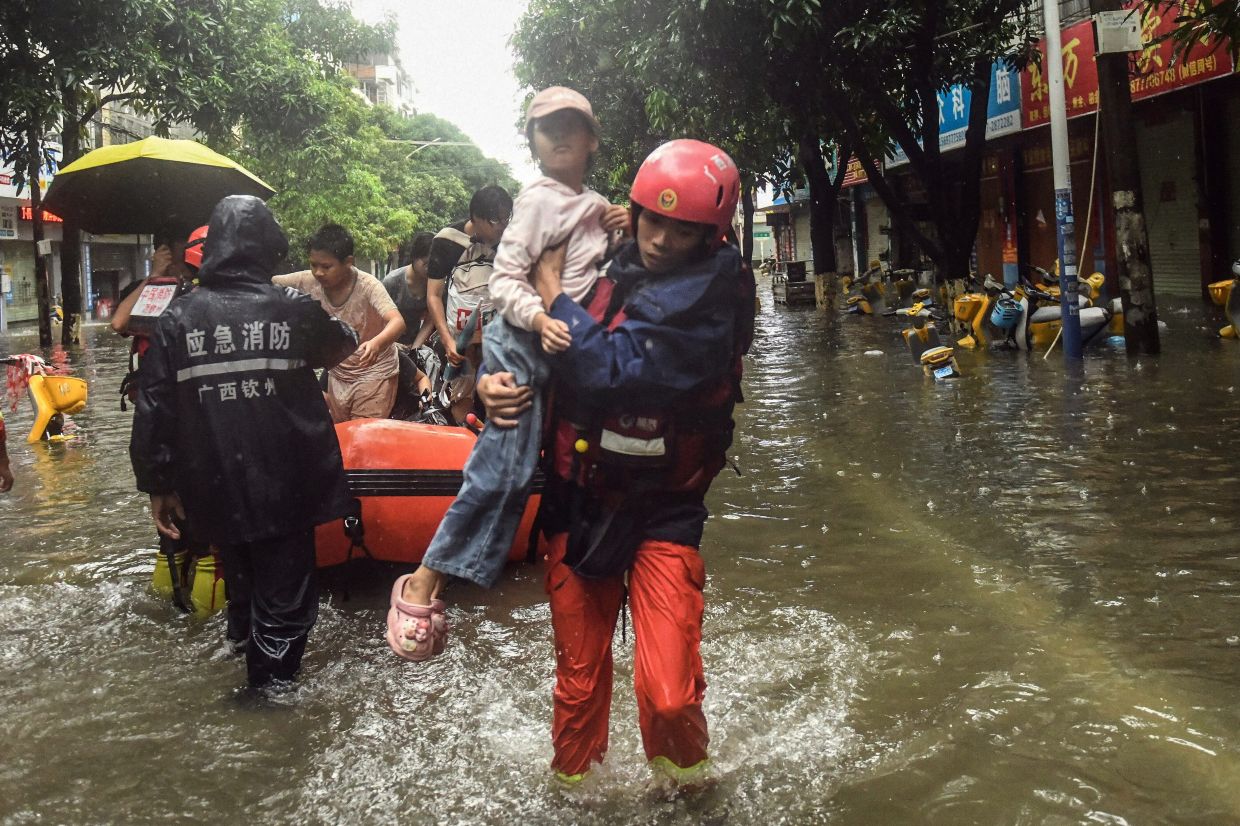
Rescue operations intensified across multiple provinces in China following a succession of severe weather events that have claimed at least 17 lives and forced the displacement of more than 100,000 people. The disaster unfolded as Typhoon Maysak unleashed torrential downpours and triggered catastrophic flooding in the southern regions of Guangxi and Guangdong, while violent thunderstorms simultaneously devastated parts of central China. The scale of the emergency reflects the region's vulnerability to seasonal weather extremes, a phenomenon that regularly tests Beijing's disaster management capabilities and infrastructure resilience during the summer monsoon season.
In Guangxi province, the impact has been particularly severe, with six confirmed deaths and approximately 130,000 residents evacuated as of Wednesday. The torrential rainfall associated with Typhoon Maysak overwhelmed drainage systems and flood management infrastructure across the region. Authorities reported that fast-moving water breached the banks of 40 distinct rivers and waterways, inundating vast areas and destroying nearly 13,000 acres of agricultural land. The cascading nature of these failures—where overflow in one waterway compounds problems downstream—created compounding crises that stretched emergency services thin across multiple jurisdictions.
The bursting of a reservoir dam near Guangxi provided some of the most arresting visual evidence of the disaster's power. Video footage broadcast by state television showed torrents of muddy water surging past remnants of concrete dam walls, with rescue personnel in bright orange life vests maneuvering inflatable boats through the debris-laden currents. The dam failure represented a critical breakdown in flood containment systems that are engineered to handle predictable seasonal rainfall patterns but struggle against the intensity of modern storm systems. Experts have increasingly questioned whether China's aging water infrastructure can withstand the climatic stresses of contemporary weather phenomena.
Weather forecasts offered little respite to residents and emergency planners. Officials explicitly cautioned that heavy rainfall would persist throughout Wednesday and likely continue into Thursday across both Guangxi and the neighbouring Guangdong province. The Minister of Water Resources, Li Guoying, warned that water levels at the Wuzhou Hydrological Station in Guangxi were expected to exceed safe thresholds by more than six metres early Thursday morning, creating fresh anxiety about potential secondary failures in reservoirs and embankment systems already straining under existing water pressure. The prolonged nature of the downpours distinguishes this event from isolated weather incidents; continuous rainfall transforms temporary flooding into sustained humanitarian crises.
Chinese authorities responded by establishing supply chains for emergency aid, coordinating distribution of food, protective rainwear, and additional inflatable rescue boats to affected communities. The State Flood Control and Drought Relief Headquarters maintained the second-highest alert level for emergency response operations in Guangxi, signalling the seriousness with which Beijing regarded the ongoing situation. President Xi Jinping issued directives for rescue teams to mobilise comprehensively and conduct operations with maximum urgency, underscoring the political importance attached to demonstrating effective state capacity during disasters. Such high-level attention often accelerates resource deployment and ensures coordination across provincial bureaucracies that might otherwise operate in silos.
The disaster extended beyond Guangxi's borders. Thunderstorms and powerful winds killed an additional 11 people in Hubei province, with one person reported missing in that region. The storms injured 331 residents and caused structural damage across thousands of properties—4,800 houses sustained significant damage while 22 collapsed entirely. Tornadoes were documented in other locations late Monday, though detailed casualty figures remained incomplete. This geographic spread indicates the scale of the weather system, which affected an area spanning hundreds of kilometres across central and southern China.
Simultaneously, a separate tragedy unfolded in northwestern Gansu province, where a landslide killed 21 people. The incident occurred at approximately 6:56 am Tuesday at Rencang village in Dangchang County, initially burying 33 individuals before rescue teams accessed the site. By Wednesday, search and rescue operations concluded with the confirmation of 21 fatalities. Local authorities allocated 30 million yuan (approximately US$4.4 million) toward reconstruction and relief efforts in the affected community. The investigation into triggering factors continued, though heavy rainfall across western provinces suggested meteorological causes linked to the same weather system devastating eastern regions.
These cascading disasters illustrate a recurring vulnerability in China's natural disaster management strategy. During summer months, the country simultaneously experiences intense rainfall in some regions while other areas endure extreme heat stress—a pattern that strains both emergency response capacity and water resource allocation. The compounding nature of this latest crisis, where storms triggered flooding in coastal provinces while landslides struck inland areas simultaneously, placed enormous demands on national rescue coordination mechanisms. Southeast Asian observers recognise similar vulnerability patterns in their own monsoon-prone countries, where rapid urbanisation and environmental degradation compound the risks posed by seasonal weather extremes.
The immediate human impact extends beyond the fatality figures and evacuation statistics. Displacement of 100,000-plus residents creates urgent pressures for emergency sheltering, sanitation, and disease prevention in the short term, while medium-term challenges include agricultural rehabilitation across devastated farming communities and reconstruction of damaged housing stock. The destruction of nearly 13,000 acres of agricultural land will likely disrupt regional food supplies and create economic hardship for rural populations whose livelihoods depend on seasonal harvests. Regional governments face the dual challenge of managing immediate humanitarian needs while planning longer-term recovery investments.
The series of disasters also raises questions about infrastructure adequacy and climate adaptation planning. China's reservoirs and flood control systems were built during previous decades when precipitation patterns differed from current norms. Scientists increasingly attribute intensified rainfall events to climate change, suggesting that historical engineering standards may no longer provide adequate safety margins. Provincial authorities must now evaluate whether existing infrastructure requires retrofitting or complete redesign to accommodate evolving meteorological realities. Such assessments carry enormous financial and political implications, as adequate preparedness demands substantial upfront investment.

