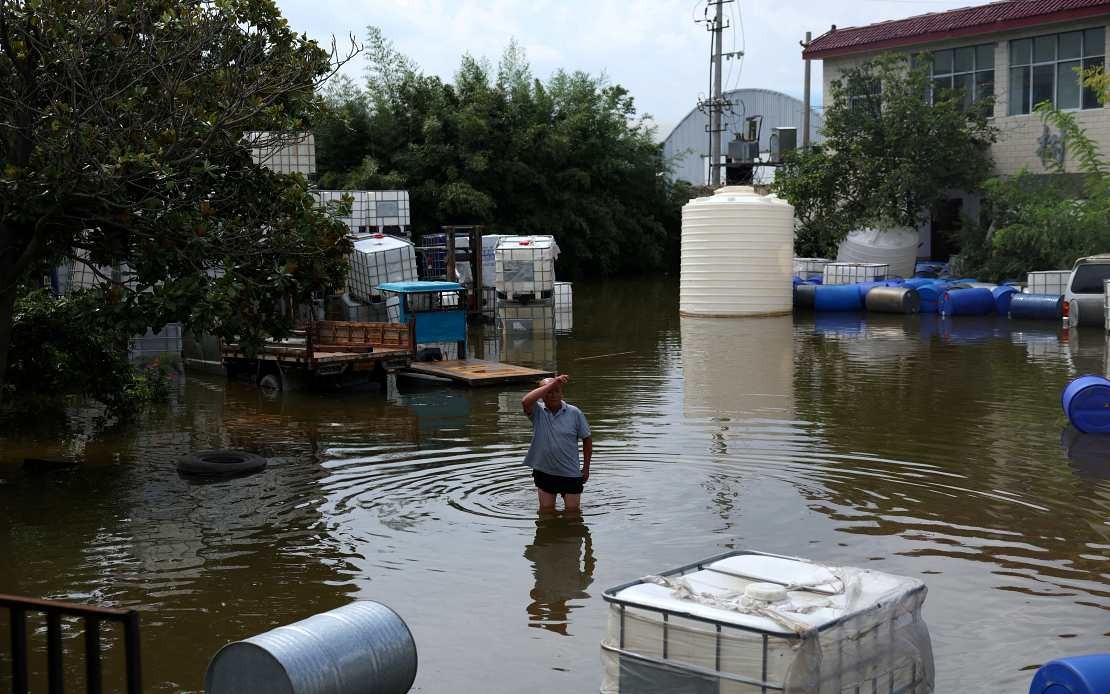
China has launched a major emergency response in central Henan Province after a critical piece of flood infrastructure gave way under the relentless downpour from Typhoon Dolphin. The Ministry of Emergency Management confirmed on Friday that rescue teams had reached Zhoukou City following the levee breach, which occurred around 11 pm on Thursday after intense rainfall swelled local waterways beyond capacity. This mobilisation represents a swift governmental reaction to one of the season's most destructive weather systems, which has already claimed significant damage across multiple provinces.
The scale of the deployment underscores the severity of the situation confronting authorities. The rescue contingent comprises 200 specialised engineering rescue personnel drawn from China Anneng Group, supplemented by 110 units of advanced heavy engineering equipment. These teams arrived on Friday and immediately integrated into ongoing emergency operations across the affected region. The specificity of this deployment—focusing on engineering capabilities rather than general rescue workers—suggests officials are confronting complex structural challenges beyond simple evacuation efforts, likely involving stabilisation of remaining embankments and clearing of debris-laden waterways.
Typhoon Dolphin, categorised as 2024's 13th typhoon, has proven particularly destructive for the region. While the storm system itself dissipated before reaching inland areas, the moisture it carried collided with local atmospheric conditions to produce extraordinary rainfall accumulations. This phenomenon, common in central China during late summer, transforms seasonal storm systems into extended precipitation events that overwhelm drainage infrastructure and saturate soil conditions. The levee breach in Zhoukou represents a spectacular failure of aging water control systems that have historically protected this densely populated agricultural region.
In response to the escalating crisis, China's National Commission for Disaster Prevention, Reduction and Relief activated a Level-IV national disaster relief emergency response on Friday. This administrative classification triggers pre-positioned emergency protocols and unlocks access to centralised resources that regional authorities alone cannot mobilise. The decision reflects confidence among senior officials that the situation requires coordinated national intervention rather than localised provincial management, indicating expectations of substantial displacement and infrastructure damage across a wide geographic area.
Logistical support has mobilised rapidly to assist displaced residents. The National Commission's office, working in concert with the Ministry of Emergency Management and the National Food and Strategic Reserves Administration, dispatched 30,000 items of disaster relief supplies destined for Zhoukou, Xuchang, and other affected municipalities. The inventory of folding beds, summer quilts, and family emergency kits suggests officials are preparing for extended displacement scenarios rather than temporary evacuations, implying concerns that restoration of essential services may require weeks rather than days.
For Malaysia and Southeast Asia, this episode carries particular significance beyond humanitarian dimensions. China's disaster management infrastructure—combining rapid personnel deployment with pre-positioned material reserves and coordinated inter-agency responses—provides a regional benchmark against which neighbouring countries measure their own preparedness. As climate patterns intensify and extreme weather events become more frequent across the monsoon belt, the effectiveness of centralised disaster coordination becomes increasingly relevant to regional stability and economic continuity.
Henan Province occupies critical importance within China's economic geography as a major agricultural hub and transportation nexus. The levee breach threatens not only immediate agricultural output for the autumn harvest but also longer-term implications for regional food security. China's grain belt historically concentrated in Henan means disruptions cascade through national commodity markets and affect pricing pressures across East and Southeast Asia. Previous flood events in the province have temporarily elevated grain prices regionally and prompted policy adjustments in import-dependent nations including Malaysia.
The deployment of engineering-focused rescue assets rather than general medical or evacuation teams suggests authorities are prioritising infrastructure stabilisation as a primary objective. This approach reflects hard lessons learned from previous catastrophic failures, including the 2012 Beijing floods where inadequate drainage systems exacerbated by development created secondary flooding. By emphasising engineering response, Chinese authorities demonstrate evolved understanding that managing extreme weather involves structural problem-solving rather than merely treating consequences after infrastructure fails.
Climate adaptation remains an ongoing challenge for China's aging water management systems, many constructed during the mid-twentieth century when precipitation patterns differed substantially from current norms. Rising temperatures are altering storm intensity distributions, making historical design parameters increasingly obsolete. Henan has already invested heavily in embankment reinforcement following major flood events in the 1990s, yet the latest breach indicates that even upgraded infrastructure faces limitations when confronted with compound meteorological extremes combining typhoon moisture with monsoonal atmospheric circulation.
The coordinated response also reflects China's institutional capacity to mobilise resources across provincial boundaries when central authorities identify critical situations. This capability—distinctive within the Asian region—enables rapid concentration of expertise and equipment that smaller provincial governments could not independently summon. For neighbouring countries with more fragmented administrative structures, the Chinese response offers both inspiration regarding disaster coordination and implicit reminders of relative capacity disparities that shape regional dynamics during crises.
Looking forward, this incident will likely accelerate discussions within Chinese policymaking circles regarding infrastructure investment priorities. Water management systems in vulnerable provinces face mounting pressure to incorporate climate change projections into future redesigns. Regional governments across Asia, particularly those facing similar geographical challenges and aging infrastructure, will monitor Chinese responses closely. The outcomes in Zhoukou may inform subsequent investment decisions in flood prevention across Southeast Asia, where comparable challenges confront multiple developing economies simultaneously managing urbanisation pressures with climate risks.

