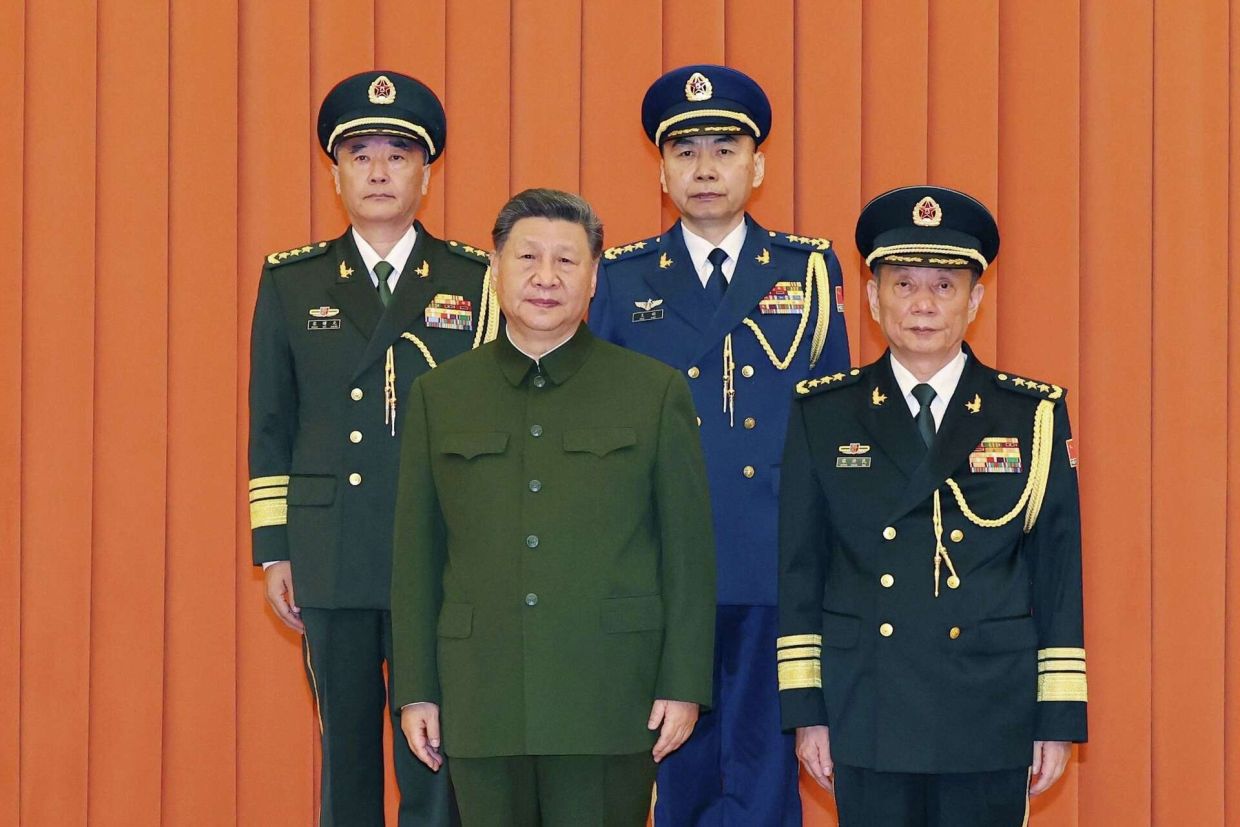
China's military establishment has moved to fill gaps left by an extended anti-corruption drive, elevating two senior officers to the rank of general in a ceremony led by Xi Jinping on Friday, July 3. The promotions of Zhang Shuguang and air force commander Wang Gang are widely viewed as a preliminary step toward reorganising the military's highest echelons, a process that will likely reshape power dynamics within the armed forces and cement Xi's grip over defence matters as he consolidates his political position.
The timing and nature of these appointments offer insight into Beijing's strategic priorities. The corruption investigations have fundamentally altered the composition of the Central Military Commission, the seven-member body that serves as the military's supreme decision-making authority. Once a forum where power was distributed among senior figures, the commission has been hollowed out by the anti-corruption campaign, with only two members currently active: Xi himself, who chairs the body, and Vice Chair Zhang Shengmin. This dramatic reduction has created both a governance challenge and an opportunity for Xi to reshape the institution according to his vision.
Zhang Shuguang's elevation carries particular significance beyond his new rank. In addition to being promoted to general, he has been appointed to head the corruption investigation unit operating within the Central Military Commission itself. This dual role positions him as both a newly minted senior commander and the architect of the purge that has removed his predecessors and rivals. Such a combination of administrative authority and investigative power suggests that Beijing intends to maintain momentum in its clean-up efforts while simultaneously installing loyalists in key positions.
The anti-corruption campaign targeting the military represents one of the most consequential institutional changes undertaken by Xi since he assumed leadership of the Communist Party and the armed forces. Two former vice chairs of the Central Military Commission, positions that traditionally carried enormous influence over defence policy and strategic direction, have been removed or effectively sidelined through the investigations. The military's previous top general has similarly been swept up in the process, creating a generational break in leadership that extends beyond simple personnel changes into the realm of strategic doctrine and operational philosophy.
For readers across Southeast Asia, these developments carry implications that extend well beyond China's borders. A military establishment weakened by internal investigations and purges may operate less predictably during a period of transition, while a consolidated chain of command under Xi could potentially enable more decisive—and potentially more assertive—military action in disputed regions. The reshuffling also underscores how thoroughly Xi has subjugated the military to his personal authority, a consolidation that influences Beijing's approach to everything from South China Sea disputes to Taiwan policy.
The Central Military Commission's reduced membership has created practical vacancies that the new generals may soon fill. As the commission approaches the completion of its current five-year term, a reorganisation is expected to be announced in autumn of next year. This timeline suggests that Zhang Shuguang and Wang Gang are being groomed for appointment to the commission itself, a move that would restore the body to a more functional state while ensuring that its members are personally vetted by Xi and have undergone scrutiny by the anti-corruption apparatus now headed by Zhang.
The broader purpose of these purges remains rooted in Xi's determination to ensure unwavering loyalty from the military establishment. The Communist Party's historical dependence on military backing to maintain power has made the armed forces a crucial stakeholder in any succession or consolidation process. By removing figures associated with previous leadership eras and installing officers who owe their advancement directly to his patronage, Xi has fundamentally altered the incentive structure within the military. Ambitious officers now understand that their career prospects depend less on regional military networks or service branch loyalties and more on demonstrating personal allegiance to the paramount leader.
This institutional transformation also reflects Xi's broader anti-corruption campaign, which has served simultaneously as both a genuine effort to eliminate systemic graft and a mechanism for eliminating political rivals. Within the military context, the distinction between rooting out corruption and consolidating power becomes particularly blurred. Officers investigated for financial impropriety often held significant positions and represented potential obstacles to Xi's authority. Their removal cleared both genuine administrative problems and potential power bases that might have challenged his vision for military modernisation and deployment.
The promotion of Wang Gang, the air force commander, deserves separate attention given the increasing importance of air power in military doctrine throughout Asia. China's military establishment has undergone sustained modernisation and doctrinal revision over the past decade, with particular emphasis on developing air, naval, and cyber capabilities. By elevating the air force commander to general rank, Beijing signals its continued prioritisation of aerial capabilities, particularly relevant given ongoing tensions over airspace in the Taiwan Strait and South China Sea. Wang's elevation also suggests that the air force, as an institution, has maintained relative stability and loyalty during the purge, perhaps indicating that its leadership navigated the anti-corruption investigations more successfully than other service branches.
The forthcoming commission reorganisation in autumn 2022 will reveal the full scope of Xi's intentions for military governance going forward. Whether additional officers beyond Zhang and Wang are promoted, which service branches gain or lose representation, and how the investigative apparatus itself is reformed will all provide crucial indicators of the military establishment's future direction. For regional observers, these details will carry significance for understanding Chinese intentions across a range of strategic domains throughout the next five-year period.

