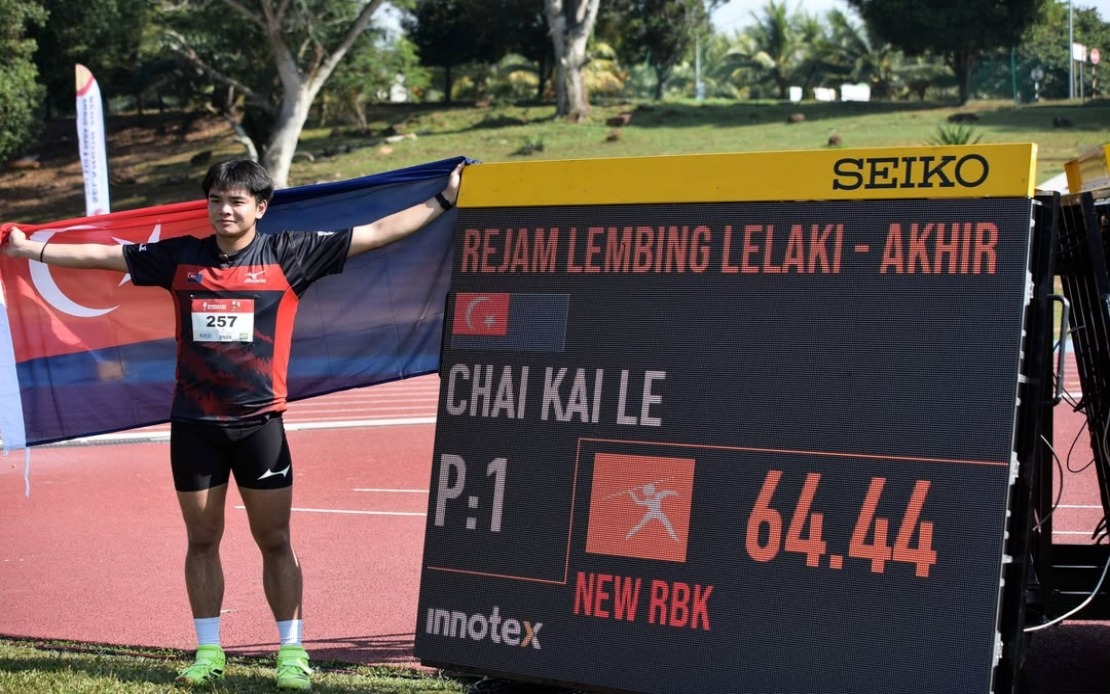
Johor's Chai Kai Le has etched his name into Malaysia Games history by smashing a quarter-century-old javelin record at the Selangor 2026 edition held at the Universiti Putra Malaysia Sports Centre in Serdang. The 18-year-old's winning throw of 64.44 metres on his second attempt eclipsed the previous Games benchmark of 62.33 metres established by Sarawak's Kho Mei Kuan during the 2000 Penang championships, underlining the emergence of a generational talent in Malaysian athletics.
Kai Le's breakthrough performance represents a significant milestone in the sport's domestic landscape, particularly given the competitive depth now evident in Malaysia's track and field programme. The feat becomes even more remarkable when contextualised against his existing credentials: the teenager already holds the national under-20 record at 65.65 metres, suggesting his trajectory could extend beyond the Games stage into senior international competition. His gold-medal performance was complemented by a strong domestic showing, as his Johor teammate Mohd Noor Iman Norman captured bronze with a throw of 59.04 metres, demonstrating the state's consistency in developing throwing talents.
Penang's Tan Chun Wei completed the podium with a silver-medal effort of 60.43 metres, a respectable throw that nonetheless fell considerably short of Kai Le's dominant display. The gap between first and second place underscores the young Johorian's technical proficiency and physical capacity, distinguishing this as more than a marginal improvement on the previous standard. Such performances shape regional perceptions of Malaysian athletics and provide benchmarks for neighbouring Southeast Asian competitors preparing for continental championships.
In comments to reporters immediately following his victory, Kai Le attributed his success to systematic long-term preparation, indicating that record-breaking was an explicit objective rather than an incidental achievement. He explained that his two-year preparation cycle for SUKMA had been methodical and purpose-driven, allowing him to arrive at the championships with realistic expectations of reaching the Games record. This disciplined approach to athletic development contrasts sharply with more haphazard training philosophies and suggests that Malaysian sports science support structures may be yielding tangible results among the younger cohort.
However, Kai Le's account of the competition also revealed the physical toll extracted by elite athletic performance. Following his successful second attempt, he acknowledged sustaining a technical error that precipitated lower back discomfort and general fatigue, limiting his capacity for subsequent throws. Rather than pursuing increasingly aggressive attempts that might compound injury risk, the teenager adopted a pragmatic approach to managing his physical state, prioritising injury prevention over potential incremental improvements to his winning mark. This demonstrates maturity in athletic decision-making and an understanding that preservation of long-term career health outweighs single-competition outcomes.
Beyond the javelin arena, the Selangor Games witnessed another significant performance from Penang's Mohammad Aiman Haikal Sahrudin, who captured the men's 10,000-metre race walk title in 47 minutes and 28.84 seconds. This victory proved particularly meaningful given his previous silver-medal finish at the Sarawak edition, demonstrating improvement across the Games cycle and validating the competitive development pathways available to race walkers within the domestic system. His triumph pushed Kelantan's Ahmad Farish Irfan Ahmad Fahmi into the silver position with a time of 47 minutes and 37.17 seconds, whilst Khor Jing Hong of the Federal Territories secured bronze in 47 minutes and 49.27 seconds.
At eighteen years old, Mohammad Aiman represents another promising young talent navigating the intersection of domestic and international athletics. His immediate ambition extends beyond SUKMA success toward inclusion within Malaysia's national senior squad, with his sights firmly trained on qualification for the 2027 Southeast Asian Games in Bangkok. Notably, the race walker recognises that the SEA Games schedule does not include the 10,000-metre event, necessitating a strategic pivot toward the 20,000-metre distance, which remains on the Selangor programme and aligns with continental championship requirements.
The progression from domestic Games success to regional competition represents the conventional pathway for Malaysian athletes, and Mohammad Aiman's articulation of this journey demonstrates clear strategic thinking about career progression. His improvement from silver to gold across consecutive SUKMA editions provides a trajectory of enhancement that, if sustained and accelerated, could position him credibly for SEA Games contention. The 20,000-metre walk demands different physical and psychological attributes than the 10,000-metre, particularly regarding the maintenance of technical form across the extended distance, making his transition a substantive challenge rather than a straightforward step upward.
These performances at SUKMA 2026 underscore the capacity of Malaysia's athletics programme to produce world-class talent capable of competing at increasingly sophisticated levels. Both Kai Le's javelin record and Mohammad Aiman's race walk gold demonstrate that systematic investment in athlete development, coaching expertise, and competition infrastructure yields measurable returns. For Malaysian sports administrators and policymakers, these results provide encouraging validation of current investment strategies whilst simultaneously establishing elevated benchmarks for future competitions.
The broader regional implications warrant consideration as well. Malaysian performances at major domestic games increasingly influence the competitive dynamics of Southeast Asian athletics, setting standards that neighbours monitor and attempt to match or exceed. Kai Le's record-breaking javelin throw and Mohammad Aiman's race walk title contribute to Malaysia's consolidated presence within regional athletics, maintaining the nation's profile as a consistent producer of medal-winning performances. This visibility carries diplomatic and soft-power dimensions extending beyond sporting outcomes, positioning Malaysia as a capable host and participant within the Southeast Asian sports landscape.
Looking forward, both athletes now face the demanding task of translating domestic success into sustained improvement and international recognition. For Kai Le, the path leads toward senior national representation, participation in continental championships, and the pursuit of standards that approach or exceed the elite European and African benchmarks that define world-class javelin performance. For Mohammad Aiman, the immediate focus narrows to SEA Games qualification and the tactical challenges inherent in transitioning to race walking distances that place greater premium on physical endurance and technical consistency over pure speed. Their trajectories will provide valuable indicators of Malaysian athletics' trajectory toward deeper international competitiveness in coming years.

