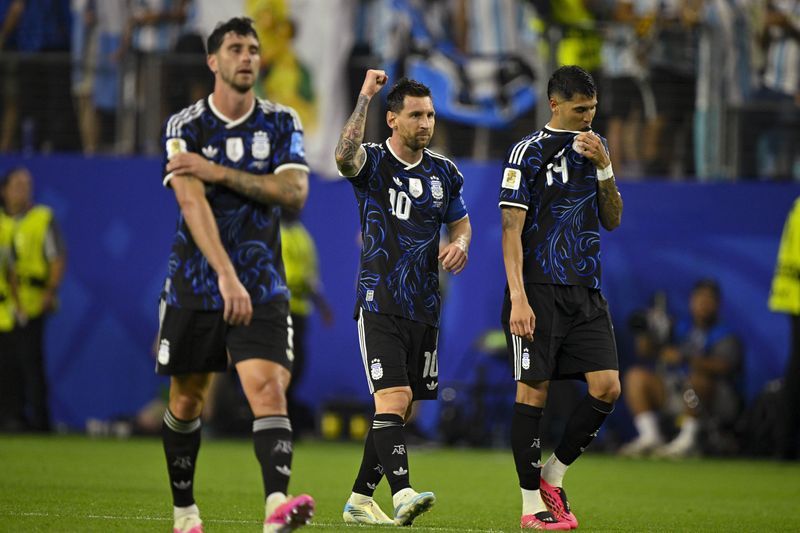
Coach Bubista has made it clear that Cape Verde will not abandon their attacking philosophy when they confront Argentina in Friday's World Cup knockout encounter, insisting the African nation's sole focus remains advancing from a group that includes the tournament's defending champions. The tone from the Cape Verde camp reflects a remarkable journey for an island nation that entered the competition as heavy underdogs yet has already left an imprint on the tournament through a series of spirited performances.
Bubista's consistency in messaging throughout the group stage has provided the backbone for Cape Verde's surprising resilience. The team drew with Spain, Uruguay, and Saudi Arabia—results that most analysts would have deemed respectable achievements for a nation ranked 67th in the FIFA standings at the tournament's start. These outcomes have validated the coaching staff's conviction that their side belongs on the world's biggest football stage and can compete with elite opposition through disciplined organisation and tactical coherence.
The Cape Verde manager elaborated on his team's mindset during his pre-match media briefing at Miami Stadium, emphasising that qualifying for this World Cup on merit represents a significant accomplishment in itself. Having finished second in their group to secure passage into the knockout rounds, Bubista argued that his players have earned the right to approach the Argentina fixture with ambition rather than mere survival instinct. This perspective matters considerably in a regional context where African football often receives less respect from traditional powers, and where qualifying nations frequently adopt defensive, cautious approaches against favourites.
Bubista's remarks about respect carried subtle undertones regarding perceptions of African football on the global stage. He acknowledged that some observers may have underestimated Cape Verde's capabilities, but countered that such dismissals reflected others' perspectives rather than the reality of his team's preparation and execution. The coach stressed that his squad will continue trusting their established methods and the developmental work that brought them to this moment, refusing to adopt an apologetic posture simply because they face the world's top-ranked team.
The decision to focus on Argentina as a collective unit rather than designing specific defensive schemes around Lionel Messi exemplifies Cape Verde's strategic approach. Bubista reasoned that while Messi presents extraordinary individual danger, fixating on neutralising one player risks neglecting the broader threats that Argentina's squad possesses. This tactical philosophy demonstrates maturity in recognising that world-class teams function as interconnected systems rather than one-dimensional operations built around singular talents.
For Malaysian and Southeast Asian readers, Cape Verde's trajectory carries resonance given similar aspirations within the region's football development. The island nation's qualification and subsequent competitive performances illustrate how emerging football nations can challenge established hierarchies through tactical discipline, collective organisation, and psychological resilience. Their willingness to pursue positive football against top-ranked opponents contrasts with the cautious approaches sometimes adopted by developing nations, offering a template for alternative strategies.
The stakes of this encounter extend beyond the immediate tournament consequences. A Cape Verde victory would rank among football's greatest underdog stories, validating the structural investments made in youth development and coaching education over preceding years. Conversely, a creditable performance resulting in elimination would still represent progress for a programme that remains relatively young in international football terms. Either outcome would influence how emerging African football nations perceive their capacity to compete at the highest levels.
Argentina, meanwhile, arrives as the tournament's prohibitive favourites under coach Lionel Scaloni, carrying the aspirations of a nation that has never won the World Cup despite reaching multiple finals. The reigning champions possess vastly superior ranking positions, individual player marketability, and historical pedigree. Yet the relative unpredictability characterising this tournament suggests that Cape Verde's apparent fearlessness carries genuine strategic merit rather than naive overconfidence.
Bubista's insistence on maintaining his team's identity rather than abandoning principles against superior opposition reflects an increasingly sophisticated understanding of modern football management. Coaches of emerging teams historically adopted the defensive mentality of attempting to frustrate favourites through compressed formations and direct counter-attacking. Contemporary approaches increasingly emphasise maintaining tactical continuity, trusting preparation, and allowing confidence to translate into performance, an evolution that Cape Verde exemplifies.
The psychological dimension proves particularly significant in knockout football where marginal technical differences can prove decisive. Cape Verde's demonstrated capability to draw against Spain and Uruguay—nations with substantially higher FIFA rankings—provides genuine evidence that the gap separating the sides, while real, may prove bridgeable. Bubista's messaging consistently reinforces this belief among his players, creating an environment where upset potential becomes realistic rather than purely hypothetical.
For broader African football representation, Cape Verde's participation and competitive contribution carry meaning beyond individual match outcomes. The team's performances challenge persistent narratives regarding African football's supposed inability to compete with European and South American establishments. Their qualification journey itself represented a significant achievement for a nation with limited historical World Cup experience, making their presence in knockout rounds particularly noteworthy.
As this confrontation approaches, the match will test not merely tactical systems and individual talents but also the psychological resilience that distinguishes competitive teams from those overwhelmed by occasion. Bubista's emphasis on humility combined with courage encapsulates the delicate balance required for underdogs to trouble heavyweights. Whether Cape Verde's fearless approach yields progression or concludes their tournament remains uncertain, but their journey already carries substantial significance for emerging football nations throughout Africa and beyond.

