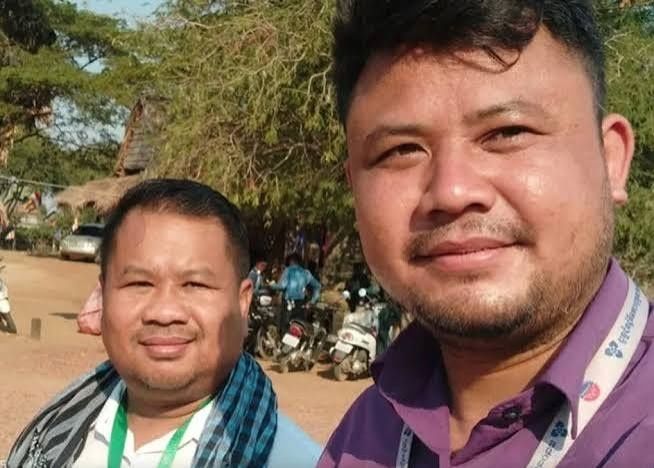
Cambodia's Supreme Court is poised to deliver a significant ruling on the appeal of two journalists convicted of treason for sharing photographs taken during military operations near the Thai border last year, a case that has become emblematic of concerns about the independence of the country's legal system under Prime Minister Hun Manet's government.
Phorn Sopheap of Battambang Post TV Online and Pheap Pheara of TSP 68 TV Online were arrested in July after returning from reporting assignments at the border, charged with posting photographs to Facebook from what authorities designated as a restricted military zone. Both men maintain their innocence, contending they possessed proper authorization to access the area where they filmed. They are now appealing to the Supreme Court to overturn their convictions and the 14-year prison sentences handed down by the Siem Reap Provincial Court in December.
The case touches on a particularly sensitive geopolitical issue. One photograph depicting land mines was subsequently republished extensively by Thai media outlets, which cited it as evidence supporting Thailand's assertion that Cambodia had deployed fresh mine installations along their shared frontier that had injured Thai soldiers on patrol. Cambodia's government had categorically rejected these allegations, asserting its compliance with international treaties prohibiting landmine use and suggesting that any mines discovered were remnants from the country's decades-long civil conflict that concluded in the late 1990s.
Border violence between the two nations erupted in July and again in December of the previous year, creating a humanitarian crisis that displaced hundreds of thousands of civilians across both territories and resulted in approximately 100 military and civilian deaths. A ceasefire agreed upon in December has held, though underlying tensions persist and the situation remains fragile. Within this volatile context, the government's decision to prosecute the journalists under treason laws has drawn intense international scrutiny.
The Siem Reap court determined in its original verdict that the two men had committed the offense of "supplying a foreign state with information prejudicial to national defense." A lower appellate court upheld this conviction in March, setting the stage for Thursday's Supreme Court hearing. The timing of the case is significant: it comes just days after the same Supreme Court upheld an incitement conviction against Rong Chhun, a prominent opposition politician who faces charges related to meetings with villagers displaced by government development projects—a ruling widely interpreted as part of a broader pattern of prosecutions targeting government critics.
The prosecution of these journalists has triggered substantial international condemnation. More than a dozen journalism organizations spanning both regional and global bodies submitted a joint letter to the Cambodian government urging it to abandon its legal action following the March appellate decision. The Committee to Protect Journalists, based in New York, has explicitly accused the government of deploying "vague national security laws to criminalise legitimate reporting" in these cases. Meanwhile, Human Rights Watch has characterized the judicial decisions as evidence of courts lacking genuine independence from the ruling political party, a charge the government has categorically denied while maintaining that the Supreme Court operates with full autonomy.
These developments underscore a troubling trajectory for press freedom in Cambodia under Hun Manet, who assumed office in August 2023 following nearly four decades of rule by his father, Hun Sen. Despite Hun Manet's education at American universities and initial hopes among observers that his leadership might bring political opening, the country has witnessed minimal liberalization of press restrictions or expansion of political space. The new administration has largely maintained the authoritarian infrastructure inherited from its predecessor, including the use of expansive national security legislation to constrain independent reporting and political opposition.
Cambodia's contemporary press environment reflects this continuity. The country currently ranks 161st out of 180 nations and territories in the 2025 Reporters Without Borders World Press Freedom Index, placing it firmly within the category of states where "the press freedom situation is considered very serious." This standing represents a stark indictment of Cambodia's commitment to fundamental journalistic freedoms and places it among the world's most repressive media environments. The conviction of Pheap Pheara and Phorn Sopheap exemplifies how broad security statutes become instruments for suppressing legitimate journalism that might embarrass or contradict official narratives.
The Supreme Court's pending decision carries implications that extend beyond these two individuals. A ruling upholding the convictions would effectively signal to Cambodia's journalism community that reporting from sensitive areas—which frequently include zones of conflict or government sensitivity—carries prosecution risks disproportionate to any actual security threat. Conversely, an unexpected reversal might suggest that international pressure and advocacy from press freedom organizations carries measurable weight within Phnom Penh's judicial system. The ruling will therefore serve as an important indicator of whether the current administration intends to genuinely diverge from its predecessor's approach to press control or whether existing restrictions will persist under the new leadership.
For the broader Southeast Asian region, Cambodia's handling of these cases matters considerably. The country's legal mechanisms have become increasingly prominent as a cautionary example of how national security frameworks can be weaponized against journalists. Malaysia, Thailand, and other regional nations monitoring Cambodia's approach may view the outcome as a potential precedent for how governments can utilize existing legislation to constrain unfavorable reporting. Conversely, international journalism organizations and human rights advocates regard the case as a crucial test of whether autocratic practices can be reformed through diplomatic and organizational pressure, or whether such systems remain fundamentally resistant to external appeals for accountability and openness.

