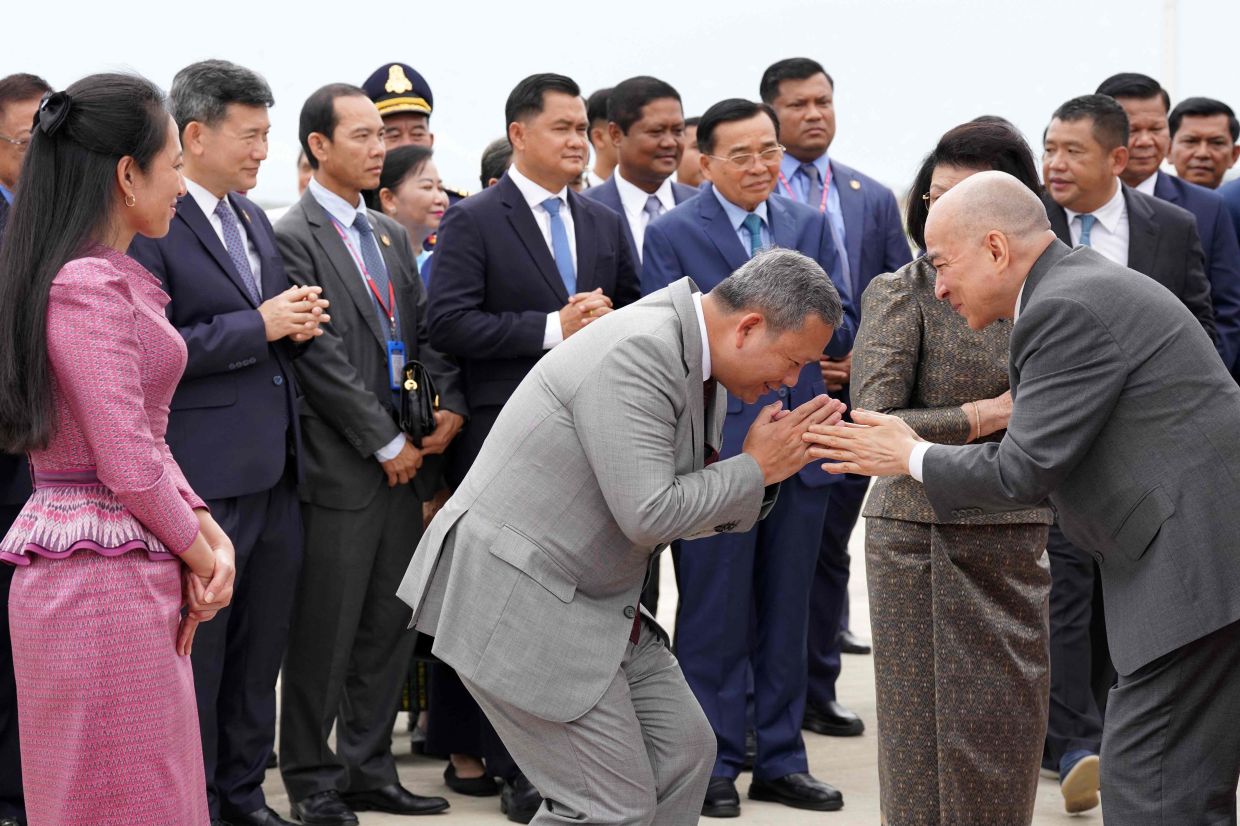
Cambodia's King Norodom Sihamoni has returned to his nation's capital after an extended medical sojourn in China, marking the completion of intensive cancer treatment that had kept him abroad since earlier in the year. The 73-year-old monarch touched down in Phnom Penh on Friday afternoon, welcomed by a delegation of prominent officials including Hun Sen, the influential former prime minister, and his son Hun Manet, who currently serves as Cambodia's premier. The arrival was broadcast across state media, underscoring the significance of the occasion within Cambodian political circles and the national consciousness.
The king's medical journey commenced when he travelled to Beijing for routine health assessments, during which physicians identified a prostate cancer diagnosis that was publicly disclosed in April. Following this discovery, Sihamoni underwent what the Royal Palace characterised as successful surgical intervention performed by Chinese medical specialists. The decision to seek treatment in China reflects the long-standing medical relationship between the Cambodian monarchy and Chinese healthcare institutions, a pattern that extends back through the kingdom's modern history.
Throughout his recovery period, which extended beyond three months, palace officials maintained periodic communication regarding the monarch's condition. In a statement released on Tuesday, prior to his departure from Beijing, the Royal Palace indicated that Sihamoni's health trajectory had shown measurable improvement following the extended treatment protocol administered by Chinese physicians. This optimistic assessment provided reassurance to the Cambodian public and government officials who had been monitoring developments concerning their head of state.
The return to Cambodia holds particular resonance given the nation's historical relationship with Beijing's medical infrastructure. Sihamoni's own father, the late King Norodom Sihanouk, similarly travelled to China for cancer treatment decades earlier, subsequently abdicating the throne in 2004 in favour of his son. That earlier precedent established a template for royal medical engagement with Chinese institutions, a pattern that has evidently persisted across generations. Sihanouk passed away in 2012, having spent his final years in relative retirement following his abdication.
Sihamoni's personal background distinguishes him among regional monarchs and has shaped his perspective throughout his reign. Before ascending to the throne two decades ago, he spent the majority of his adult life living overseas, pursuing an accomplished career in the performing arts. His linguistic capabilities—fluency in Khmer, French, Czech, and English—reflect this cosmopolitan education and international exposure, attributes that have informed his approach to governance and cultural patronage within Cambodia.
The involvement of both Hun Sen and Hun Manet in welcoming the monarch home carries significant political overtones within Cambodia's complex governance structure. Hun Sen's presence, despite his formal departure from the prime ministerial role, underscores his continued influence within Cambodian politics and his ceremonial relationship with the crown. Hun Manet's attendance as the incumbent prime minister represents the formal state apparatus, illustrating the continuity of Cambodia's political establishment during this period of royal recovery.
For Southeast Asia more broadly, the successful completion of Sihamoni's treatment carries implications for regional stability and institutional continuity. Cambodia's monarchy serves as a stabilising institution within a nation that has experienced considerable turbulence throughout its modern history. The assurance of the king's improved health provides confidence to both domestic stakeholders and the international community regarding Cambodia's institutional stability in the coming period.
The public nature of the monarch's medical situation and recovery also reflects contemporary approaches to royal health disclosures. Unlike previous eras when such matters remained largely private, the Cambodian palace opted for measured transparency, announcing both the diagnosis and the treatment progress to the public. This approach balances the traditional mystique associated with monarchy with modern expectations of institutional accountability and public information.
Moving forward, the implications of Sihamoni's successful treatment and return to Cambodia extend beyond immediate health considerations. The event reinforces Cambodia's ongoing healthcare and diplomatic relationships with China, a partnership that encompasses not only medical matters but broader dimensions of bilateral engagement. For Malaysian observers and Southeast Asian analysts, the incident illustrates how regional monarchies navigate complex health challenges while maintaining institutional dignity and political functionality.
The king's recovery also carries personal significance given his relatively solitary position within the Cambodian royal family structure. As a lifelong bachelor without direct heirs, questions of succession and institutional continuity have occasionally surfaced in regional discourse. His return in improved health effectively addresses immediate concerns regarding Cambodia's leadership stability and the monarchy's operational capacity throughout the foreseeable future. The successful Chinese medical intervention thus becomes not merely a personal matter but a component of Cambodia's broader political narrative.

