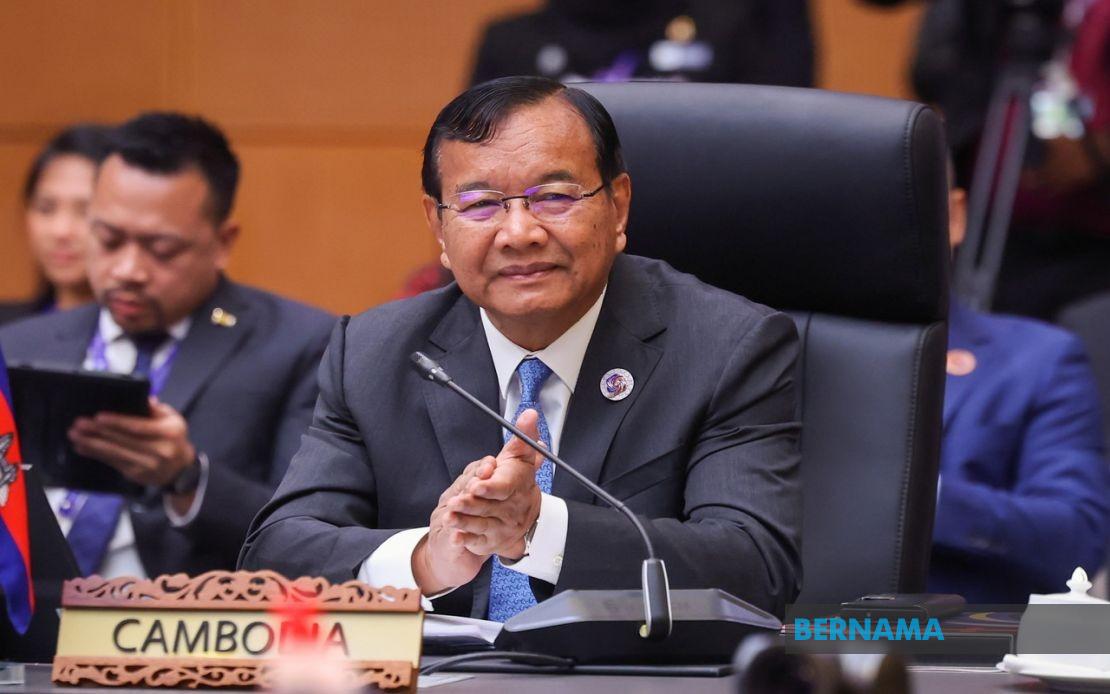
Cambodia's Deputy Prime Minister and Foreign Minister Prak Sokhonn touched down at Kuala Lumpur International Airport on August 3 for a significant two-day official visit designed to reinvigorate ties between Kuala Lumpur and Phnom Penh. His arrival marks another chapter in the deepening engagement between two neighbouring Southeast Asian nations increasingly focused on consolidating economic and diplomatic partnerships. Sokhonn landed at Terminal 1 of KLIA at 1.48 pm, met by Cambodian Ambassador to Malaysia Ouk Chandara and Malaysian Government chief ceremony officer Datuk Rozainor Ramli, underscoring the protocol significance attached to the engagement by both capitals.
The visit arrives at a moment when Malaysia-Cambodia relations are experiencing measurable momentum across multiple sectors. Beyond ceremonial courtesy, Sokhonn's itinerary reflects substantive bilateral architecture. The Deputy PM is scheduled to hold a courtesy audience with Prime Minister Datuk Seri Anwar Ibrahim, a customary but strategically important meeting that sets the political tone for deeper institutional engagement. Following this initial interface, Sokhonn will progress through a series of official engagements aimed at translating political goodwill into concrete collaborative outcomes across governmental structures.
The centrepiece of Sokhonn's visit is the third convening of the Cambodia-Malaysia Joint Commission for Bilateral Cooperation, scheduled for the following day in Kuala Lumpur. This institutional mechanism serves as the primary vehicle for reviewing implementation progress on previously agreed bilateral initiatives and examining the minutes from the second JCBC meeting. Joint commissions of this nature function as critical checkpoints in bilateral relations, ensuring that political commitments translate into practical outcomes and identifying areas requiring renewed attention or resource allocation. The comprehensiveness of such reviews typically covers trade facilitation, investment frameworks, educational exchanges, cultural programmes, and security cooperation.
Parallel to the JCBC proceedings, Sokhonn is expected to engage in bilateral discussions with Malaysia's Foreign Minister Datuk Seri Mohamad Hasan. These ministerial-level talks provide an avenue for addressing strategic concerns, exploring emerging opportunities, and managing any outstanding bilateral matters outside the formal commission structure. Such direct ministerial engagement often yields announcements regarding new cooperative initiatives or refinements to existing agreements, making these sessions particularly consequential for future bilateral trajectory.
The economic dimension of Malaysia-Cambodia relations has recently demonstrated robust dynamism. In 2025 alone, bilateral trade between the two countries surged 27.4 per cent year-on-year, reaching RM5 billion, equivalent to approximately USD1.17 billion. This acceleration reflects growing commercial integration and suggests that businesses in both nations perceive expanding market opportunities across their shared border. The trade growth outpaces general regional trends, indicating that Malaysia-Cambodia commerce is benefiting from specific sectoral advantages or preferential arrangements that merit monitoring.
Malaysia's investment profile in Cambodia underscores the depth of economic interdependence. As of 2024, cumulative Malaysian direct investment in Cambodia totalled USD3.20 billion, or roughly RM13.07 billion, distributed across 162 registered projects. This positions Malaysia as Cambodia's third-largest foreign investor, a ranking that reflects sustained Malaysian corporate commitment to the Cambodian market. The scale of investment suggests that Malaysian enterprises view Cambodia as strategically important for regional operations, whether as a production base, market entry point, or logistics hub.
The significance of these economic metrics extends beyond simple statistical comparison. For Malaysian policymakers and business interests, Cambodia represents both a complementary economy and a growth frontier. The investment scale indicates that major Malaysian corporations have already embedded themselves within Cambodian supply chains and commercial ecosystems. Conversely, for Cambodia, Malaysian investment represents a crucial source of capital, technology transfer, and employment generation, making Malaysia a priority partner in its broader economic integration strategy.
Bilateral mechanisms like the JCBC become increasingly valuable when economic ties deepen, as they provide institutional frameworks for managing complex commercial relationships and addressing disputes or barriers that inevitably emerge. The review of previous agreed minutes suggests a comprehensive agenda spanning multiple dimensions of cooperation, likely including trade promotion measures, investment protection protocols, and sectoral collaboration in areas such as agriculture, manufacturing, tourism, and digital economy initiatives.
Regionally, the Malaysia-Cambodia partnership reflects broader ASEAN cohesion efforts, where bilateral relationships between member states serve as building blocks for collective regional identity and integration. Sokhonn's visit demonstrates Cambodia's commitment to maintaining robust partnerships within the association, particularly with a country like Malaysia that holds considerable economic and political influence within ASEAN frameworks. For Malaysia, consistent engagement with Cambodia reinforces its status as a regional hub and relationship manager.
The timing of this visit also carries broader strategic implications. As Southeast Asia navigates complex geopolitical currents involving major power competition and evolving trade dynamics, bilateral partnerships between ASEAN members gain renewed salience. Countries increasingly emphasise South-South cooperation and intra-ASEAN engagement as counterweights to external pressures and as mechanisms for advancing shared development aspirations. Sokhonn's presence in Kuala Lumpur signals that Cambodia values this partnership sufficiently to dispatch its senior foreign affairs minister for direct engagement.
Looking forward, observers should monitor outcomes from the JCBC meeting and ministerial talks for announcements regarding new initiatives, investment facilitation measures, or sector-specific cooperation frameworks. Trade growth rates of 27.4 per cent year-on-year suggest momentum that both governments will likely attempt to channel into expanded cooperation. Potential areas for enhanced collaboration might include digital economy development, green technology sectors, human capital development through educational exchanges, or deeper regional integration within ASEAN structures.
The visit also provides an opportunity for both governments to address any bilateral concerns or friction points away from public view, using the courtesy and diplomatic protocols that surround such high-level visits. These behind-the-scenes conversations often prove as consequential as formal meetings, enabling candid discussion of sensitive matters and allowing diplomatic space for resolving emerging tensions before they escalate into formal disputes.

