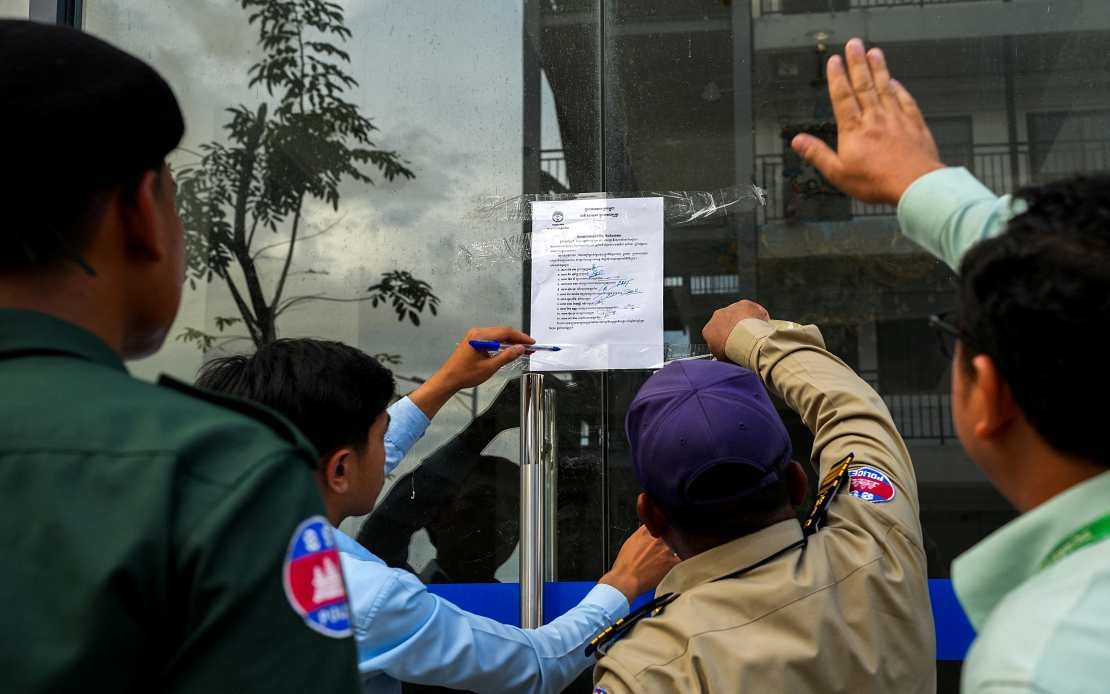
Cambodia has stepped up its aggressive response to the proliferation of cybercriminal operations within its borders, expelling over 16,000 foreign nationals suspected of involvement in online fraud schemes during the opening half of 2026. The deportations represent part of a broader government initiative to combat what has become an international concern, with the removals forming a subset of more than 45,000 total foreign deportations carried out across the same period. Police Lieutenant General Sok Veasna, who heads the General Department of Immigration, outlined the scale of enforcement efforts during a mid-year policy review, emphasising that operations targeting online fraud have accelerated markedly since the calendar year began.
The ramifications of Cambodia's cyber-scam industry extend far beyond its borders, creating complications for neighbouring nations including Malaysia and other ASEAN members whose citizens have fallen victim to schemes originating from Cambodian-based networks. The phenomenon reflects a troubling trend whereby criminal enterprises leverage Cambodia's geography and regulatory environment to target vulnerable populations across the region and globally. Malaysian authorities have repeatedly documented cases involving victims who transferred significant sums to accounts controlled by networks with operational bases in Cambodia, underscoring the transnational nature of the problem and the importance of coordinated regional responses.
A permanent entry ban now applies to all individuals expelled from Cambodia under the cyber-scam crackdown, according to immigration officials. This measure aims to prevent repeat offenders from reconstituting their operations after deportation, though enforcement of such restrictions depends substantially on Cambodia's capacity to maintain comprehensive border documentation and information-sharing protocols with regional counterparts. The permanence of the prohibition signals governmental determination to treat such offences with maximum severity, positioning online fraud within the framework of crimes warranting irreversible immigration consequences.
Cambodia's legislative response to the crisis has accelerated alongside enforcement operations. In April of this year, the kingdom enacted the Law on Combating Online Scams, introducing substantially increased penalties for those directing and orchestrating fraudulent schemes. The law distinguishes between mid-level operatives and senior kingpins, reserving harsher sentences for individuals occupying leadership positions within criminal hierarchies. This legislative framework represents an acknowledgment that deterrence through punishment requires differentiation based on culpability and organisational role.
Yet analysts caution that surface-level enforcement, however dramatic in scale, addresses only the visible manifestation of deeper structural problems. Thong Mengdavid, deputy director at the China-ASEAN Studies Centre of the Cambodia University of Technology and Science, characterises the deportation campaign as a necessary but insufficient response to criminal networks that depend upon local complicity for survival. His assessment highlights a critical vulnerability in Cambodia's anti-scam strategy: the identification and prosecution of corrupt officials and community members who provide operational support to foreign scammers.
The protection infrastructure enabling cyber-scam operations to flourish involves collaboration between criminal elements and individuals positioned within Cambodia's institutional apparatus. Without dismantling these enabling networks, Mengdavid argues, the removal of foreign operatives merely creates openings for replacement personnel, allowing criminal enterprises to reconstitute their workforce and resume activities. This cyclical pattern suggests that sustainable progress requires confronting corruption at institutional levels, a far more demanding undertaking than managing border enforcement.
Underlying the cyber-scam phenomenon lies a human trafficking dimension that complicates both the legal and humanitarian dimensions of Cambodia's response. Many foreign nationals operating within scam networks arrived through coercive recruitment schemes, essentially functioning as indentured labourers within hierarchical criminal organisations. The distinction between perpetrator and victim blurs considerably when foreign workers have been trafficked into Cambodia and compelled to participate in fraudulent activities under threat. Effective policy responses must therefore incorporate provisions distinguishing between trafficked workers and those who arrived voluntarily to participate in criminal enterprise.
Cambodia's reputational damage from becoming a recognised hub for online scam operations has motivated governmental action at multiple institutional levels. The kingdom faces international pressure from trading partners, tourism-dependent economies, and development organisations concerned about its governance environment. Singapore, Thailand, and other ASEAN neighbours with significant financial services sectors view Cambodian cyber-scam networks as threatening regional financial integrity and consumer confidence. The political incentive to demonstrate governmental capacity and willingness to address the problem has therefore intensified.
Regional cooperation mechanisms remain underdeveloped despite the transnational character of cyber-scam operations. Malaysian law enforcement agencies frequently encounter fraud victims with connections to Cambodian networks, yet information-sharing protocols between countries remain incomplete and sometimes cumbersome. Enhanced bilateral and multilateral frameworks for intelligence exchange, joint investigations, and coordinated enforcement could amplify the effectiveness of individual nations' efforts. The ASEAN framework ostensibly provides mechanisms for such coordination, but implementation across member states remains inconsistent.
The sustainability of Cambodia's enforcement campaign depends upon maintaining political commitment and resource allocation beyond the immediate crisis period. Bureaucratic momentum can dissipate once initial dramatic actions generate international acclaim and domestic political advantage. Structural reform addressing corruption, institutional strengthening, and long-term capacity-building require sustained investment that extends far beyond headline-grabbing deportation statistics. Cambodia's trajectory over the coming months will indicate whether current initiatives represent genuine systemic transformation or primarily constitute a public relations exercise.
For Malaysian policymakers and law enforcement agencies, Cambodia's intensified action offers both encouragement and caution. The encouraging dimension lies in demonstrated willingness by a neighbouring state to confront a destabilising problem affecting the broader region. The cautionary aspect involves recognition that unilateral action, however vigorous, cannot fully resolve challenges requiring coordinated regional approaches. Malaysia's interests in regional stability and consumer protection argue for proactive engagement with Cambodia's government to strengthen bilateral mechanisms and ensure that enforcement gains translate into sustainable improvements in transnational crime prevention.

