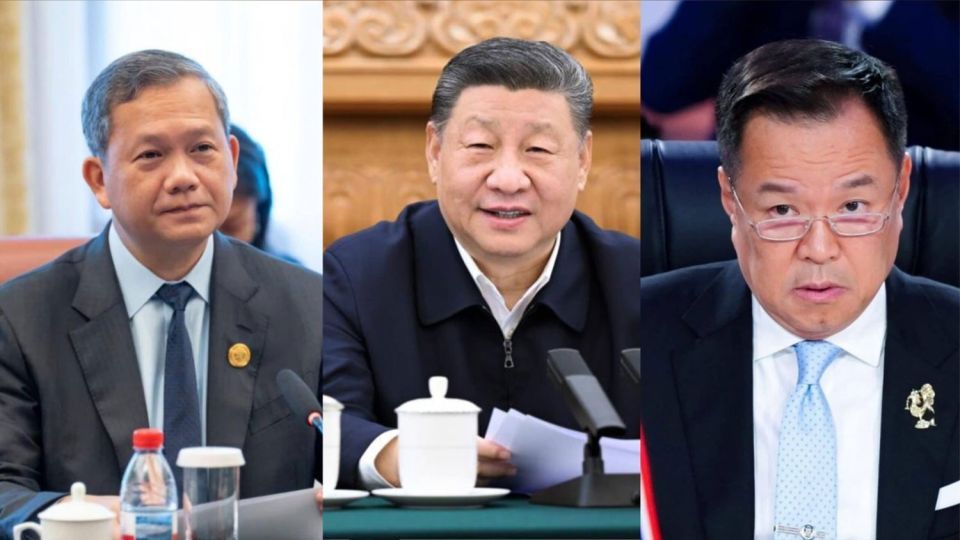
Prime Ministers Hun Manet of Cambodia and Anutin Chanvirakul of Thailand are set to convene in Shanghai on July 17 for the opening ceremony of the World AI Conference 2026, an event where both regional leaders have been invited by Chinese President Xi Jinping. The high-profile gathering presents a rare opportunity for engagement between the two Southeast Asian neighbours, though observers are closely monitoring whether Beijing will seize the occasion to advance stalled negotiations over their contentious border situation. The two premiers have not sat down at the negotiating table since December, when tensions remain unresolved over territorial disputes involving thousands of displaced Cambodian civilians.
Hun Manet's delegation travelling from July 15 to 17 will comprise several heavyweight figures in Cambodia's administration, including Foreign Minister Prak Sokhonn, Defence Minister Tea Seiha, and Sun Chanthol, the first vice-chairman of the Council for the Development of Cambodia. Thailand's contingent will be similarly composed, with Foreign Minister Sihasak Phuangketkeow expected to accompany Anutin to the conference. Both leaders have scheduled separate bilateral meetings with President Xi and Premier Li Qiang, suggesting that China intends to engage each nation individually as well as in potential multilateral contexts during the Shanghai event.
Cambodia's Foreign Ministry framed the visit as an opportunity to strengthen ties with Beijing. The official statement emphasised that the trip underscores Cambodia and China's mutual dedication to deepening their historical partnership and fostering collaborative endeavours that benefit both nations. The ministry particularly highlighted how the Shanghai engagement will serve to catalyse progress on implementing Cambodia and China's Comprehensive Strategic Partnership of Cooperation and advance what officials call the Diamond Cooperation Framework. Through this lens, the visit represents an effort to construct what Cambodia describes as an all-weather Cambodia-China Community with a Shared Future suited to contemporary regional dynamics.
Thailand's foreign ministry issued its own parallel statement, emphasising that Anutin's attendance will reinforce the Thailand-China Comprehensive Strategic Cooperative Partnership and advance bilateral interests. The coordinated messaging from both governments suggests a degree of alignment on maintaining strong economic and diplomatic relations with Beijing, despite the underlying bilateral dispute that continues to fester between the two neighbours. This alignment, however, may mask competing interests and unresolved grievances that informal handshakes—such as those exchanged during the ASEAN Future Forum in Hanoi last June—cannot genuinely address.
The border question remains the elephant in the room. When Hun Manet and Anutin last encountered each other at the third ASEAN Future Forum in early June in Hanoi, Vietnam, they performed the customary diplomatic ritual of a photograph together. Yet substantive discussions addressing the longstanding boundary controversy notably did not materialise. Regional analysts have begun to speculate whether China, as a major economic partner to both nations, might employ its considerable leverage during the Shanghai conference to nudge Cambodia and Thailand toward serious dialogue aimed at resolving their differences.
According to Kin Phea, director of the International Relations Institute at the Royal Academy of Cambodia, the core impediment to settlement may lie not with civilian governments but with military hierarchies in Thailand. He contends that the Thai armed forces have consistently failed to honour commitments that Thailand's civilian administration has made with Cambodian counterparts. Phea argues that Thailand's military apparatus operates with substantial autonomy, permitting it to pursue aggressive territorial actions and encroach upon Cambodian sovereignty without meaningful constraint from Bangkok's civilian leadership.
Phea has called upon China to assume a more assertive role as a diplomatic mediator between the two nations. He advocates for Beijing to compel both parties to return to formal negotiations and pursue resolution through peaceful, lawful channels grounded in established international legal principles. Such intervention, Phea suggests, would align with China's stated commitment to regional stability and its capacity to influence the behaviour of both neighbouring states through economic and political incentives.
The starting point for any renewed dialogue, analysts argue, should be the Fuxian Consensus hammered out in December 2025 through Chinese diplomatic intervention. Phea insists that Thailand must be held accountable to the commitments enshrined in that agreement. This demands a withdrawal of Thai military personnel from territory currently under their control, a resumption of formal border talks, and renewed engagement with the Joint Boundary Commission without further prevarication. The protracted nature of these disputes suggests that reliance on goodwill alone has proven insufficient to achieve progress.
The humanitarian dimension of the border standoff cannot be overlooked. Approximately 20,000 Cambodian civilians remain displaced from their homes in border regions currently under Thai occupation. For these populations, any breakthrough in diplomatic negotiations would carry profound implications for their ability to return to their communities and rebuild lives disrupted by territorial contestation. The Shanghai conference thus represents more than a ceremonial gathering; it symbolises a potential inflection point in a dispute that has directly harmed tens of thousands of ordinary Cambodians.
Regional observers will scrutinise not only what is said during formal bilateral meetings in Shanghai but also what transpires in side conversations and whether Chinese diplomacy can generate sufficient momentum to move both governments toward substantive border negotiations. The convergence of Cambodia's and Thailand's delegations in Shanghai, facilitated by Xi Jinping's invitation to attend the World AI Conference, provides China with an opportune moment to advance its interests in regional stability while potentially addressing one of Southeast Asia's most persistent border disputes. Whether Beijing will employ this opportunity remains an open question that will shape perceptions of China's role as a diplomatic broker in the region.

