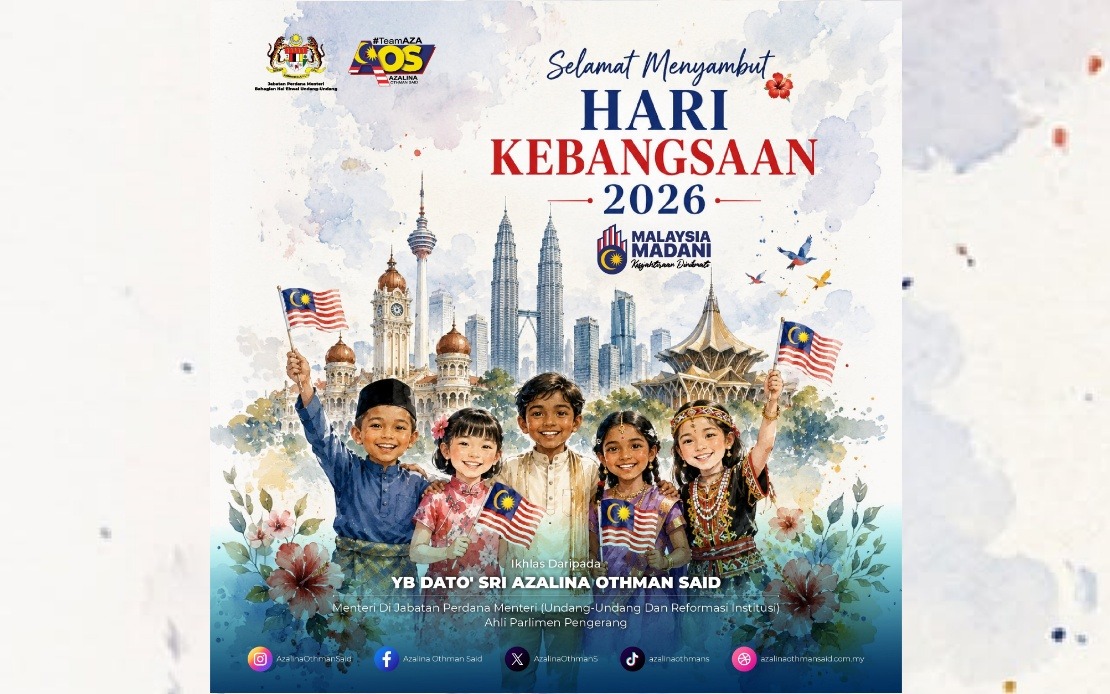
Malaysia's leadership has collectively reinforced the message of national unity on the nation's 69th independence anniversary, with senior Cabinet ministers using the occasion to reflect on the country's journey and chart its future direction. Through social media platforms and official appearances, the government signalled that the struggles of past generations remain deeply relevant to contemporary challenges facing the multiracial nation.
Azalina Othman Said, who leads the Law and Institutional Reform portfolio in the Prime Minister's Department, articulated perhaps the most fundamental assertion: that Malaysia's cohesion depends fundamentally on transcending divisions of ethnicity, faith and social standing. Her message positioned unity not as an aspirational ideal but as the foundation upon which all national progress rests. This framing reflects an understanding that nearly seven decades after achieving independence, the mechanisms that bind Malaysians together require constant reinforcement and deliberate cultivation rather than assuming they will persist automatically.
Home Minister Saifuddin Nasution Ismail approached the anniversary from a generational perspective, drawing an explicit line between the sacrifices made by independence fighters and the responsibilities incumbent on today's citizens. His reminder that Malaysia's diverse population nonetheless shares singular ownership of both territory and future attempted to bridge abstract patriotic sentiment with practical imperatives. The notion that common homeland supersedes other identity markers—a proposition that has proven contentious in Malaysian political discourse—was presented as self-evident rather than requiring justification.
Works Minister Alexander Nanta Linggi broadened this geographic inclusivity to encompass the entire federation from Peninsular Malaysia through Sabah and Sarawak, emphasising that the independence legacy belongs equally to all territorial constituents. This emphasis carries particular significance given historical tensions over peninsular-centric narratives and the need to reinforce that Sabah and Sarawak's incorporation into Malaysia represents a shared project rather than subordinate participation. His call for Malaysians to play "respective roles" in nation-building implicitly acknowledged that unity emerges through different contributions rather than uniformity.
The government's interpretation of independence underwent deeper philosophical examination through Minister Zulkifli Hasan's address, which positioned Merdeka beyond ceremonial flag-waving to encompass something approaching spiritual commitment. By invoking religious language—describing independence as a "sacred trust from Allah"—and quoting independence figures like the late Dr Burhanuddin Al-Helmy, Hasan attempted to connect contemporary governance to the founding generation's moral framework. This approach sought to elevate National Day observance beyond nostalgia into a framework for evaluating whether current policies honor the sacrifices that secured independence.
Crucially, the government linked this philosophical interpretation to concrete policy measures intended to validate independence's contemporary meaning. The expansion of BUDI MADANI subsidy eligibility, commitments to infrastructure across all school types, free artificial intelligence application subscriptions for youth, and healthcare acceleration initiatives were presented as manifestations of independence's promise. This packaging represented an effort to demonstrate that invoking heritage and unity serves purposes beyond rhetorical flourish—it justifies specific resource allocations and policy priorities framed as honoring the independence legacy.
Higher Education Minister Zambry Abd Kadir's observations about early gathering at Dataran Putrajaya and the visible diversity of attendees provided empirical grounding to leadership rhetoric about national cohesion. The minister's satisfaction with "truly lively and well-attended celebration" and visible cross-communal participation served as evidence that unity messaging resonates with popular sentiment. Yet such observations warrant scrutiny: the question of who participates in official National Day celebrations and whether such participation reflects broader societal integration or represents a specific demographic remains unexamined in official accounts.
National Unity Minister Aaron Ago Dagang explicitly connected observed celebration dynamics to government aspiration for building "a harmonious society," effectively using the event itself as validation of policies and messaging. Digital Minister Gobind Singh Deo elevated Malaysia's diversity to a geopolitical asset, arguing that the nation's ability to maintain multicultural governance represents a model worthy of international admiration. This framing transforms potential vulnerability—that Malaysia's multiple religious, ethnic and cultural constituencies could fracture—into claimed strength and competitive advantage in global context.
The 2026 National Day theme "Malaysia MADANI: Kesejahteraan Dinikmati" (Malaysia MADANI: Prosperity Enjoyed) functioned as the integrating concept across ministerial statements. MADANI governance, as government discourse positions it, represents not merely a policy platform but a philosophical approach to development that deliberately encompasses all populations and regions. The theme's emphasis on shared prosperity underscores that unity serves instrumental purposes—without cohesion, the government suggests, prosperity cannot be broadly distributed, and divisions threaten everyone's welfare.
For Malaysian readers, these Cabinet messages convey several interconnected narratives. The government continues to emphasise that national independence remains unfinished business requiring active commitment rather than inherited certainty. The deliberate invocation of founding figures and religious frameworks alongside contemporary policy measures attempts to create coherence between heritage values and current governance. The emphasis on geographic inclusivity suggests conscious effort to counter perceptions of peninsular dominance. Most significantly, the government projects an understanding that unity requires constant articulation and reinforcement—the fact that multiple ministers felt compelled to reiterate similar themes suggests that Malaysian leadership views social cohesion as neither guaranteed nor inevitable but rather as requiring sustained political investment and messaging.
For Southeast Asian observers, Malaysia's National Day observances provide insight into how a structurally plural society attempts to manage diversity while maintaining political stability. The emphasis on shared destiny despite acknowledged differences reflects an approach quite different from either monocultural nationalism or multicultural pluralism that abandons common identity frameworks. Whether such messaging effectively addresses underlying tensions around resource distribution, political representation, and religious freedom remains an open question beyond the scope of official celebrations.

