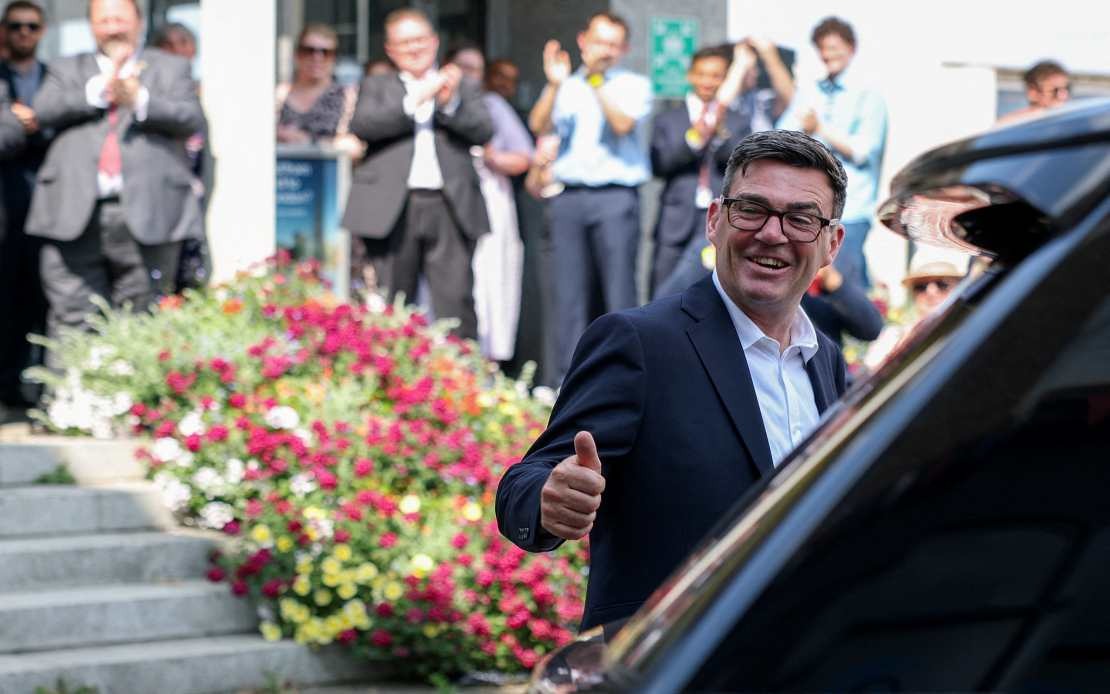
Andy Burnham has formally assumed the position of United Kingdom Prime Minister, entering office with a mandate centred on restoring public trust in government and delivering tangible relief from cost-of-living pressures. The former Greater Manchester mayor, who secured the Labour leadership unopposed just over a month after returning to Parliament, made his intentions clear during remarks from his Downing Street office following his audience with King Charles III. His appointment marks a significant moment for the country's political trajectory and holds implications for how Britain may reshape its governance structure and policy priorities in coming months.
The new Prime Minister's inaugural address emphasised the notion of "reflection and resolution," framing the current juncture as one demanding honesty about Britain's difficulties alongside demonstrable capacity to overcome them. This rhetorical positioning suggests Burnham intends to distance his administration from the fractious and reactive governance that has characterised recent years. He underscored his acute awareness that the United Kingdom has cycled through seven prime ministers in a single decade, a reality he presented not merely as a statistical curiosity but as a fundamental impediment to coherent policymaking. The repetitive turnover, he argued, demands a commitment to more steadfast and conscientious political leadership that extends beyond electoral cycles and short-term gestures.
Burnham's circle indicated that his administration would insist political stability must translate into concrete improvements for ordinary citizens, particularly regarding the cost of living that has dominated British households' concerns. This represents a deliberate recalibration of priorities compared to his predecessor's approach. The new Prime Minister has previously flagged his intention to dissolve Starmer's digital identity programme, reallocating resources instead toward tangible support for household finances and everyday expenses. This decision signals a pivot away from surveillance infrastructure toward direct assistance, a positioning that may resonate with constituencies frustrated by technological initiatives perceived as removals of privacy rather than sources of practical benefit.
Devolution of power from Westminster represents another cornerstone of Burnham's governing vision, reflecting his experience managing a devolved authority. His background as mayor of Greater Manchester, a metropolitan region striving to exercise greater control over its own economic and social affairs, has clearly shaped his conviction that London-centric governance inadequately serves Britain's diverse regions. This commitment to territorial redistribution of authority could substantially alter how policy is formulated and implemented across England, Scotland, Wales, and Northern Ireland, with potential ramifications for how Southeast Asian governments regard British federalism and regional autonomy models.
During his initial week in office, Burnham is anticipated to unveil a suite of measures designed to ease immediate pressures on households. Energy costs represent a primary target, with speculation that his government may expand North Sea oil and gas extraction through additional drilling licences. This prospective decision places him in potential tension with his own party's 2024 manifesto commitments, which explicitly ruled out issuing new North Sea drilling permits. Environmental advocacy groups have mobilised to remind the new administration of these pledges, contending that expanded fossil fuel extraction delivers minimal relief to energy bills while contradicting stated climate objectives. For Malaysia and other Commonwealth economies tracking UK policy directions, this inconsistency illustrates the difficult trade-offs between immediate cost-of-living pressures and longer-term sustainability commitments.
Thames Water, Britain's largest water utility, presents another consequential early decision for Burnham's administration. The company carries a debt burden exceeding £20 billion, teetering toward potential collapse and state intervention. The new Prime Minister has already signalled openness to expanded public ownership of essential services, and Thames Water's creditors have indicated willingness to discuss rescue arrangements with Burnham's government. A temporary nationalisation remains possible, though politically contentious. This situation exemplifies the broader tension between market-oriented utilities governance and direct state provision, a debate resonating across the Commonwealth as nations reconsider the privatisation legacy of previous decades.
Burnham's Cabinet appointments, particularly the chancellorship selection, will offer early indicators of his administration's economic direction and policy emphasis. Two senior figures, Energy Secretary Ed Miliband and Home Secretary Shabana Mahmood, reportedly contend for the Treasury portfolio. Miliband brings experience in energy governance and climate policy, while Mahmood offers security and social policy expertise. Either appointment would signal distinct priorities regarding the balance between industrial transformation, energy transition, and social order management. For Malaysian observers of British governance, these appointments illuminate how Labour positions itself on critical infrastructure, green energy investment, and state intervention in troubled industries.
The transition from Keir Starmer's administration to Burnham's represents a notable ideological and stylistic recalibration within the Labour party. Starmer's tenure emphasised technocratic competence and business-friendly positioning, while Burnham's background in metropolitan governance and public service unionism suggests a greater willingness to embrace active state intervention and regional empowerment. This repositioning occurs amid broader global uncertainty regarding the balance between market liberalism and state capacity, questions particularly salient for Southeast Asian economies evaluating alternative governance models and economic strategies.
Burnham's elevation to the premiership occurred through an unopposed leadership contest, distinguishing his path from most recent prime ministerial transitions. This unconventional succession reflects either genuine party consensus or, alternatively, the absence of compelling alternative candidates willing to contest. Either interpretation carries implications for his political legitimacy and the cohesion of the Labour party as it approaches major legislative challenges. Unlike his predecessors who secured office through formal competitive contests, Burnham inherits a party apparatus ostensibly unified behind his candidacy, though such superficial unity may mask unresolved factional tensions regarding direction and priorities.
The international dimensions of Burnham's premiership remain largely opaque at this juncture. His emphasis on devolution and domestic cost-of-living pressures suggests initial concentration on internal affairs rather than foreign policy repositioning. Nevertheless, his track record prioritising regional economic development and infrastructure investment may influence Britain's approach toward Commonwealth relationships and trade partnerships. For Malaysia and Southeast Asian economies, the composition and direction of Burnham's government merits close observation, particularly regarding trade relations, investment frameworks, and the United Kingdom's regional security posture as it recalibrates priorities under new leadership.
The symbolic importance of Burnham's ascension extends beyond immediate policy questions to encompass broader narratives about British governance stability and institutional competence. After a decade characterised by rapid leadership changes, internal party divisions, and perceived policy incoherence, his administration arrives promising steadiness and accountability. Whether his government can deliver on these commitments, particularly while navigating the contradictions between cost-of-living relief and climate commitments, energy security and environmental protection, will substantially shape both British politics and international perceptions of British institutional capacity in an era of compound crises and competing imperatives.

