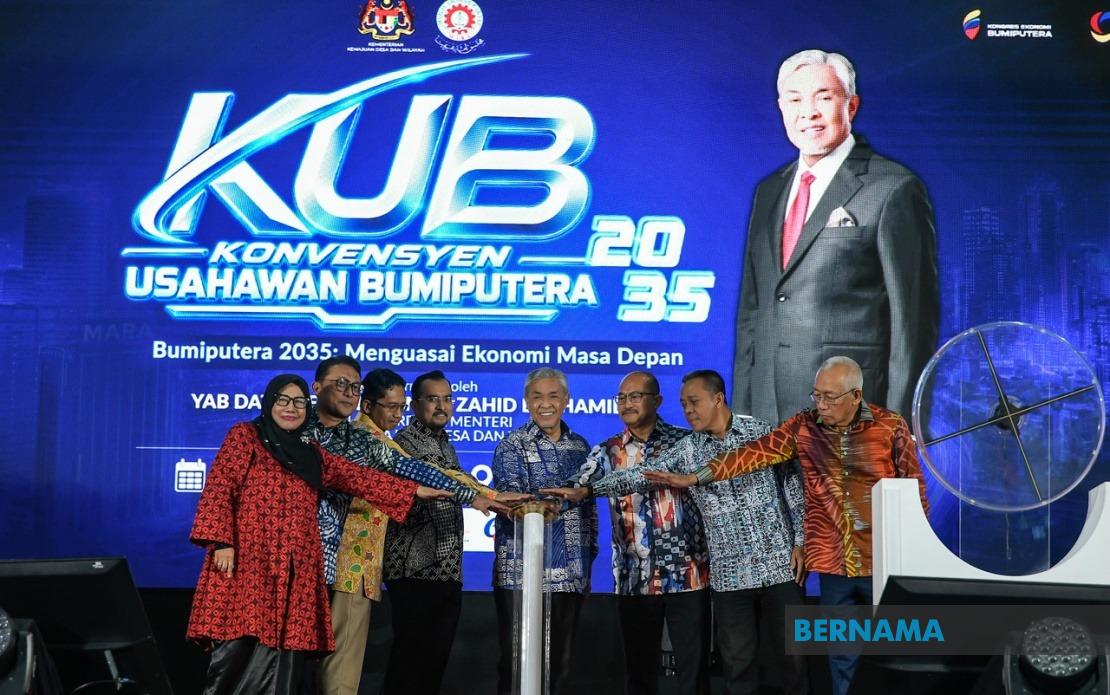
Deputy Prime Minister Datuk Seri Dr Ahmad Zahid Hamidi has called for a fundamental shift in how Bumiputera entrepreneurs approach business expansion, urging them to move beyond passive participation in Malaysia's economic value chain towards building substantive ownership stakes and significantly scaling their operations. Speaking at the closing ceremony of the Bumiputera Entrepreneurs Convention (KUB) 2035 Declaration in Alor Setar on August 27, Ahmad Zahid articulated a vision that transcends the decades-long emphasis on including Bumiputera participation, signalling instead a pivot towards deeper economic control and competitive positioning within key sectors.
The Deputy Prime Minister's remarks reflect growing policy recognition that historical approaches to Bumiputera economic empowerment have primarily focussed on ensuring representation within existing value chains rather than cultivating indigenous Malaysian enterprises capable of leading and dominating their industries. Ahmad Zahid acknowledged this legacy whilst positioning the coming years as a critical inflection point. He characterised the immediate challenge facing policymakers and entrepreneurs alike as moving from a participation-centred paradigm towards one emphasising ownership consolidation, business expansion capabilities, and sectoral dominance. This reorientation carries significant implications for how government resources, tax incentives, and regulatory frameworks might be deployed to support Bumiputera advancement.
Acknowledging the government's ongoing commitment to facilitating Bumiputera entrepreneurial growth, Ahmad Zahid outlined the state's role as encompassing ecosystem development, expanded financing access, and creation of competitive opportunities. However, he insisted that state support alone remained insufficient, emphasising instead that entrepreneurs themselves must demonstrate courage and initiative in pursuing expansion, engaging directly with market competition, and generating measurable economic value. This framing introduces a degree of shared responsibility, suggesting that whilst government remains instrumental in removing structural barriers, entrepreneurial ambition and risk-taking appetite ultimately determine success trajectories. The emphasis on courage and competitive engagement suggests policy recognition that protected or subsidised pathways may inadvertently inhibit the development of genuinely competitive Bumiputera enterprises capable of thriving in regional and global markets.
To facilitate this transition, Ahmad Zahid identified three critical systemic shifts required within the Bumiputera entrepreneurship ecosystem by 2035. First among these is integration of the fragmented support infrastructure currently characterising business development assistance. The Deputy Prime Minister observed that existing mechanisms for financing, technical training, and market access operate through disconnected institutional channels, creating inefficiencies and reducing the aggregate impact of government support. Consolidating these instruments into a more coherent ecosystem would theoretically enable entrepreneurs to navigate support mechanisms more seamlessly whilst allowing policymakers to identify and address remaining gaps in assistance provision.
The second imperative involves reorienting the entrepreneurship development model from emphasis on producing quantities of entrepreneurs towards a more selective approach concentrated on growing existing entrepreneurs into market leaders. This signals potential departure from historical emphasis on numerical targets for Bumiputera business formation, suggesting instead quality-focussed metrics prioritising business growth rates, revenue generation, and market share consolidation. Such reorientation acknowledges that sustainable economic empowerment derives not from maximising the number of small Bumiputera enterprises but from cultivating a smaller cohort of substantively competitive firms capable of competing regionally and internationally. For Malaysian policymakers, this represents meaningful strategic recalibration towards demonstrable economic impact rather than programmatic participation metrics.
The third identified shift concerns ensuring that overall national economic expansion simultaneously strengthens local Malaysian companies, preventing scenarios wherein growth primarily benefits foreign or non-Bumiputera enterprises. This objective addresses persistent concerns within Malaysian economic policy that rapid development in particular sectors—technology, finance, manufacturing—has disproportionately benefited multinational corporations and non-indigenous Malaysian businesses whilst generating limited wealth accumulation within Bumiputera communities. Integrating local company strengthening into broader development strategies suggests Ahmad Zahid envisions fiscal and regulatory instruments deliberately designed to channel economic opportunities towards Malaysian entrepreneurs alongside pursuit of macroeconomic growth targets.
The fragmentation characterising Malaysia's current entrepreneurship support architecture represents a longstanding structural challenge. Financing sources ranging from government development banks to private sector venture capital typically operate according to distinct criteria and requirements. Technical training providers—from government agencies to private consultancies to university-based programmes—offer inconsistent curricula and certification standards. Market access initiatives channelled through trade missions, government procurement preferences, and sector-specific buyer networks remain largely compartmentalised. This fragmentation imposes significant transaction costs on entrepreneurs attempting to access multiple support streams, creating unnecessary complexity and potentially limiting uptake of available assistance.
Integrating these fragmented systems would require substantial institutional coordination and potentially significant restructuring of existing agency mandates and funding mechanisms. Such integration could encompass creation of unified entrepreneurship support portals, consolidated financing pathways enabling entrepreneurs to access diverse capital sources through single application processes, standardised training curricula coordinated across providers, and unified market access mechanisms. The benefits of such integration would extend beyond convenience, potentially enabling holistic assessment of entrepreneur capabilities and matching of support services to individual business development stages and sectoral contexts.
The distinction Ahmad Zahid emphasises between producing entrepreneurs and growing entrepreneurs carries particular resonance for Malaysian policymakers and development practitioners. Production-focussed models typically prioritise maximising numbers of business registrations, entrepreneurship training programme completions, and micro-enterprise formations. Growing entrepreneurs, conversely, emphasises business progression, revenue scale-up, employment generation, and sectoral value chain integration. Evidence from various national contexts suggests that whilst many entrepreneurs commence operations, relatively few achieve meaningful scale or sustained profitability. Reorienting government support towards growth trajectories of promising existing enterprises potentially generates greater aggregate economic impact than dispersing resources thinly across larger quantities of marginal businesses.
For Malaysian entrepreneurs and policymakers, Ahmad Zahid's vision suggests evolving expectations around Bumiputera economic participation. Rather than viewing Bumiputera advancement primarily through lenses of employment within established value chains or participation in government procurement preferences, the emerging framework emphasises building distinctly competitive Malaysian enterprises capable of leading sectors and competing internationally. This represents ideological evolution within Malaysian economic policy, reflecting perhaps growing confidence in Bumiputera competitive capabilities and recognition that protective frameworks alone prove insufficient for sustainable wealth creation and sectoral control.
The practical implementation of Ahmad Zahid's proposed ecosystem and strategic shifts will likely determine whether Bumiputera entrepreneurship experiences substantive advancement or whether policy articulation exceeds administrative execution. Critical questions include whether fragmented entrepreneurship support systems can realistically be integrated without compromising existing programmes, whether government agencies possess capacity and willingness to shift from numerically-focussed to impact-focussed metrics, and whether fiscal resources will match policy ambitions. Additionally, the timeframe to 2035 provides substantial runway for implementation but also introduces temporal uncertainty regarding whether initiatives will sustain across electoral cycles and ministerial transitions. Malaysian entrepreneurs and observer stakeholders will closely monitor whether Ahmad Zahid's stated commitments translate into concrete resource allocation and institutional restructuring supporting genuine Bumiputera business scaling and sectoral control consolidation.

