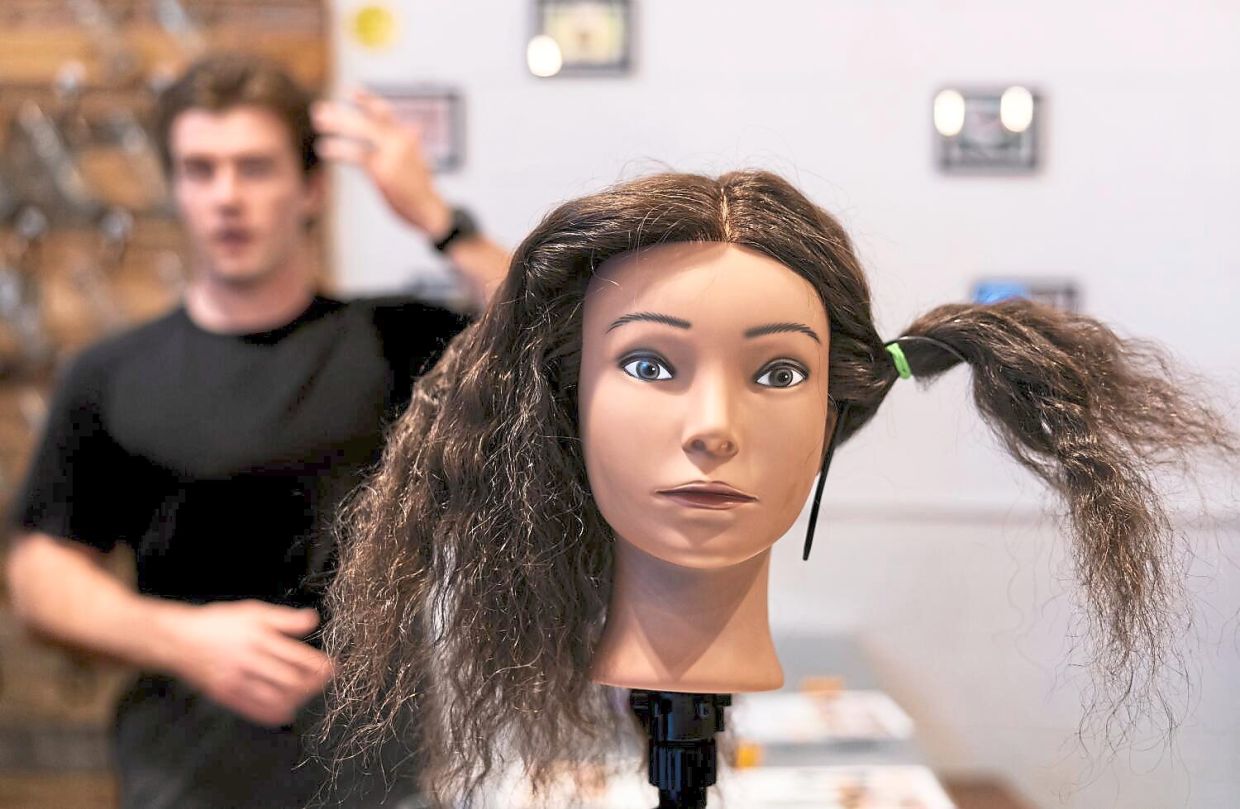
A gathering at Captain Fatty's Brewery in Santa Barbara County recently revealed an unexpected challenge facing contemporary fathers: learning to braid their children's hair. What might seem like a simple domestic task became the centrepiece of a sold-out evening when Austin Nieves, founder of the Santa Barbara Dads group, organised a "Pints and Ponytails" event inspired by a viral British concept. Fifteen men ranging from their thirties to sixties attended the May event, where professional hairstylists guided them through techniques using mannequins while they relaxed in a casual bar setting. The transformation was telling—Nieves observed that initial awkwardness melted away after the first drink, as participants moved from sitting on the sidelines to enthusiastically attempting braids and ponytails.
The broader significance of such gatherings extends far beyond hair-styling instruction. Nieves discovered during his own transition to fatherhood that while his wife immediately gained access to a robust network of mother groups offering friendship, advice and training, his experience as a first-time father was far more isolating. With limited male peers in his circle who had children, Nieves recognised a genuine gap in support systems designed for fathers navigating active parenting. This experience motivated him to create structured spaces where fathers could connect, share challenges and develop both practical skills and emotional bonds with others in similar life circumstances.
Academic research increasingly validates the existence of this paternal isolation problem. A 2006 study by sociologists Chris Knoester and David J. Eggebeen, published in the Journal Of Family Issues, found that increased involvement in fatherhood correlates with declining well-being and reduced social participation as men sacrifice time with friends. Clinical psychologists Hillary Halpern and Maureen Perry-Jenkins have documented how the transition from single life to active fatherhood frequently triggers emotional turbulence and identity displacement. More recently, researchers at Stockholm's Karolinska Institute concluded in 2021 that fathers navigating their transition to parenthood require targeted support mechanisms. Notably, the Karolinska study identified father groups as particularly effective interventions, with most male participants reporting high satisfaction and noting that membership improved their relationships with partners and children, strengthened self-confidence, promoted family equality and notably reduced feelings of loneliness.
Nieves experienced this life shift acutely when his son Hudson was born three years ago. The contrast between his previous social existence and his new reality became jarring—conversations that once revolved around entertainment and television now centred entirely on infant developmental milestones. This fundamental recalibration of identity and social engagement prompted his decision to establish dedicated community spaces. In October 2023, while living in Costa Mesa, he launched the Orange County Dads club, which quickly organised monthly meetups at coffee shops, visits to zoological parks, collaborative music sessions during holidays and even CPR training courses. Remarkably, despite positioning itself strictly as a fathers' club, the group expanded significantly through organic word-of-mouth promotion—wives and partners proved instrumental in sharing Nieves' social media content with their husbands, effectively becoming ambassadors for the community.
Members like Mikhail Alfon, founder of social media strategy firm Blue Light Media, found immediate value in the peer connections. Alfon brought his son Santos to multiple gatherings, noting on social media that discovering friends navigating the same life stage proved invaluable. The existence of such peers transforms the parenting journey from an isolating individual challenge into a shared collective experience, normalising concerns and struggles that fathers might otherwise keep private due to cultural expectations around masculinity and self-sufficiency.
When Nieves and his family relocated to Santa Barbara in April 2025 after purchasing property there, he faced a moment of potential community disconnection. Rather than accept this disruption, he established the Santa Barbara Dads group within a month of arrival, conducting their inaugural meetup in May 2025 and committing to regular monthly gatherings. This rapid re-establishment demonstrates both the personal commitment Nieves holds toward building father networks and the hunger among men for such communities. The expansion from Santa Barbara's perspective is particularly significant—establishing multiple regional chapters indicates that parental isolation among fathers is not localised phenomenon but rather a widespread challenge affecting men across diverse geographic and demographic contexts.
Austin Jones, a Santa Barbara-based real estate professional and investor, discovered the group through Instagram and immediately recognised its relevance. Jones articulated a perspective many fathers share: balancing multiple demanding roles—husband, father and business owner—without adequate emotional or practical support. The layering of these identities creates a pressure cooker effect where men feel simultaneously responsible for excellence across all domains yet lack peer communities to validate struggles or share coping strategies. For Jones, the particular appeal of the Pints and Ponytails event stemmed from a specific parenting challenge: managing his two-and-a-half-year-old daughter Noa's textured, curly hair. Before attending, he possessed minimal hair-care skills beyond securing a headband, limiting both his practical capabilities and his confidence in this aspect of hands-on parenting.
The experience proved transformative for Jones. During the brewery event, he developed sufficient confidence through guided practise to confidently style his mannequin into a polished ponytail, and subsequently committed to applying these newly acquired techniques with his actual daughter. This progression illustrates how father groups function on multiple levels simultaneously—they provide practical skill acquisition that removes concrete barriers to active parenting, they create psychologically safe spaces where men can acknowledge skill gaps without social judgment, and they foster confidence that enables fathers to expand their direct caregiving capabilities. For a child like Noa, having both parents equipped with basic hair-care competency represents meaningful inclusion and gender-neutral approaches to domestic labour.
The emergence and expansion of fathers' groups like those Nieves established reflect broader cultural shifts in how parenting is conceptualised and executed. Contemporary parenting increasingly expects both mothers and fathers to be emotionally available, practically skilled and deeply invested in child development. Yet infrastructure supporting this transition remains asymmetrically distributed, with mothers accessing extensive formal networks while fathers navigate largely alone. These community initiatives address this structural imbalance by creating deliberately designed spaces where men can acknowledge the emotional labour, practical demands and identity restructuring inherent in modern fatherhood. Rather than treating paternal involvement as an individual personality trait, father groups position active parenting as a legitimate domain where men deserve peer support and skill-building opportunities comparable to what mothers routinely access.
For Southeast Asian contexts including Malaysia, where traditional gender roles remain more entrenched in some communities even as urban centres experience cultural evolution, the father-group model presents relevant lessons. Malaysia's diverse population encompasses communities at different stages of parenting philosophy transformation, from traditional structures where maternal care roles predominate to modern dual-career families requiring equitable parenting distribution. Importing the father-group concept need not mean wholesale adoption of the North American bar-based social model, but rather the underlying principle: creating deliberate community infrastructure supporting fathers in active parenting roles, offering both practical skill development and emotional validation. Whether implemented through community centres, religious organisations, corporate wellness programmes or educational institutions, such initiatives could address paternal isolation while normalising father involvement as culturally positive rather than transgressive.
The sustainability and scaling of these initiatives depends partly on identifying male champions like Nieves willing to invest personal time and social capital in building community infrastructure. It also requires recognition among mothers, partners and broader communities that father support networks benefit entire families and societies. When fathers feel less isolated, more confident and more equipped with practical skills, they become more engaged parents, more present partners and contribute meaningfully to gender-equitable family dynamics. The transformation at Captain Fatty's Brewery—from silent awkwardness to collaborative learning and genuine camaraderie—encapsulates this broader possibility: that deliberate community building can address the loneliness embedded in modern fatherhood while simultaneously preparing men for fuller participation in child-rearing across all life domains.

