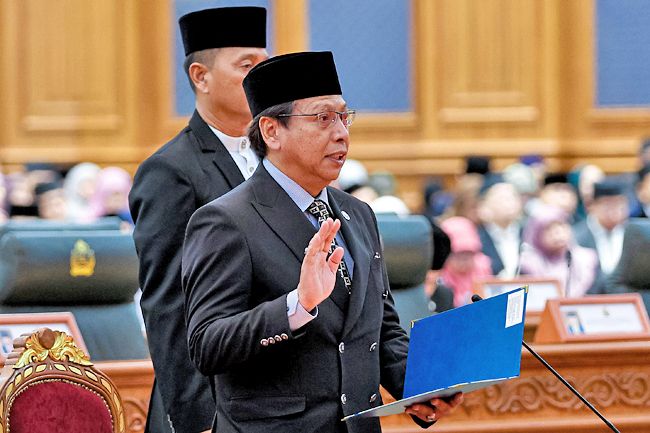
Brunei's government has expanded its presence in the Legislative Council with the formal swearing-in of four senior Cabinet ministers in a ceremony conducted on Monday, August 3rd, marking the opening day of the Second Meeting of the 22nd Legislative Council Session in Bandar Seri Begawan. The induction represents a significant step in the administration's restructuring of ministerial roles and their corresponding legislative responsibilities, bringing enhanced representation from the executive branch into the kingdom's parliament.
The four ministers elevated to ex-officio membership in the Legislative Council include Datuk Seri Setia Awang Sufian Sabtu, who oversees security and law matters at the Prime Minister's Office; Datuk Seri Setia Awang Mohamad Azmi Mohd Hanifah, responsible for energy, upstream and downstream operations under the Prime Minister's Office; Pengiran Datuk Seri Setia Mohammad Tashim Pengiran Hassan, leading the Religious Affairs portfolio; and Datuk Seri Setia Awang Mohammed Riza Datuk Paduka Mohammed Yunos, who holds the Transport and InfoCommunications brief. This expansion of ministerial presence within the chamber reflects an evolving governance structure in the sultanate.
The ceremony itself adhered strictly to the constitutional framework established by the 1959 Brunei Constitution, which provides for the appointment of ex-officio members to the Legislative Council from among the executive branch. This procedural adherence underscores Brunei's commitment to maintaining constitutional governance even as it adjusts its institutional arrangements. The 1959 Constitution remains the foundation for Brunei's political structures, having been adapted and modified over the decades to accommodate the nation's development and evolving needs.
For regional observers, this development carries particular significance in understanding Brunei's approach to legislative-executive integration. Unlike some Southeast Asian neighbours that maintain stricter separation between parliament and cabinet, Brunei's system permits—and indeed encourages—direct ministerial participation in legislative proceedings through ex-officio appointments. This model facilitates closer coordination between policy formulation and legislative scrutiny, allowing ministers to present their initiatives directly and respond immediately to parliamentary questioning.
The security portfolio's elevation within the council reflects broader regional concerns about maintaining stability and governance across Southeast Asia. Awang Sufian Sabtu's appointment as an ex-officio member signifies that matters of national security and law enforcement will receive heightened parliamentary attention. This is particularly relevant given the complex security environment across the region, where maritime boundaries, counterterrorism initiatives, and cross-border cooperation remain persistent challenges that benefit from transparent legislative oversight.
The energy ministry's inclusion within the expanded council membership highlights Brunei's ongoing strategic focus on its petroleum sector, a cornerstone of the nation's economy. Awang Mohamad Azmi Mohd Hanifah's legislative presence ensures that critical decisions regarding upstream and downstream operations, exploration strategies, and energy infrastructure development receive direct parliamentary scrutiny. For Malaysian stakeholders and regional energy markets, such parliamentary engagement in energy policy carries implications for cross-border cooperation, regional energy security, and investment patterns throughout the Association of Southeast Asian Nations.
Religious affairs representation through Pengiran Mohammad Tashim Pengiran Hassan's appointment addresses the cultural and spiritual dimensions of governance that remain central to Brunei's identity as a Malay-Muslim sultanate. The Religious Affairs ministry's direct participation in legislative deliberations ensures that policies affecting Islamic education, religious institutions, and matters of faith receive appropriate parliamentary consideration within a framework that respects the sultan's custodial role in religious matters.
The inclusion of the Transport and InfoCommunications ministry through Datuk Seri Awang Mohammed Riza Datuk Paduka Mohammed Yunos reflects contemporary recognition that connectivity and digital infrastructure are fundamental to national development. Parliamentary involvement in transport and communications policy enables legislators to influence infrastructure investment priorities, technological adoption rates, and digital transformation initiatives that increasingly define competitiveness across Southeast Asia.
The ceremony was presided over by Pehin Orang Kaya Seri Lela Datuk Seri Setia Awang Abdul Rahman Datuk Setia Mohamed Taib in his capacity as Speaker, a position that carries significant ceremonial and administrative authority within the Legislative Council. The Speaker's presence lent formal dignity to the proceedings while ensuring proper constitutional protocols were observed throughout the induction process.
This expansion of ministerial representation within the Legislative Council occurs within the context of Brunei's broader governance framework, where the Sultan retains significant executive authority alongside the appointed and elected components of the council. The balance between these elements continues to evolve as the kingdom navigates contemporary challenges in economic diversification, technological advancement, and regional engagement. The appointment structure reinforces Brunei's deliberate model of governance that emphasises continuity, constitutional adherence, and integrated policy-making.
For Malaysian political observers, Brunei's approach offers an instructive contrast to Westminster-influenced systems that typically maintain clearer distinctions between ministerial and legislative roles. While Malaysia's cabinet system requires ministers to maintain parliamentary seats and face regular scrutiny, Brunei's ex-officio mechanism creates a more seamlessly integrated structure. Understanding these differences illuminates the various pathways through which Southeast Asian democracies and constitutional monarchies organise executive-legislative relations.
The formalisation of these ministerial appointments through constitutional ceremony demonstrates Brunei's commitment to procedural regularity and institutional legitimacy. Rather than administrative appointment alone, the public swearing-in ceremony signals to both domestic and international audiences the intentional and considered nature of governance changes. This emphasis on formal procedure reinforces institutional stability even as the content of ministerial portfolios and their responsibilities may shift in response to national priorities and regional developments.

